

11 The Confinement and Migration of Charge-Carriers in Lead …
203
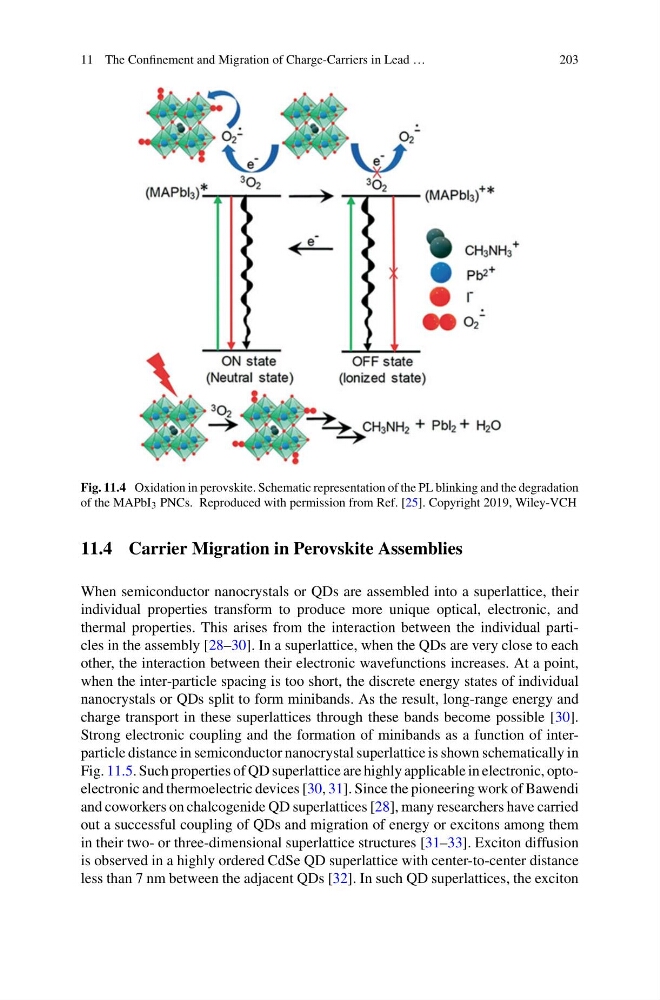
Fig. 11.4 Oxidation in perovskite. Schematic representation of the PL blinking and the degradation
of the MAPbI 3 PNCs. Reproduced with permission from Ref. [25]. Copyright 2019, Wiley-VCH
11.4 Carrier Migration in Perovskite Assemblies
When semiconductor nanocrystals or QDs are assembled into a superlattice, their
individual properties transform to produce more unique optical, electronic, and
thermal properties. This arises from the interaction between the individual particles in the assembly [28–30]. In a superlattice, when the QDs are very close to each
other, the interaction between their electronic wavefunctions increases. At a point,
when the inter-particle spacing is too short, the discrete energy states of individual
nanocrystals or QDs split to form minibands. As the result, long-range energy and
charge transport in these superlattices through these bands become possible [30].
Strong electronic coupling and the formation of minibands as a function of interparticle distance in semiconductor nanocrystal superlattice is shown schematically in
Fig. 11.5. Such properties of QD superlattice are highly applicable in electronic, optoelectronic and thermoelectric devices [30, 31]. Since the pioneering work of Bawendi
and coworkers on chalcogenide QD superlattices [28], many researchers have carried
out a successful coupling of QDs and migration of energy or excitons among them
in their two- or three-dimensional superlattice structures [31–33]. Exciton diffusion
is observed in a highly ordered CdSe QD superlattice with center-to-center distance
less than 7 nm between the adjacent QDs [32]. In such QD superlattices, the exciton
203
Fig. 11.4 Oxidation in perovskite. Schematic representation of the PL blinking and the degradation
of the MAPbI 3 PNCs. Reproduced with permission from Ref. [25]. Copyright 2019, Wiley-VCH
11.4 Carrier Migration in Perovskite Assemblies
When semiconductor nanocrystals or QDs are assembled into a superlattice, their
individual properties transform to produce more unique optical, electronic, and
thermal properties. This arises from the interaction between the individual particles in the assembly [28–30]. In a superlattice, when the QDs are very close to each
other, the interaction between their electronic wavefunctions increases. At a point,
when the inter-particle spacing is too short, the discrete energy states of individual
nanocrystals or QDs split to form minibands. As the result, long-range energy and
charge transport in these superlattices through these bands become possible [30].
Strong electronic coupling and the formation of minibands as a function of interparticle distance in semiconductor nanocrystal superlattice is shown schematically in
Fig. 11.5. Such properties of QD superlattice are highly applicable in electronic, optoelectronic and thermoelectric devices [30, 31]. Since the pioneering work of Bawendi
and coworkers on chalcogenide QD superlattices [28], many researchers have carried
out a successful coupling of QDs and migration of energy or excitons among them
in their two- or three-dimensional superlattice structures [31–33]. Exciton diffusion
is observed in a highly ordered CdSe QD superlattice with center-to-center distance
less than 7 nm between the adjacent QDs [32]. In such QD superlattices, the exciton