

202
S. Ghimire et al.
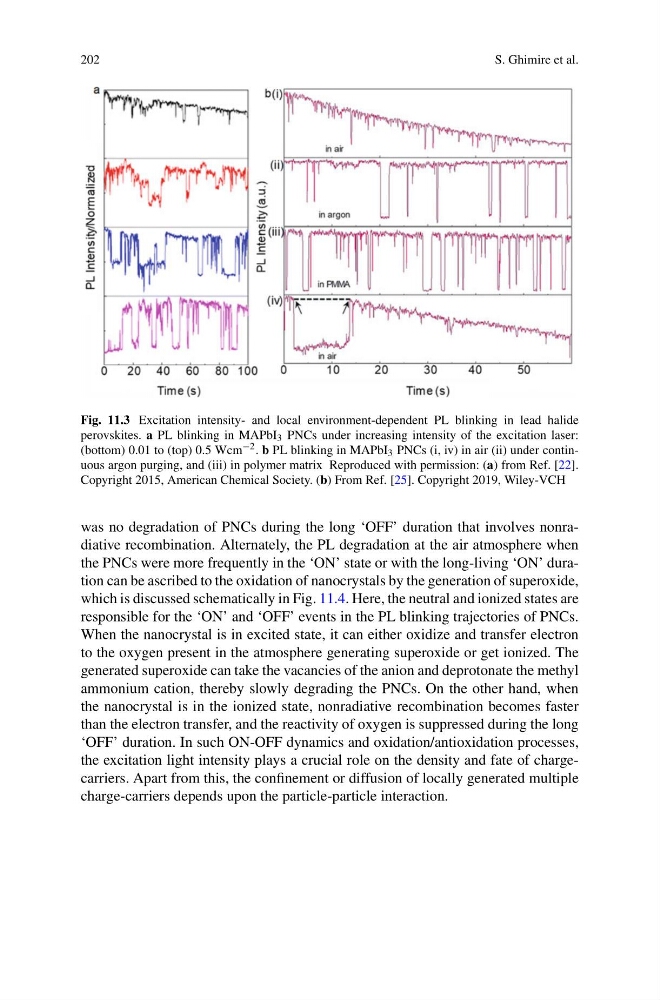
Fig. 11.3 Excitation intensity- and local environment-dependent PL blinking in lead halide
perovskites. a PL blinking in MAPbI 3 PNCs under increasing intensity of the excitation laser:
(bottom) 0.01 to (top) 0.5 Wcm −2 . b PL blinking in MAPbI 3 PNCs (i, iv) in air (ii) under continuous argon purging, and (iii) in polymer matrix Reproduced with permission: (a) from Ref. [22].
Copyright 2015, American Chemical Society. (b) From Ref. [25]. Copyright 2019, Wiley-VCH
was no degradation of PNCs during the long ‘OFF’ duration that involves nonradiative recombination. Alternately, the PL degradation at the air atmosphere when
the PNCs were more frequently in the ‘ON’ state or with the long-living ‘ON’ duration can be ascribed to the oxidation of nanocrystals by the generation of superoxide,
which is discussed schematically in Fig. 11.4. Here, the neutral and ionized states are
responsible for the ‘ON’ and ‘OFF’ events in the PL blinking trajectories of PNCs.
When the nanocrystal is in excited state, it can either oxidize and transfer electron
to the oxygen present in the atmosphere generating superoxide or get ionized. The
generated superoxide can take the vacancies of the anion and deprotonate the methyl
ammonium cation, thereby slowly degrading the PNCs. On the other hand, when
the nanocrystal is in the ionized state, nonradiative recombination becomes faster
than the electron transfer, and the reactivity of oxygen is suppressed during the long
‘OFF’ duration. In such ON-OFF dynamics and oxidation/antioxidation processes,
the excitation light intensity plays a crucial role on the density and fate of chargecarriers. Apart from this, the confinement or diffusion of locally generated multiple
charge-carriers depends upon the particle-particle interaction.
S. Ghimire et al.
Fig. 11.3 Excitation intensity- and local environment-dependent PL blinking in lead halide
perovskites. a PL blinking in MAPbI 3 PNCs under increasing intensity of the excitation laser:
(bottom) 0.01 to (top) 0.5 Wcm −2 . b PL blinking in MAPbI 3 PNCs (i, iv) in air (ii) under continuous argon purging, and (iii) in polymer matrix Reproduced with permission: (a) from Ref. [22].
Copyright 2015, American Chemical Society. (b) From Ref. [25]. Copyright 2019, Wiley-VCH
was no degradation of PNCs during the long ‘OFF’ duration that involves nonradiative recombination. Alternately, the PL degradation at the air atmosphere when
the PNCs were more frequently in the ‘ON’ state or with the long-living ‘ON’ duration can be ascribed to the oxidation of nanocrystals by the generation of superoxide,
which is discussed schematically in Fig. 11.4. Here, the neutral and ionized states are
responsible for the ‘ON’ and ‘OFF’ events in the PL blinking trajectories of PNCs.
When the nanocrystal is in excited state, it can either oxidize and transfer electron
to the oxygen present in the atmosphere generating superoxide or get ionized. The
generated superoxide can take the vacancies of the anion and deprotonate the methyl
ammonium cation, thereby slowly degrading the PNCs. On the other hand, when
the nanocrystal is in the ionized state, nonradiative recombination becomes faster
than the electron transfer, and the reactivity of oxygen is suppressed during the long
‘OFF’ duration. In such ON-OFF dynamics and oxidation/antioxidation processes,
the excitation light intensity plays a crucial role on the density and fate of chargecarriers. Apart from this, the confinement or diffusion of locally generated multiple
charge-carriers depends upon the particle-particle interaction.