

11 The Confinement and Migration of Charge-Carriers in Lead …
201
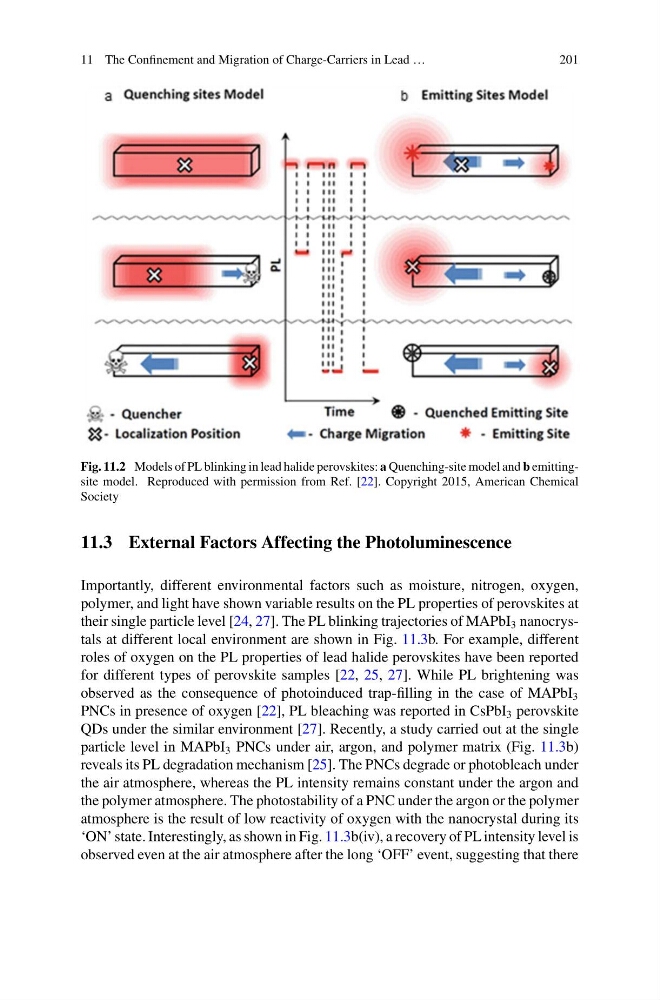
Fig. 11.2 Models of PL blinking in lead halide perovskites: a Quenching-site model and b emittingsite model. Reproduced with permission from Ref. [22]. Copyright 2015, American Chemical
Society
11.3 External Factors Affecting the Photoluminescence
Importantly, different environmental factors such as moisture, nitrogen, oxygen,
polymer, and light have shown variable results on the PL properties of perovskites at
their single particle level [24, 27]. The PL blinking trajectories of MAPbI 3 nanocrystals at different local environment are shown in Fig. 11.3b. For example, different
roles of oxygen on the PL properties of lead halide perovskites have been reported
for different types of perovskite samples [22, 25, 27]. While PL brightening was
observed as the consequence of photoinduced trap-filling in the case of MAPbI 3
PNCs in presence of oxygen [22], PL bleaching was reported in CsPbI 3 perovskite
QDs under the similar environment [27]. Recently, a study carried out at the single
particle level in MAPbI 3 PNCs under air, argon, and polymer matrix (Fig. 11.3b)
reveals its PL degradation mechanism [25]. The PNCs degrade or photobleach under
the air atmosphere, whereas the PL intensity remains constant under the argon and
the polymer atmosphere. The photostability of a PNC under the argon or the polymer
atmosphere is the result of low reactivity of oxygen with the nanocrystal during its
‘ON’ state. Interestingly, as shown in Fig. 11.3b(iv), a recovery of PL intensity level is
observed even at the air atmosphere after the long ‘OFF’ event, suggesting that there
201
Fig. 11.2 Models of PL blinking in lead halide perovskites: a Quenching-site model and b emittingsite model. Reproduced with permission from Ref. [22]. Copyright 2015, American Chemical
Society
11.3 External Factors Affecting the Photoluminescence
Importantly, different environmental factors such as moisture, nitrogen, oxygen,
polymer, and light have shown variable results on the PL properties of perovskites at
their single particle level [24, 27]. The PL blinking trajectories of MAPbI 3 nanocrystals at different local environment are shown in Fig. 11.3b. For example, different
roles of oxygen on the PL properties of lead halide perovskites have been reported
for different types of perovskite samples [22, 25, 27]. While PL brightening was
observed as the consequence of photoinduced trap-filling in the case of MAPbI 3
PNCs in presence of oxygen [22], PL bleaching was reported in CsPbI 3 perovskite
QDs under the similar environment [27]. Recently, a study carried out at the single
particle level in MAPbI 3 PNCs under air, argon, and polymer matrix (Fig. 11.3b)
reveals its PL degradation mechanism [25]. The PNCs degrade or photobleach under
the air atmosphere, whereas the PL intensity remains constant under the argon and
the polymer atmosphere. The photostability of a PNC under the argon or the polymer
atmosphere is the result of low reactivity of oxygen with the nanocrystal during its
‘ON’ state. Interestingly, as shown in Fig. 11.3b(iv), a recovery of PL intensity level is
observed even at the air atmosphere after the long ‘OFF’ event, suggesting that there