

12
H. Miyasaka et al.
shifts to 610 nm and the weak positive band at 720 nm evolves into a negative signal
ascribable to the stimulated emission. Within a few ps following the excitation, the
absorption intensity at ~520 nm relative to that at ~620 nm increases and the positive
absorption bands gradually decrease together with the recovery of the negative one
in the wavelength >680 nm in a few tens of ps time range. At and after ca. 50 ps
following the excitation, only the weak negative signal due to the cycloreversion
reaction remains in the wavelength range of 400–550 nm. From the detailed analyses
of the temporal evolution of the spectra, the dynamics of F1(c) in the excited state
pumped by the 500-nm absorption were summarized as the interconversion from
the Franck–Condon 1B state to 2A state with the time constant of 140 fs which is
followed by the geometrical rearrangement of 1.5 ps. The lifetime of the relaxed 2A
state was 10 ps.
As reported previously, the stepwise two-photon excitation of fulgide derivatives
by the picosecond laser pulse induced the enhancement of the cycloreversion reaction [10–12]. To precisely elucidate the mechanism, femtosecond two-pulse pump
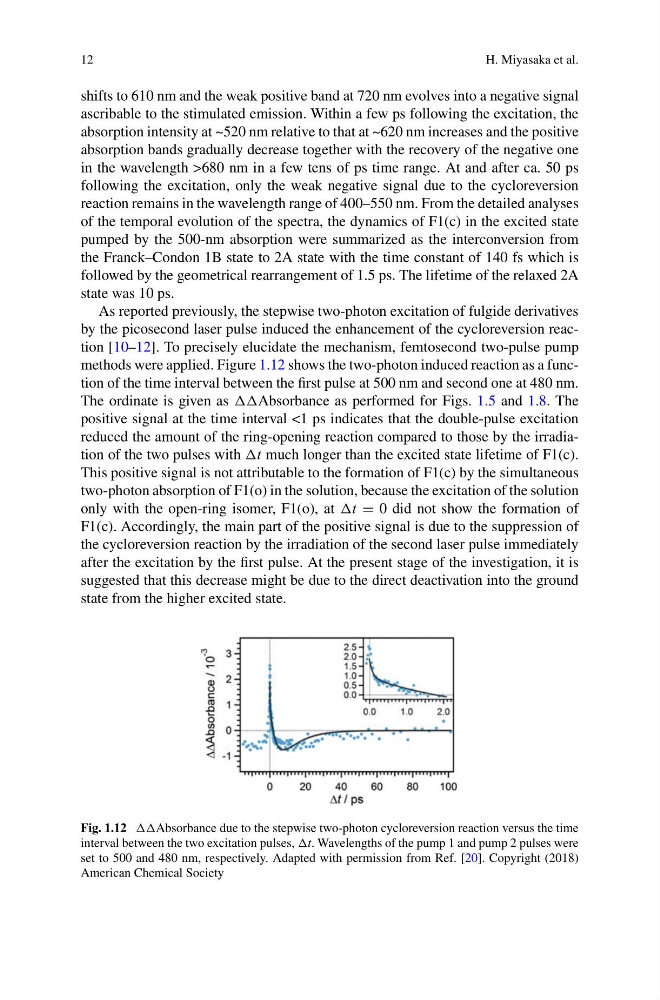
methods were applied. Figure 1.12 shows the two-photon induced reaction as a function of the time interval between the first pulse at 500 nm and second one at 480 nm.
The ordinate is given as Absorbance as performed for Figs. 1.5 and 1.8. The
positive signal at the time interval <1 ps indicates that the double-pulse excitation
reduced the amount of the ring-opening reaction compared to those by the irradiation of the two pulses with t much longer than the excited state lifetime of F1(c).
This positive signal is not attributable to the formation of F1(c) by the simultaneous
two-photon absorption of F1(o) in the solution, because the excitation of the solution
only with the open-ring isomer, F1(o), at t = 0 did not show the formation of
F1(c). Accordingly, the main part of the positive signal is due to the suppression of
the cycloreversion reaction by the irradiation of the second laser pulse immediately
after the excitation by the first pulse. At the present stage of the investigation, it is
suggested that this decrease might be due to the direct deactivation into the ground
state from the higher excited state.
Fig. 1.12 Absorbance due to the stepwise two-photon cycloreversion reaction versus the time
interval between the two excitation pulses, t. Wavelengths of the pump 1 and pump 2 pulses were
set to 500 and 480 nm, respectively. Adapted with permission from Ref. [20]. Copyright (2018)
American Chemical Society
H. Miyasaka et al.
shifts to 610 nm and the weak positive band at 720 nm evolves into a negative signal
ascribable to the stimulated emission. Within a few ps following the excitation, the
absorption intensity at ~520 nm relative to that at ~620 nm increases and the positive
absorption bands gradually decrease together with the recovery of the negative one
in the wavelength >680 nm in a few tens of ps time range. At and after ca. 50 ps
following the excitation, only the weak negative signal due to the cycloreversion
reaction remains in the wavelength range of 400–550 nm. From the detailed analyses
of the temporal evolution of the spectra, the dynamics of F1(c) in the excited state
pumped by the 500-nm absorption were summarized as the interconversion from
the Franck–Condon 1B state to 2A state with the time constant of 140 fs which is
followed by the geometrical rearrangement of 1.5 ps. The lifetime of the relaxed 2A
state was 10 ps.
As reported previously, the stepwise two-photon excitation of fulgide derivatives
by the picosecond laser pulse induced the enhancement of the cycloreversion reaction [10–12]. To precisely elucidate the mechanism, femtosecond two-pulse pump
methods were applied. Figure 1.12 shows the two-photon induced reaction as a function of the time interval between the first pulse at 500 nm and second one at 480 nm.
The ordinate is given as Absorbance as performed for Figs. 1.5 and 1.8. The
positive signal at the time interval <1 ps indicates that the double-pulse excitation
reduced the amount of the ring-opening reaction compared to those by the irradiation of the two pulses with t much longer than the excited state lifetime of F1(c).
This positive signal is not attributable to the formation of F1(c) by the simultaneous
two-photon absorption of F1(o) in the solution, because the excitation of the solution
only with the open-ring isomer, F1(o), at t = 0 did not show the formation of
F1(c). Accordingly, the main part of the positive signal is due to the suppression of
the cycloreversion reaction by the irradiation of the second laser pulse immediately
after the excitation by the first pulse. At the present stage of the investigation, it is
suggested that this decrease might be due to the direct deactivation into the ground
state from the higher excited state.
Fig. 1.12 Absorbance due to the stepwise two-photon cycloreversion reaction versus the time
interval between the two excitation pulses, t. Wavelengths of the pump 1 and pump 2 pulses were
set to 500 and 480 nm, respectively. Adapted with permission from Ref. [20]. Copyright (2018)
American Chemical Society