

180
N. Tamai and S. Masuo
which is in contrast with CdSe QD-Au HNs as shown in Sect. 10.5. This difference
is originated from the relatively weak electronic coupling between CdSe NRs and
Au NPs even though the existence of hot electron transfer.
10.5 Electron Transfer in Three-Dimensional
Quantum-Confined System: CdSe QD-Acceptor HNs
For 3D confined system of PbS QD-Au HNs, we observed ultrafast electron transfer
and ps scale hole transfer from the band-edge state of PbS QDs to Au NPs by
state-selective femtosecond transient absorption spectroscopy [26]. For CdSe/CdS
core/shell QD-Au HNs, the electron transfer from higher excited and band-edge
states of core/shell QDs to Au NPs was reported, although the excitation wavelength
dependence and the consistency between the rise time of bleach dynamics and the
initial bleach amplitude has not been examined yet [27]. We synthesized and characterized CdSe QD-Au HNs with different-sized Au NPs, and the mechanism of
electron transfer from CdSe QDs to Au NPs was revealed by state-selective transient
absorption spectroscopy [28].
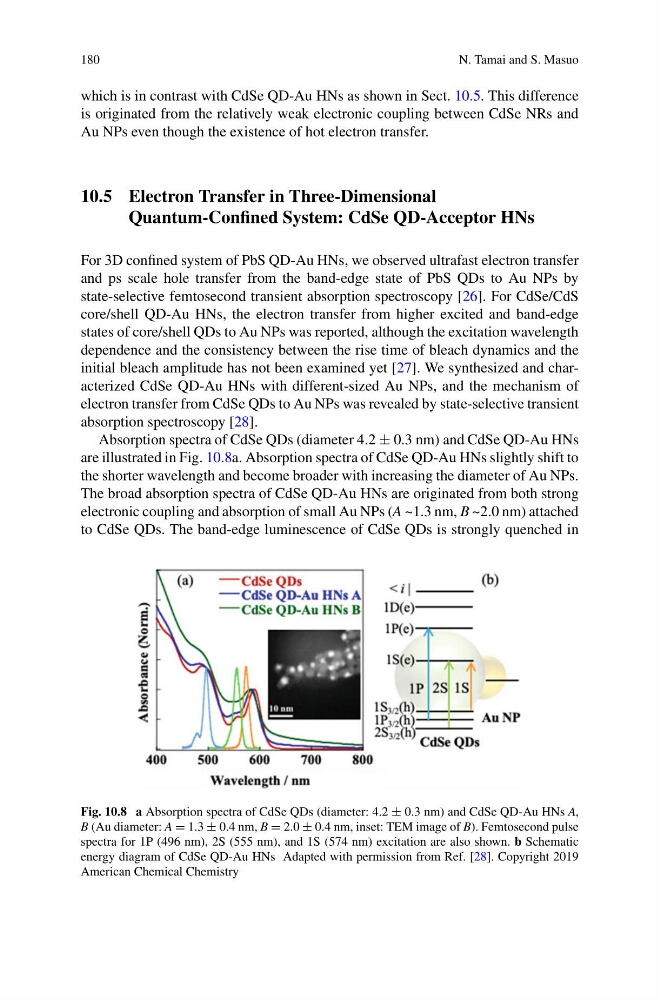
Absorption spectra of CdSe QDs (diameter 4.2 ± 0.3 nm) and CdSe QD-Au HNs
are illustrated in Fig. 10.8a. Absorption spectra of CdSe QD-Au HNs slightly shift to
the shorter wavelength and become broader with increasing the diameter of Au NPs.
The broad absorption spectra of CdSe QD-Au HNs are originated from both strong
electronic coupling and absorption of small Au NPs (A ~1.3 nm, B ~2.0 nm) attached
to CdSe QDs. The band-edge luminescence of CdSe QDs is strongly quenched in
Fig. 10.8 a Absorption spectra of CdSe QDs (diameter: 4.2 ± 0.3 nm) and CdSe QD-Au HNs A,
B (Au diameter: A = 1.3 ± 0.4 nm, B = 2.0 ± 0.4 nm, inset: TEM image of B). Femtosecond pulse
spectra for 1P (496 nm), 2S (555 nm), and 1S (574 nm) excitation are also shown. b Schematic
energy diagram of CdSe QD-Au HNs Adapted with permission from Ref. [28]. Copyright 2019
American Chemical Chemistry
N. Tamai and S. Masuo
which is in contrast with CdSe QD-Au HNs as shown in Sect. 10.5. This difference
is originated from the relatively weak electronic coupling between CdSe NRs and
Au NPs even though the existence of hot electron transfer.
10.5 Electron Transfer in Three-Dimensional
Quantum-Confined System: CdSe QD-Acceptor HNs
For 3D confined system of PbS QD-Au HNs, we observed ultrafast electron transfer
and ps scale hole transfer from the band-edge state of PbS QDs to Au NPs by
state-selective femtosecond transient absorption spectroscopy [26]. For CdSe/CdS
core/shell QD-Au HNs, the electron transfer from higher excited and band-edge
states of core/shell QDs to Au NPs was reported, although the excitation wavelength
dependence and the consistency between the rise time of bleach dynamics and the
initial bleach amplitude has not been examined yet [27]. We synthesized and characterized CdSe QD-Au HNs with different-sized Au NPs, and the mechanism of
electron transfer from CdSe QDs to Au NPs was revealed by state-selective transient
absorption spectroscopy [28].
Absorption spectra of CdSe QDs (diameter 4.2 ± 0.3 nm) and CdSe QD-Au HNs
are illustrated in Fig. 10.8a. Absorption spectra of CdSe QD-Au HNs slightly shift to
the shorter wavelength and become broader with increasing the diameter of Au NPs.
The broad absorption spectra of CdSe QD-Au HNs are originated from both strong
electronic coupling and absorption of small Au NPs (A ~1.3 nm, B ~2.0 nm) attached
to CdSe QDs. The band-edge luminescence of CdSe QDs is strongly quenched in
Fig. 10.8 a Absorption spectra of CdSe QDs (diameter: 4.2 ± 0.3 nm) and CdSe QD-Au HNs A,
B (Au diameter: A = 1.3 ± 0.4 nm, B = 2.0 ± 0.4 nm, inset: TEM image of B). Femtosecond pulse
spectra for 1P (496 nm), 2S (555 nm), and 1S (574 nm) excitation are also shown. b Schematic
energy diagram of CdSe QD-Au HNs Adapted with permission from Ref. [28]. Copyright 2019
American Chemical Chemistry