

10 Hot Carrier Transfer and Carrier Manipulation of Semiconductor …
179
0
0.5
1
1.5
2
CdSe NRs
CdSe NR-Au HNs A
CdSe NR-Au HNs B
CdSe NR-Au HNs C
- OD (Norm.)
Time / ps
0
0.1
0.2
0
1 0
2 0
3 0
4 0
CdSe NRs
CdSe NR-Au HNs A
CdSe NR-Au HNs B
CdSe NR-Au HNs C
OD / OD
Excitation Intensity / W
400
500
600
700
800
CdSe NRs
CdSe NR-Au HNs A
CdSe-NR-Au HNs B
CdSe-NR-Au HNs C
Absorbance (Norm.)
Wavelength / nm
50 nm
0
0.5
1
1.5
2
CdSe NRs
CdSe NR-Au HNs A
CdSe NR-Au HNs B
CdSe NR-Au HNs C
- OD (Norm.)
Time / ps
(b)
0
0.1
0.2
0
1 0
2 0
3 0
4 0
CdSe NRs
CdSe NR-Au HNs A
CdSe NR-Au HNs B
CdSe NR-Au HNs C
OD / OD
Excitation Intensity / W
(c)
400
500
600
700
800
CdSe NRs
CdSe NR-Au HNs A
CdSe-NR-Au HNs B
CdSe-NR-Au HNs C
Absorbance (Norm.)
Wavelength / nm
50 nm
(a)
CdSe NR
Au NP
k 1
k HET
1 e
1 h
< i |
CdSe NR
Au NP
k 1
k HET
1 e
1 h
< i |
(d)
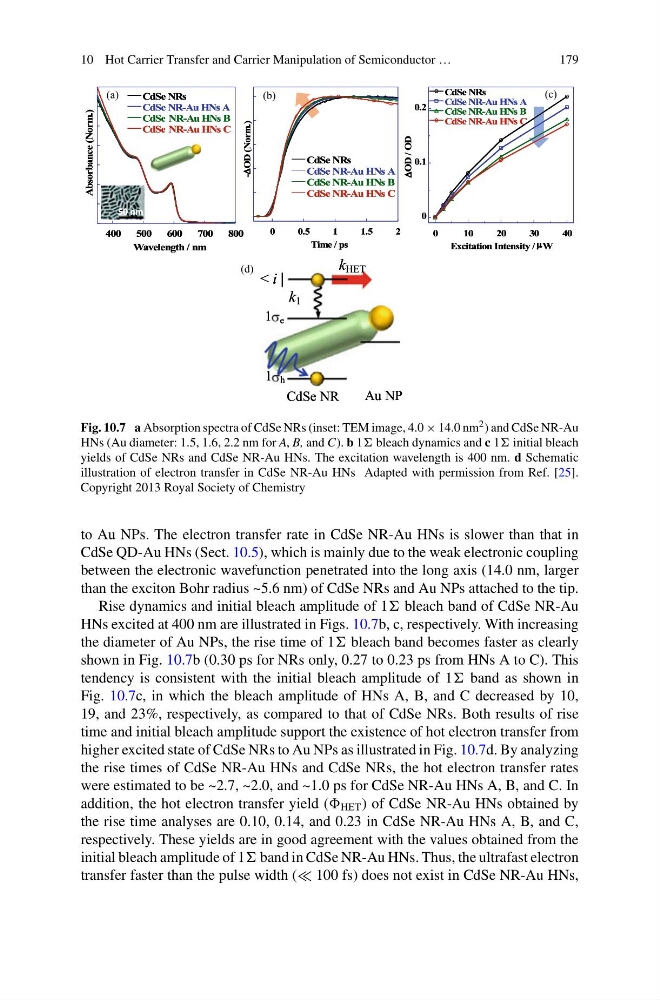
Fig. 10.7 a Absorption spectra of CdSe NRs (inset: TEM image, 4.0 × 14.0 nm 2 ) and CdSe NR-Au
HNs (Au diameter: 1.5, 1.6, 2.2 nm for A, B, and C). b 1 bleach dynamics and c 1 initial bleach
yields of CdSe NRs and CdSe NR-Au HNs. The excitation wavelength is 400 nm. d Schematic
illustration of electron transfer in CdSe NR-Au HNs Adapted with permission from Ref. [25].
Copyright 2013 Royal Society of Chemistry
to Au NPs. The electron transfer rate in CdSe NR-Au HNs is slower than that in
CdSe QD-Au HNs (Sect. 10.5), which is mainly due to the weak electronic coupling
between the electronic wavefunction penetrated into the long axis (14.0 nm, larger
than the exciton Bohr radius ~5.6 nm) of CdSe NRs and Au NPs attached to the tip.
Rise dynamics and initial bleach amplitude of 1 bleach band of CdSe NR-Au
HNs excited at 400 nm are illustrated in Figs. 10.7b, c, respectively. With increasing
the diameter of Au NPs, the rise time of 1 bleach band becomes faster as clearly
shown in Fig. 10.7b (0.30 ps for NRs only, 0.27 to 0.23 ps from HNs A to C). This
tendency is consistent with the initial bleach amplitude of 1 band as shown in
Fig. 10.7c, in which the bleach amplitude of HNs A, B, and C decreased by 10,
19, and 23%, respectively, as compared to that of CdSe NRs. Both results of rise
time and initial bleach amplitude support the existence of hot electron transfer from
higher excited state of CdSe NRs to Au NPs as illustrated in Fig. 10.7d. By analyzing
the rise times of CdSe NR-Au HNs and CdSe NRs, the hot electron transfer rates
were estimated to be ~2.7, ~2.0, and ~1.0 ps for CdSe NR-Au HNs A, B, and C. In
addition, the hot electron transfer yield ( HET ) of CdSe NR-Au HNs obtained by
the rise time analyses are 0.10, 0.14, and 0.23 in CdSe NR-Au HNs A, B, and C,
respectively. These yields are in good agreement with the values obtained from the
initial bleach amplitude of 1 band in CdSe NR-Au HNs. Thus, the ultrafast electron
transfer faster than the pulse width ( 100 fs) does not exist in CdSe NR-Au HNs,
179
0
0.5
1
1.5
2
CdSe NRs
CdSe NR-Au HNs A
CdSe NR-Au HNs B
CdSe NR-Au HNs C
- OD (Norm.)
Time / ps
0
0.1
0.2
0
1 0
2 0
3 0
4 0
CdSe NRs
CdSe NR-Au HNs A
CdSe NR-Au HNs B
CdSe NR-Au HNs C
OD / OD
Excitation Intensity / W
400
500
600
700
800
CdSe NRs
CdSe NR-Au HNs A
CdSe-NR-Au HNs B
CdSe-NR-Au HNs C
Absorbance (Norm.)
Wavelength / nm
50 nm
0
0.5
1
1.5
2
CdSe NRs
CdSe NR-Au HNs A
CdSe NR-Au HNs B
CdSe NR-Au HNs C
- OD (Norm.)
Time / ps
(b)
0
0.1
0.2
0
1 0
2 0
3 0
4 0
CdSe NRs
CdSe NR-Au HNs A
CdSe NR-Au HNs B
CdSe NR-Au HNs C
OD / OD
Excitation Intensity / W
(c)
400
500
600
700
800
CdSe NRs
CdSe NR-Au HNs A
CdSe-NR-Au HNs B
CdSe-NR-Au HNs C
Absorbance (Norm.)
Wavelength / nm
50 nm
(a)
CdSe NR
Au NP
k 1
k HET
1 e
1 h
< i |
CdSe NR
Au NP
k 1
k HET
1 e
1 h
< i |
(d)
Fig. 10.7 a Absorption spectra of CdSe NRs (inset: TEM image, 4.0 × 14.0 nm 2 ) and CdSe NR-Au
HNs (Au diameter: 1.5, 1.6, 2.2 nm for A, B, and C). b 1 bleach dynamics and c 1 initial bleach
yields of CdSe NRs and CdSe NR-Au HNs. The excitation wavelength is 400 nm. d Schematic
illustration of electron transfer in CdSe NR-Au HNs Adapted with permission from Ref. [25].
Copyright 2013 Royal Society of Chemistry
to Au NPs. The electron transfer rate in CdSe NR-Au HNs is slower than that in
CdSe QD-Au HNs (Sect. 10.5), which is mainly due to the weak electronic coupling
between the electronic wavefunction penetrated into the long axis (14.0 nm, larger
than the exciton Bohr radius ~5.6 nm) of CdSe NRs and Au NPs attached to the tip.
Rise dynamics and initial bleach amplitude of 1 bleach band of CdSe NR-Au
HNs excited at 400 nm are illustrated in Figs. 10.7b, c, respectively. With increasing
the diameter of Au NPs, the rise time of 1 bleach band becomes faster as clearly
shown in Fig. 10.7b (0.30 ps for NRs only, 0.27 to 0.23 ps from HNs A to C). This
tendency is consistent with the initial bleach amplitude of 1 band as shown in
Fig. 10.7c, in which the bleach amplitude of HNs A, B, and C decreased by 10,
19, and 23%, respectively, as compared to that of CdSe NRs. Both results of rise
time and initial bleach amplitude support the existence of hot electron transfer from
higher excited state of CdSe NRs to Au NPs as illustrated in Fig. 10.7d. By analyzing
the rise times of CdSe NR-Au HNs and CdSe NRs, the hot electron transfer rates
were estimated to be ~2.7, ~2.0, and ~1.0 ps for CdSe NR-Au HNs A, B, and C. In
addition, the hot electron transfer yield ( HET ) of CdSe NR-Au HNs obtained by
the rise time analyses are 0.10, 0.14, and 0.23 in CdSe NR-Au HNs A, B, and C,
respectively. These yields are in good agreement with the values obtained from the
initial bleach amplitude of 1 band in CdSe NR-Au HNs. Thus, the ultrafast electron
transfer faster than the pulse width ( 100 fs) does not exist in CdSe NR-Au HNs,