

178
N. Tamai and S. Masuo
0
1
2
3
4
5
OD (Norm.)
Time / ps
20 nm
(a)
(b)
CdSe NPLs
CdSe NPL - Au HNs
Hot electron transfer
CdSe NPL
Au NP
(c)
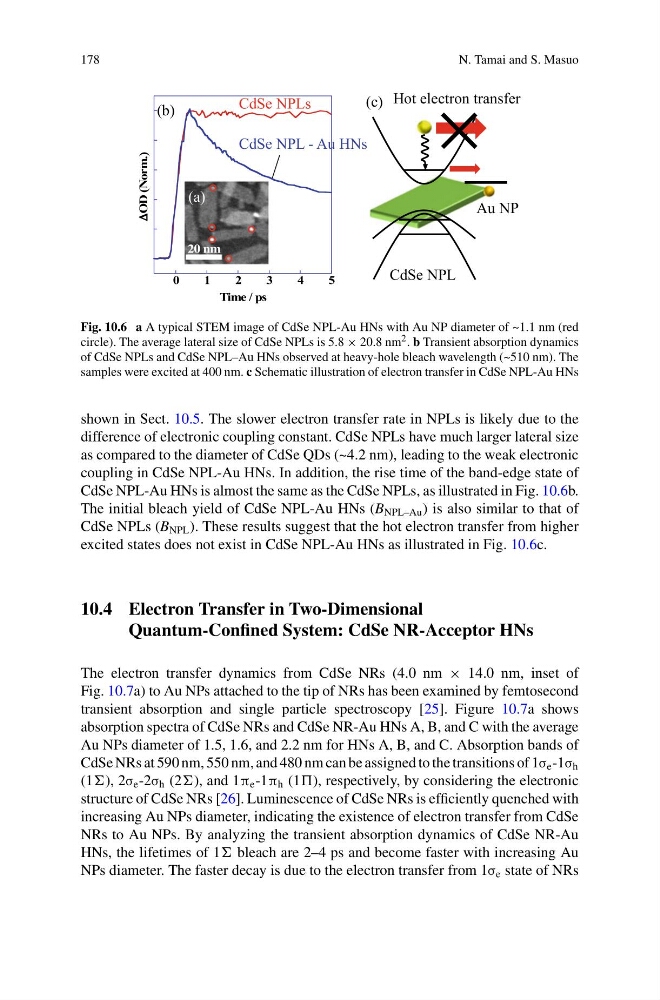
Fig. 10.6 a A typical STEM image of CdSe NPL-Au HNs with Au NP diameter of ~1.1 nm (red
circle). The average lateral size of CdSe NPLs is 5.8 × 20.8 nm 2 . b Transient absorption dynamics
of CdSe NPLs and CdSe NPL–Au HNs observed at heavy-hole bleach wavelength (~510 nm). The
samples were excited at 400 nm. c Schematic illustration of electron transfer in CdSe NPL-Au HNs
shown in Sect. 10.5. The slower electron transfer rate in NPLs is likely due to the
difference of electronic coupling constant. CdSe NPLs have much larger lateral size
as compared to the diameter of CdSe QDs (~4.2 nm), leading to the weak electronic
coupling in CdSe NPL-Au HNs. In addition, the rise time of the band-edge state of
CdSe NPL-Au HNs is almost the same as the CdSe NPLs, as illustrated in Fig. 10.6b.
The initial bleach yield of CdSe NPL-Au HNs (B NPL–Au ) is also similar to that of
CdSe NPLs (B NPL ). These results suggest that the hot electron transfer from higher
excited states does not exist in CdSe NPL-Au HNs as illustrated in Fig. 10.6c.
10.4 Electron Transfer in Two-Dimensional
Quantum-Confined System: CdSe NR-Acceptor HNs
The electron transfer dynamics from CdSe NRs (4.0 nm × 14.0 nm, inset of
Fig. 10.7a) to Au NPs attached to the tip of NRs has been examined by femtosecond
transient absorption and single particle spectroscopy [25]. Figure 10.7a shows
absorption spectra of CdSe NRs and CdSe NR-Au HNs A, B, and C with the average
Au NPs diameter of 1.5, 1.6, and 2.2 nm for HNs A, B, and C. Absorption bands of
CdSe NRs at 590 nm, 550 nm, and 480 nm can be assigned to the transitions of 1σ e -1σ h
(1), 2σ e -2σ h (2), and 1π e -1π h (1), respectively, by considering the electronic
structure of CdSe NRs [26]. Luminescence of CdSe NRs is efficiently quenched with
increasing Au NPs diameter, indicating the existence of electron transfer from CdSe
NRs to Au NPs. By analyzing the transient absorption dynamics of CdSe NR-Au
HNs, the lifetimes of 1 bleach are 2–4 ps and become faster with increasing Au
NPs diameter. The faster decay is due to the electron transfer from 1σ e state of NRs
N. Tamai and S. Masuo
0
1
2
3
4
5
OD (Norm.)
Time / ps
20 nm
(a)
(b)
CdSe NPLs
CdSe NPL - Au HNs
Hot electron transfer
CdSe NPL
Au NP
(c)
Fig. 10.6 a A typical STEM image of CdSe NPL-Au HNs with Au NP diameter of ~1.1 nm (red
circle). The average lateral size of CdSe NPLs is 5.8 × 20.8 nm 2 . b Transient absorption dynamics
of CdSe NPLs and CdSe NPL–Au HNs observed at heavy-hole bleach wavelength (~510 nm). The
samples were excited at 400 nm. c Schematic illustration of electron transfer in CdSe NPL-Au HNs
shown in Sect. 10.5. The slower electron transfer rate in NPLs is likely due to the
difference of electronic coupling constant. CdSe NPLs have much larger lateral size
as compared to the diameter of CdSe QDs (~4.2 nm), leading to the weak electronic
coupling in CdSe NPL-Au HNs. In addition, the rise time of the band-edge state of
CdSe NPL-Au HNs is almost the same as the CdSe NPLs, as illustrated in Fig. 10.6b.
The initial bleach yield of CdSe NPL-Au HNs (B NPL–Au ) is also similar to that of
CdSe NPLs (B NPL ). These results suggest that the hot electron transfer from higher
excited states does not exist in CdSe NPL-Au HNs as illustrated in Fig. 10.6c.
10.4 Electron Transfer in Two-Dimensional
Quantum-Confined System: CdSe NR-Acceptor HNs
The electron transfer dynamics from CdSe NRs (4.0 nm × 14.0 nm, inset of
Fig. 10.7a) to Au NPs attached to the tip of NRs has been examined by femtosecond
transient absorption and single particle spectroscopy [25]. Figure 10.7a shows
absorption spectra of CdSe NRs and CdSe NR-Au HNs A, B, and C with the average
Au NPs diameter of 1.5, 1.6, and 2.2 nm for HNs A, B, and C. Absorption bands of
CdSe NRs at 590 nm, 550 nm, and 480 nm can be assigned to the transitions of 1σ e -1σ h
(1), 2σ e -2σ h (2), and 1π e -1π h (1), respectively, by considering the electronic
structure of CdSe NRs [26]. Luminescence of CdSe NRs is efficiently quenched with
increasing Au NPs diameter, indicating the existence of electron transfer from CdSe
NRs to Au NPs. By analyzing the transient absorption dynamics of CdSe NR-Au
HNs, the lifetimes of 1 bleach are 2–4 ps and become faster with increasing Au
NPs diameter. The faster decay is due to the electron transfer from 1σ e state of NRs