

10 Hot Carrier Transfer and Carrier Manipulation of Semiconductor …
175
For carrier extraction from NPLs, we prepared CdSe NPLs-molecular acceptor,
methyl viologen (MV
2+ ), HNs to make clear the hot and band-edge electron transfer
by analyzing the formation of radical cation (MV
+ ), as well as the decay dynamics
of the band-edge state of NPLs [10]. CdSe NPLs attached with Au NPs (acceptor)
were also examined to analyze the hot electron transfer.
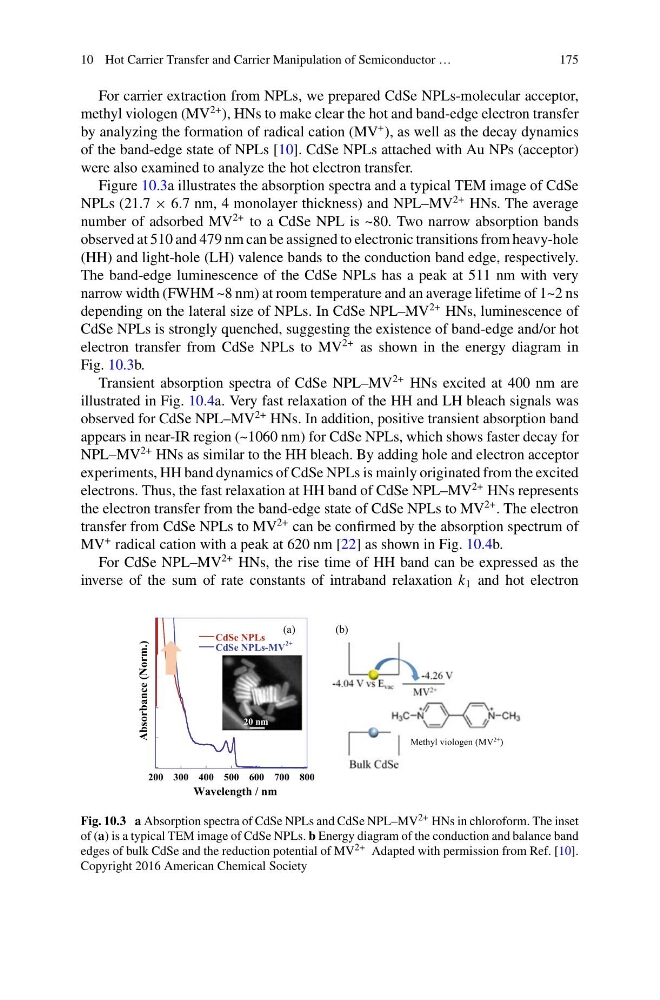
Figure 10.3a illustrates the absorption spectra and a typical TEM image of CdSe
NPLs (21.7 × 6.7 nm, 4 monolayer thickness) and NPL–MV
2+ HNs. The average
number of adsorbed MV
2+ to a CdSe NPL is ~80. Two narrow absorption bands
observed at 510 and 479 nm can be assigned to electronic transitions from heavy-hole
(HH) and light-hole (LH) valence bands to the conduction band edge, respectively.
The band-edge luminescence of the CdSe NPLs has a peak at 511 nm with very
narrow width (FWHM ~8 nm) at room temperature and an average lifetime of 1~2 ns
depending on the lateral size of NPLs. In CdSe NPL–MV
2+ HNs, luminescence of
CdSe NPLs is strongly quenched, suggesting the existence of band-edge and/or hot
electron transfer from CdSe NPLs to MV
2+ as shown in the energy diagram in
Fig. 10.3b.
Transient absorption spectra of CdSe NPL–MV
2+ HNs excited at 400 nm are
illustrated in Fig. 10.4a. Very fast relaxation of the HH and LH bleach signals was
observed for CdSe NPL–MV
2+ HNs. In addition, positive transient absorption band
appears in near-IR region (~1060 nm) for CdSe NPLs, which shows faster decay for
NPL–MV
2+ HNs as similar to the HH bleach. By adding hole and electron acceptor
experiments, HH band dynamics of CdSe NPLs is mainly originated from the excited
electrons. Thus, the fast relaxation at HH band of CdSe NPL–MV
2+ HNs represents
the electron transfer from the band-edge state of CdSe NPLs to MV
2+ . The electron
transfer from CdSe NPLs to MV
2+ can be confirmed by the absorption spectrum of
MV
+ radical cation with a peak at 620 nm [22] as shown in Fig. 10.4b.
For CdSe NPL–MV
2+ HNs, the rise time of HH band can be expressed as the
inverse of the sum of rate constants of intraband relaxation k 1 and hot electron
200 300 400 500 600 700 800
CdSe NPLs
Absorbance (Norm.)
Wavelength / nm
CdSe NPLs-MV
2+
Methyl viologen (MV
2+
)
(a)
(b)
20 nm
Fig. 10.3 a Absorption spectra of CdSe NPLs and CdSe NPL–MV 2+ HNs in chloroform. The inset
of (a) is a typical TEM image of CdSe NPLs. b Energy diagram of the conduction and balance band
edges of bulk CdSe and the reduction potential of MV 2+ Adapted with permission from Ref. [10].
Copyright 2016 American Chemical Society
175
For carrier extraction from NPLs, we prepared CdSe NPLs-molecular acceptor,
methyl viologen (MV
2+ ), HNs to make clear the hot and band-edge electron transfer
by analyzing the formation of radical cation (MV
+ ), as well as the decay dynamics
of the band-edge state of NPLs [10]. CdSe NPLs attached with Au NPs (acceptor)
were also examined to analyze the hot electron transfer.
Figure 10.3a illustrates the absorption spectra and a typical TEM image of CdSe
NPLs (21.7 × 6.7 nm, 4 monolayer thickness) and NPL–MV
2+ HNs. The average
number of adsorbed MV
2+ to a CdSe NPL is ~80. Two narrow absorption bands
observed at 510 and 479 nm can be assigned to electronic transitions from heavy-hole
(HH) and light-hole (LH) valence bands to the conduction band edge, respectively.
The band-edge luminescence of the CdSe NPLs has a peak at 511 nm with very
narrow width (FWHM ~8 nm) at room temperature and an average lifetime of 1~2 ns
depending on the lateral size of NPLs. In CdSe NPL–MV
2+ HNs, luminescence of
CdSe NPLs is strongly quenched, suggesting the existence of band-edge and/or hot
electron transfer from CdSe NPLs to MV
2+ as shown in the energy diagram in
Fig. 10.3b.
Transient absorption spectra of CdSe NPL–MV
2+ HNs excited at 400 nm are
illustrated in Fig. 10.4a. Very fast relaxation of the HH and LH bleach signals was
observed for CdSe NPL–MV
2+ HNs. In addition, positive transient absorption band
appears in near-IR region (~1060 nm) for CdSe NPLs, which shows faster decay for
NPL–MV
2+ HNs as similar to the HH bleach. By adding hole and electron acceptor
experiments, HH band dynamics of CdSe NPLs is mainly originated from the excited
electrons. Thus, the fast relaxation at HH band of CdSe NPL–MV
2+ HNs represents
the electron transfer from the band-edge state of CdSe NPLs to MV
2+ . The electron
transfer from CdSe NPLs to MV
2+ can be confirmed by the absorption spectrum of
MV
+ radical cation with a peak at 620 nm [22] as shown in Fig. 10.4b.
For CdSe NPL–MV
2+ HNs, the rise time of HH band can be expressed as the
inverse of the sum of rate constants of intraband relaxation k 1 and hot electron
200 300 400 500 600 700 800
CdSe NPLs
Absorbance (Norm.)
Wavelength / nm
CdSe NPLs-MV
2+
Methyl viologen (MV
2+
)
(a)
(b)
20 nm
Fig. 10.3 a Absorption spectra of CdSe NPLs and CdSe NPL–MV 2+ HNs in chloroform. The inset
of (a) is a typical TEM image of CdSe NPLs. b Energy diagram of the conduction and balance band
edges of bulk CdSe and the reduction potential of MV 2+ Adapted with permission from Ref. [10].
Copyright 2016 American Chemical Society