

174
N. Tamai and S. Masuo
where [i] 0 is the initial concentration of the i state and ⊗ indicates the convolution.
This equation is based in the long lifetime of 1S(e) state. In the existence of band-edge
electron transfer from 1S(e) state with the rate constant of k ET , the decay component
of exp(−k ET t) should be introduced instead of 1 in Eq. (10.1).
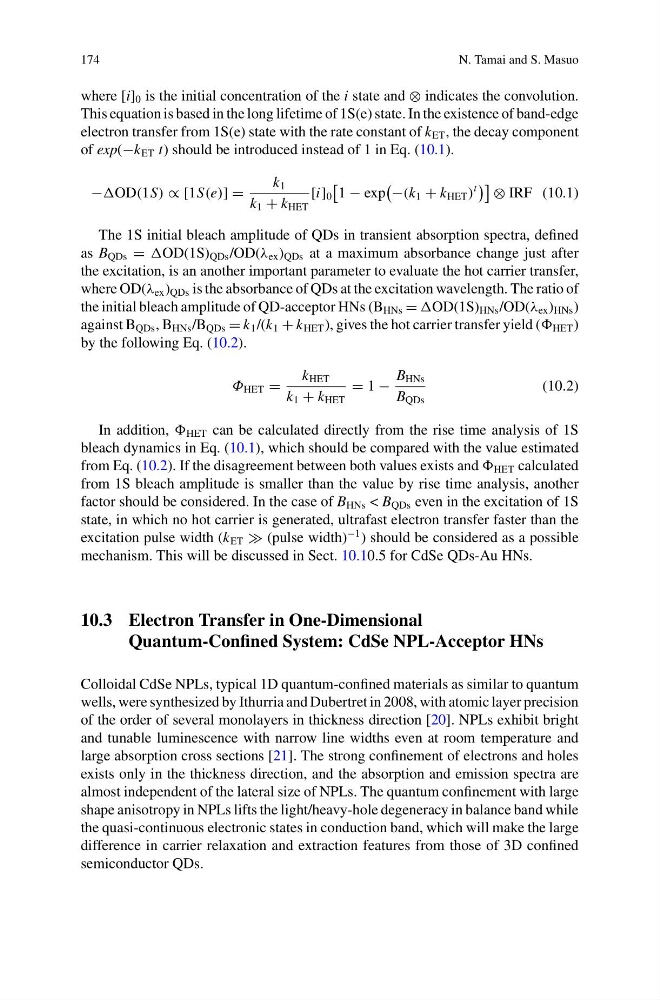
−OD(1S) ∝ [1S(e)] =
k 1
k 1 + k HET
[i] 0
1 − exp
−(k 1 + k HET )
t
⊗ IRF (10.1)
The 1S initial bleach amplitude of QDs in transient absorption spectra, defined
as B QDs = OD(1S) QDs /OD(λ ex ) QDs at a maximum absorbance change just after
the excitation, is an another important parameter to evaluate the hot carrier transfer,
where OD(λ ex ) QDs is the absorbance of QDs at the excitation wavelength. The ratio of
the initial bleach amplitude of QD-acceptor HNs (B HNs = OD(1S) HNs /OD(λ ex ) HNs )
against B QDs , B HNs /B QDs = k 1 /(k 1 + k HET ), gives the hot carrier transfer yield ( HET )
by the following Eq. (10.2).
Φ HET =
k HET
k 1 + k HET
= 1 −
B HNs
B QDs
(10.2)
In addition, HET can be calculated directly from the rise time analysis of 1S
bleach dynamics in Eq. (10.1), which should be compared with the value estimated
from Eq. (10.2). If the disagreement between both values exists and HET calculated
from 1S bleach amplitude is smaller than the value by rise time analysis, another
factor should be considered. In the case of B HNs < B QDs even in the excitation of 1S
state, in which no hot carrier is generated, ultrafast electron transfer faster than the
excitation pulse width (k ET (pulse width)
−1 ) should be considered as a possible
mechanism. This will be discussed in Sect. 10.10.5 for CdSe QDs-Au HNs.
10.3 Electron Transfer in One-Dimensional
Quantum-Confined System: CdSe NPL-Acceptor HNs
Colloidal CdSe NPLs, typical 1D quantum-confined materials as similar to quantum
wells, were synthesized by Ithurria and Dubertret in 2008, with atomic layer precision
of the order of several monolayers in thickness direction [20]. NPLs exhibit bright
and tunable luminescence with narrow line widths even at room temperature and
large absorption cross sections [21]. The strong confinement of electrons and holes
exists only in the thickness direction, and the absorption and emission spectra are
almost independent of the lateral size of NPLs. The quantum confinement with large
shape anisotropy in NPLs lifts the light/heavy-hole degeneracy in balance band while
the quasi-continuous electronic states in conduction band, which will make the large
difference in carrier relaxation and extraction features from those of 3D confined
semiconductor QDs.
N. Tamai and S. Masuo
where [i] 0 is the initial concentration of the i state and ⊗ indicates the convolution.
This equation is based in the long lifetime of 1S(e) state. In the existence of band-edge
electron transfer from 1S(e) state with the rate constant of k ET , the decay component
of exp(−k ET t) should be introduced instead of 1 in Eq. (10.1).
−OD(1S) ∝ [1S(e)] =
k 1
k 1 + k HET
[i] 0
1 − exp
−(k 1 + k HET )
t
⊗ IRF (10.1)
The 1S initial bleach amplitude of QDs in transient absorption spectra, defined
as B QDs = OD(1S) QDs /OD(λ ex ) QDs at a maximum absorbance change just after
the excitation, is an another important parameter to evaluate the hot carrier transfer,
where OD(λ ex ) QDs is the absorbance of QDs at the excitation wavelength. The ratio of
the initial bleach amplitude of QD-acceptor HNs (B HNs = OD(1S) HNs /OD(λ ex ) HNs )
against B QDs , B HNs /B QDs = k 1 /(k 1 + k HET ), gives the hot carrier transfer yield ( HET )
by the following Eq. (10.2).
Φ HET =
k HET
k 1 + k HET
= 1 −
B HNs
B QDs
(10.2)
In addition, HET can be calculated directly from the rise time analysis of 1S
bleach dynamics in Eq. (10.1), which should be compared with the value estimated
from Eq. (10.2). If the disagreement between both values exists and HET calculated
from 1S bleach amplitude is smaller than the value by rise time analysis, another
factor should be considered. In the case of B HNs < B QDs even in the excitation of 1S
state, in which no hot carrier is generated, ultrafast electron transfer faster than the
excitation pulse width (k ET (pulse width)
−1 ) should be considered as a possible
mechanism. This will be discussed in Sect. 10.10.5 for CdSe QDs-Au HNs.
10.3 Electron Transfer in One-Dimensional
Quantum-Confined System: CdSe NPL-Acceptor HNs
Colloidal CdSe NPLs, typical 1D quantum-confined materials as similar to quantum
wells, were synthesized by Ithurria and Dubertret in 2008, with atomic layer precision
of the order of several monolayers in thickness direction [20]. NPLs exhibit bright
and tunable luminescence with narrow line widths even at room temperature and
large absorption cross sections [21]. The strong confinement of electrons and holes
exists only in the thickness direction, and the absorption and emission spectra are
almost independent of the lateral size of NPLs. The quantum confinement with large
shape anisotropy in NPLs lifts the light/heavy-hole degeneracy in balance band while
the quasi-continuous electronic states in conduction band, which will make the large
difference in carrier relaxation and extraction features from those of 3D confined
semiconductor QDs.