

10 Hot Carrier Transfer and Carrier Manipulation of Semiconductor …
173
spectroscopy and the initial bleach yield of the band-edge state of semiconductor
NCs. The effect of quantum confinement of semiconductor NCs on the extraction of
hot carriers by acceptor molecules and metal nanoparticles (NPs) (Fig. 10.1) will be
discussed.
Given the situation that the size of metal NPs becomes larger, plasmonic field
appears near NPs called plasmonic nanostructures. Multiple carriers or excitons can
be generated in semiconductor NCs by the interaction with plasmonic nanostructures.
The generated multiple excitons disappear within a few ps ~ hundred ps by Auger
recombination (AR) processes [13–18], so the extraction of multiple excitons is also
important for the application to solar energy conversion. Secondly, the manipulation
of a single and multiple excitons in a single QD is demonstrated by the distance
regulation between plasmonic nanostructures and a single QD. The competition
between electromagnetic enhancement of absorption and luminescence and energy
transfer quenching by a single plasmonic nanostructure will be discussed.
10.2 Analytical Methods of Hot Carrier Extraction
from Semiconductor NCs—Acceptor Hybrid System
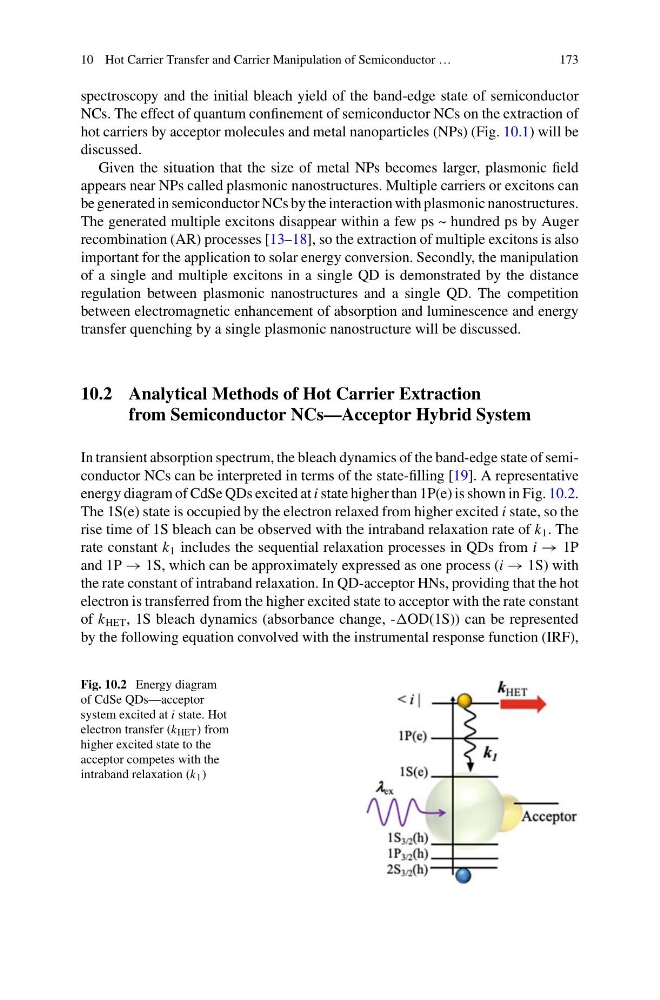
In transient absorption spectrum, the bleach dynamics of the band-edge state of semiconductor NCs can be interpreted in terms of the state-filling [19]. A representative
energy diagram of CdSe QDs excited at i state higher than 1P(e) is shown in Fig. 10.2.
The 1S(e) state is occupied by the electron relaxed from higher excited i state, so the
rise time of 1S bleach can be observed with the intraband relaxation rate of k 1 . The
rate constant k 1 includes the sequential relaxation processes in QDs from i → 1P
and 1P → 1S, which can be approximately expressed as one process (i → 1S) with
the rate constant of intraband relaxation. In QD-acceptor HNs, providing that the hot
electron is transferred from the higher excited state to acceptor with the rate constant
of k HET , 1S bleach dynamics (absorbance change, -OD(1S)) can be represented
by the following equation convolved with the instrumental response function (IRF),
Fig. 10.2 Energy diagram
of CdSe QDs—acceptor
system excited at i state. Hot
electron transfer (k HET ) from
higher excited state to the
acceptor competes with the
intraband relaxation (k 1 )
173
spectroscopy and the initial bleach yield of the band-edge state of semiconductor
NCs. The effect of quantum confinement of semiconductor NCs on the extraction of
hot carriers by acceptor molecules and metal nanoparticles (NPs) (Fig. 10.1) will be
discussed.
Given the situation that the size of metal NPs becomes larger, plasmonic field
appears near NPs called plasmonic nanostructures. Multiple carriers or excitons can
be generated in semiconductor NCs by the interaction with plasmonic nanostructures.
The generated multiple excitons disappear within a few ps ~ hundred ps by Auger
recombination (AR) processes [13–18], so the extraction of multiple excitons is also
important for the application to solar energy conversion. Secondly, the manipulation
of a single and multiple excitons in a single QD is demonstrated by the distance
regulation between plasmonic nanostructures and a single QD. The competition
between electromagnetic enhancement of absorption and luminescence and energy
transfer quenching by a single plasmonic nanostructure will be discussed.
10.2 Analytical Methods of Hot Carrier Extraction
from Semiconductor NCs—Acceptor Hybrid System
In transient absorption spectrum, the bleach dynamics of the band-edge state of semiconductor NCs can be interpreted in terms of the state-filling [19]. A representative
energy diagram of CdSe QDs excited at i state higher than 1P(e) is shown in Fig. 10.2.
The 1S(e) state is occupied by the electron relaxed from higher excited i state, so the
rise time of 1S bleach can be observed with the intraband relaxation rate of k 1 . The
rate constant k 1 includes the sequential relaxation processes in QDs from i → 1P
and 1P → 1S, which can be approximately expressed as one process (i → 1S) with
the rate constant of intraband relaxation. In QD-acceptor HNs, providing that the hot
electron is transferred from the higher excited state to acceptor with the rate constant
of k HET , 1S bleach dynamics (absorbance change, -OD(1S)) can be represented
by the following equation convolved with the instrumental response function (IRF),
Fig. 10.2 Energy diagram
of CdSe QDs—acceptor
system excited at i state. Hot
electron transfer (k HET ) from
higher excited state to the
acceptor competes with the
intraband relaxation (k 1 )