

172
N. Tamai and S. Masuo
of the typical quantum-confined materials is semiconductor quantum dots (QDs),
in which electron and hole are confined along three-dimensional (3D) directions,
showing the size-tunable absorption and luminescence spectra originating from the
discrete electronic states [1], and highly efficient multiple exciton generation (MEG)
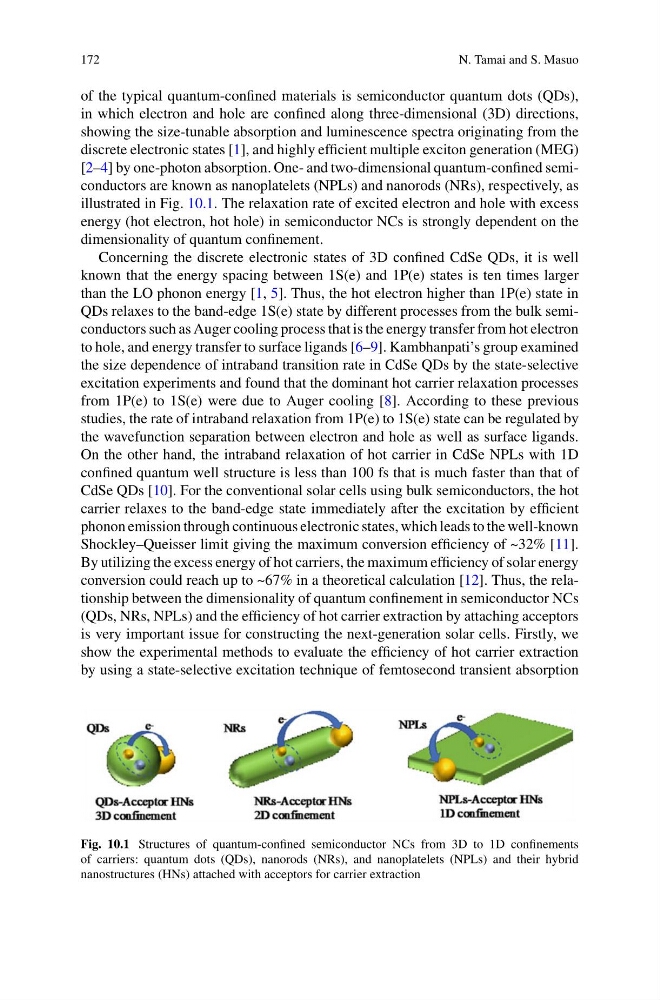
[2–4] by one-photon absorption. One- and two-dimensional quantum-confined semiconductors are known as nanoplatelets (NPLs) and nanorods (NRs), respectively, as
illustrated in Fig. 10.1. The relaxation rate of excited electron and hole with excess
energy (hot electron, hot hole) in semiconductor NCs is strongly dependent on the
dimensionality of quantum confinement.
Concerning the discrete electronic states of 3D confined CdSe QDs, it is well
known that the energy spacing between 1S(e) and 1P(e) states is ten times larger
than the LO phonon energy [1, 5]. Thus, the hot electron higher than 1P(e) state in
QDs relaxes to the band-edge 1S(e) state by different processes from the bulk semiconductors such as Auger cooling process that is the energy transfer from hot electron
to hole, and energy transfer to surface ligands [6–9]. Kambhanpati’s group examined
the size dependence of intraband transition rate in CdSe QDs by the state-selective
excitation experiments and found that the dominant hot carrier relaxation processes
from 1P(e) to 1S(e) were due to Auger cooling [8]. According to these previous
studies, the rate of intraband relaxation from 1P(e) to 1S(e) state can be regulated by
the wavefunction separation between electron and hole as well as surface ligands.
On the other hand, the intraband relaxation of hot carrier in CdSe NPLs with 1D
confined quantum well structure is less than 100 fs that is much faster than that of
CdSe QDs [10]. For the conventional solar cells using bulk semiconductors, the hot
carrier relaxes to the band-edge state immediately after the excitation by efficient
phonon emission through continuous electronic states, which leads to the well-known
Shockley–Queisser limit giving the maximum conversion efficiency of ~32% [11].
By utilizing the excess energy of hot carriers, the maximum efficiency of solar energy
conversion could reach up to ~67% in a theoretical calculation [12]. Thus, the relationship between the dimensionality of quantum confinement in semiconductor NCs
(QDs, NRs, NPLs) and the efficiency of hot carrier extraction by attaching acceptors
is very important issue for constructing the next-generation solar cells. Firstly, we
show the experimental methods to evaluate the efficiency of hot carrier extraction
by using a state-selective excitation technique of femtosecond transient absorption
Fig. 10.1 Structures of quantum-confined semiconductor NCs from 3D to 1D confinements
of carriers: quantum dots (QDs), nanorods (NRs), and nanoplatelets (NPLs) and their hybrid
nanostructures (HNs) attached with acceptors for carrier extraction
N. Tamai and S. Masuo
of the typical quantum-confined materials is semiconductor quantum dots (QDs),
in which electron and hole are confined along three-dimensional (3D) directions,
showing the size-tunable absorption and luminescence spectra originating from the
discrete electronic states [1], and highly efficient multiple exciton generation (MEG)
[2–4] by one-photon absorption. One- and two-dimensional quantum-confined semiconductors are known as nanoplatelets (NPLs) and nanorods (NRs), respectively, as
illustrated in Fig. 10.1. The relaxation rate of excited electron and hole with excess
energy (hot electron, hot hole) in semiconductor NCs is strongly dependent on the
dimensionality of quantum confinement.
Concerning the discrete electronic states of 3D confined CdSe QDs, it is well
known that the energy spacing between 1S(e) and 1P(e) states is ten times larger
than the LO phonon energy [1, 5]. Thus, the hot electron higher than 1P(e) state in
QDs relaxes to the band-edge 1S(e) state by different processes from the bulk semiconductors such as Auger cooling process that is the energy transfer from hot electron
to hole, and energy transfer to surface ligands [6–9]. Kambhanpati’s group examined
the size dependence of intraband transition rate in CdSe QDs by the state-selective
excitation experiments and found that the dominant hot carrier relaxation processes
from 1P(e) to 1S(e) were due to Auger cooling [8]. According to these previous
studies, the rate of intraband relaxation from 1P(e) to 1S(e) state can be regulated by
the wavefunction separation between electron and hole as well as surface ligands.
On the other hand, the intraband relaxation of hot carrier in CdSe NPLs with 1D
confined quantum well structure is less than 100 fs that is much faster than that of
CdSe QDs [10]. For the conventional solar cells using bulk semiconductors, the hot
carrier relaxes to the band-edge state immediately after the excitation by efficient
phonon emission through continuous electronic states, which leads to the well-known
Shockley–Queisser limit giving the maximum conversion efficiency of ~32% [11].
By utilizing the excess energy of hot carriers, the maximum efficiency of solar energy
conversion could reach up to ~67% in a theoretical calculation [12]. Thus, the relationship between the dimensionality of quantum confinement in semiconductor NCs
(QDs, NRs, NPLs) and the efficiency of hot carrier extraction by attaching acceptors
is very important issue for constructing the next-generation solar cells. Firstly, we
show the experimental methods to evaluate the efficiency of hot carrier extraction
by using a state-selective excitation technique of femtosecond transient absorption
Fig. 10.1 Structures of quantum-confined semiconductor NCs from 3D to 1D confinements
of carriers: quantum dots (QDs), nanorods (NRs), and nanoplatelets (NPLs) and their hybrid
nanostructures (HNs) attached with acceptors for carrier extraction