

176
N. Tamai and S. Masuo
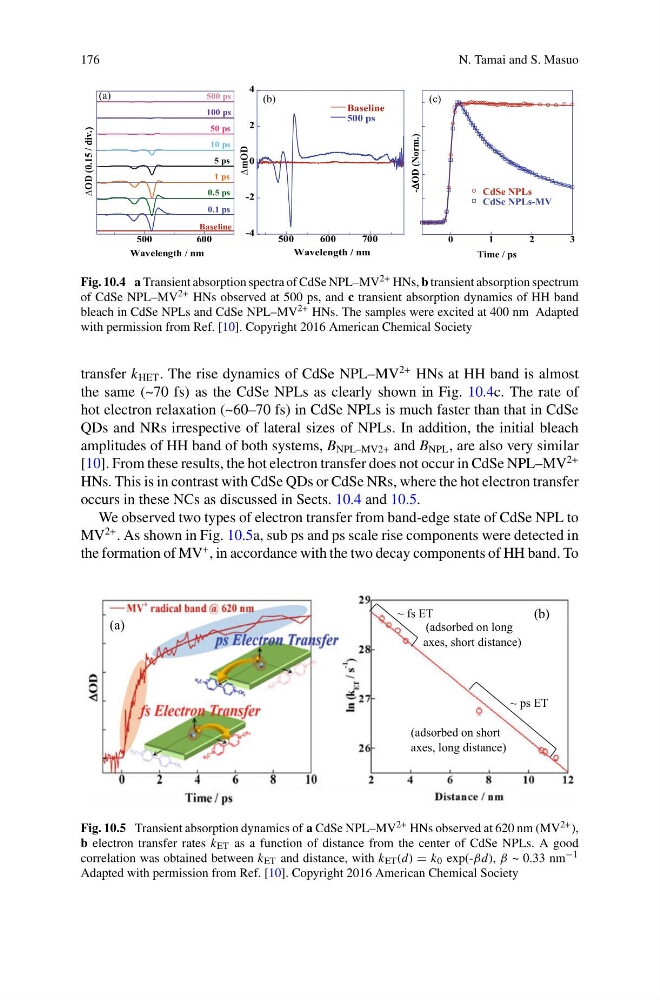
Fig. 10.4 a Transient absorption spectra of CdSe NPL–MV 2+ HNs, b transient absorption spectrum
of CdSe NPL–MV 2+ HNs observed at 500 ps, and c transient absorption dynamics of HH band
bleach in CdSe NPLs and CdSe NPL–MV 2+ HNs. The samples were excited at 400 nm Adapted
with permission from Ref. [10]. Copyright 2016 American Chemical Society
transfer k HET . The rise dynamics of CdSe NPL–MV
2+ HNs at HH band is almost
the same (~70 fs) as the CdSe NPLs as clearly shown in Fig. 10.4c. The rate of
hot electron relaxation (~60–70 fs) in CdSe NPLs is much faster than that in CdSe
QDs and NRs irrespective of lateral sizes of NPLs. In addition, the initial bleach
amplitudes of HH band of both systems, B NPL–MV2+ and B NPL , are also very similar
[10]. From these results, the hot electron transfer does not occur in CdSe NPL–MV
2+
HNs. This is in contrast with CdSe QDs or CdSe NRs, where the hot electron transfer
occurs in these NCs as discussed in Sects. 10.4 and 10.5.
We observed two types of electron transfer from band-edge state of CdSe NPL to
MV
2+ . As shown in Fig. 10.5a, sub ps and ps scale rise components were detected in
the formation of MV
+ , in accordance with the two decay components of HH band. To
~ fs ET
~ ps ET
(adsorbed on short
axes, long distance)
(a)
(b)
(adsorbed on long
axes, short distance)
Fig. 10.5 Transient absorption dynamics of a CdSe NPL–MV 2+ HNs observed at 620 nm (MV 2+ ),
b electron transfer rates k ET as a function of distance from the center of CdSe NPLs. A good
correlation was obtained between k ET and distance, with k ET (d) = k 0 exp(-βd), β ~ 0.33 nm −1
Adapted with permission from Ref. [10]. Copyright 2016 American Chemical Society
N. Tamai and S. Masuo
Fig. 10.4 a Transient absorption spectra of CdSe NPL–MV 2+ HNs, b transient absorption spectrum
of CdSe NPL–MV 2+ HNs observed at 500 ps, and c transient absorption dynamics of HH band
bleach in CdSe NPLs and CdSe NPL–MV 2+ HNs. The samples were excited at 400 nm Adapted
with permission from Ref. [10]. Copyright 2016 American Chemical Society
transfer k HET . The rise dynamics of CdSe NPL–MV
2+ HNs at HH band is almost
the same (~70 fs) as the CdSe NPLs as clearly shown in Fig. 10.4c. The rate of
hot electron relaxation (~60–70 fs) in CdSe NPLs is much faster than that in CdSe
QDs and NRs irrespective of lateral sizes of NPLs. In addition, the initial bleach
amplitudes of HH band of both systems, B NPL–MV2+ and B NPL , are also very similar
[10]. From these results, the hot electron transfer does not occur in CdSe NPL–MV
2+
HNs. This is in contrast with CdSe QDs or CdSe NRs, where the hot electron transfer
occurs in these NCs as discussed in Sects. 10.4 and 10.5.
We observed two types of electron transfer from band-edge state of CdSe NPL to
MV
2+ . As shown in Fig. 10.5a, sub ps and ps scale rise components were detected in
the formation of MV
+ , in accordance with the two decay components of HH band. To
~ fs ET
~ ps ET
(adsorbed on short
axes, long distance)
(a)
(b)
(adsorbed on long
axes, short distance)
Fig. 10.5 Transient absorption dynamics of a CdSe NPL–MV 2+ HNs observed at 620 nm (MV 2+ ),
b electron transfer rates k ET as a function of distance from the center of CdSe NPLs. A good
correlation was obtained between k ET and distance, with k ET (d) = k 0 exp(-βd), β ~ 0.33 nm −1
Adapted with permission from Ref. [10]. Copyright 2016 American Chemical Society