

8
H. Miyasaka et al.
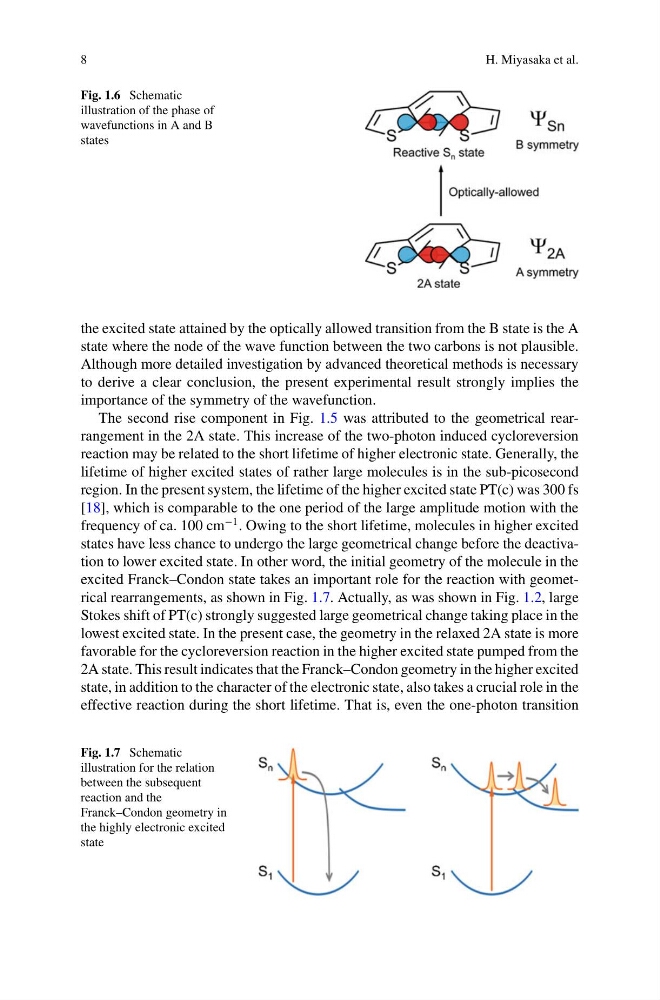
Fig. 1.6 Schematic
illustration of the phase of
wavefunctions in A and B
states
the excited state attained by the optically allowed transition from the B state is the A
state where the node of the wave function between the two carbons is not plausible.
Although more detailed investigation by advanced theoretical methods is necessary
to derive a clear conclusion, the present experimental result strongly implies the
importance of the symmetry of the wavefunction.
The second rise component in Fig. 1.5 was attributed to the geometrical rearrangement in the 2A state. This increase of the two-photon induced cycloreversion
reaction may be related to the short lifetime of higher electronic state. Generally, the
lifetime of higher excited states of rather large molecules is in the sub-picosecond
region. In the present system, the lifetime of the higher excited state PT(c) was 300 fs
[18], which is comparable to the one period of the large amplitude motion with the
frequency of ca. 100 cm
−1 . Owing to the short lifetime, molecules in higher excited
states have less chance to undergo the large geometrical change before the deactivation to lower excited state. In other word, the initial geometry of the molecule in the
excited Franck–Condon state takes an important role for the reaction with geometrical rearrangements, as shown in Fig. 1.7. Actually, as was shown in Fig. 1.2, large
Stokes shift of PT(c) strongly suggested large geometrical change taking place in the
lowest excited state. In the present case, the geometry in the relaxed 2A state is more
favorable for the cycloreversion reaction in the higher excited state pumped from the
2A state. This result indicates that the Franck–Condon geometry in the higher excited
state, in addition to the character of the electronic state, also takes a crucial role in the
effective reaction during the short lifetime. That is, even the one-photon transition
Fig. 1.7 Schematic
illustration for the relation
between the subsequent
reaction and the
Franck–Condon geometry in
the highly electronic excited
state
H. Miyasaka et al.
Fig. 1.6 Schematic
illustration of the phase of
wavefunctions in A and B
states
the excited state attained by the optically allowed transition from the B state is the A
state where the node of the wave function between the two carbons is not plausible.
Although more detailed investigation by advanced theoretical methods is necessary
to derive a clear conclusion, the present experimental result strongly implies the
importance of the symmetry of the wavefunction.
The second rise component in Fig. 1.5 was attributed to the geometrical rearrangement in the 2A state. This increase of the two-photon induced cycloreversion
reaction may be related to the short lifetime of higher electronic state. Generally, the
lifetime of higher excited states of rather large molecules is in the sub-picosecond
region. In the present system, the lifetime of the higher excited state PT(c) was 300 fs
[18], which is comparable to the one period of the large amplitude motion with the
frequency of ca. 100 cm
−1 . Owing to the short lifetime, molecules in higher excited
states have less chance to undergo the large geometrical change before the deactivation to lower excited state. In other word, the initial geometry of the molecule in the
excited Franck–Condon state takes an important role for the reaction with geometrical rearrangements, as shown in Fig. 1.7. Actually, as was shown in Fig. 1.2, large
Stokes shift of PT(c) strongly suggested large geometrical change taking place in the
lowest excited state. In the present case, the geometry in the relaxed 2A state is more
favorable for the cycloreversion reaction in the higher excited state pumped from the
2A state. This result indicates that the Franck–Condon geometry in the higher excited
state, in addition to the character of the electronic state, also takes a crucial role in the
effective reaction during the short lifetime. That is, even the one-photon transition
Fig. 1.7 Schematic
illustration for the relation
between the subsequent
reaction and the
Franck–Condon geometry in
the highly electronic excited
state