

1 Advanced Control of Photochemical Reactions …
9
from the ground state can access to the specific electronic state, the reaction may not
so efficiently occur in the vertical transition of which Franck–Condon geometry is
far from the crossing point for the reaction.
The wavelength of the second laser pulse is also an important factor for the
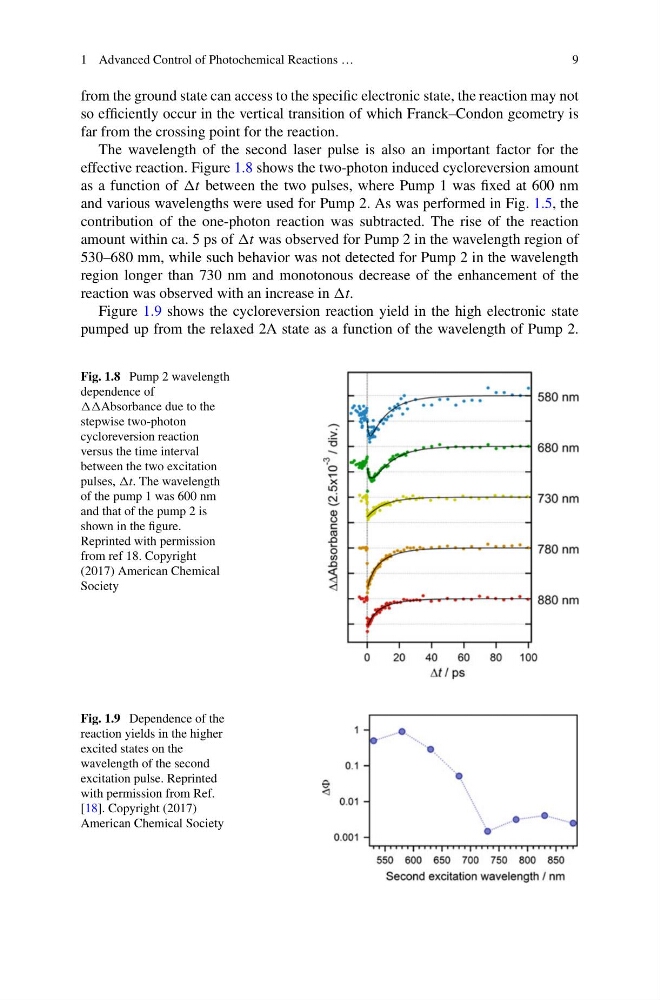
effective reaction. Figure 1.8 shows the two-photon induced cycloreversion amount
as a function of t between the two pulses, where Pump 1 was fixed at 600 nm
and various wavelengths were used for Pump 2. As was performed in Fig. 1.5, the
contribution of the one-photon reaction was subtracted. The rise of the reaction
amount within ca. 5 ps of t was observed for Pump 2 in the wavelength region of
530–680 mm, while such behavior was not detected for Pump 2 in the wavelength
region longer than 730 nm and monotonous decrease of the enhancement of the
reaction was observed with an increase in t.
Figure 1.9 shows the cycloreversion reaction yield in the high electronic state
pumped up from the relaxed 2A state as a function of the wavelength of Pump 2.
Fig. 1.8 Pump 2 wavelength
dependence of
Absorbance due to the
stepwise two-photon
cycloreversion reaction
versus the time interval
between the two excitation
pulses, t. The wavelength
of the pump 1 was 600 nm
and that of the pump 2 is
shown in the figure.
Reprinted with permission
from ref 18. Copyright
(2017) American Chemical
Society
Fig. 1.9 Dependence of the
reaction yields in the higher
excited states on the
wavelength of the second
excitation pulse. Reprinted
with permission from Ref.
[18]. Copyright (2017)
American Chemical Society
9
from the ground state can access to the specific electronic state, the reaction may not
so efficiently occur in the vertical transition of which Franck–Condon geometry is
far from the crossing point for the reaction.
The wavelength of the second laser pulse is also an important factor for the
effective reaction. Figure 1.8 shows the two-photon induced cycloreversion amount
as a function of t between the two pulses, where Pump 1 was fixed at 600 nm
and various wavelengths were used for Pump 2. As was performed in Fig. 1.5, the
contribution of the one-photon reaction was subtracted. The rise of the reaction
amount within ca. 5 ps of t was observed for Pump 2 in the wavelength region of
530–680 mm, while such behavior was not detected for Pump 2 in the wavelength
region longer than 730 nm and monotonous decrease of the enhancement of the
reaction was observed with an increase in t.
Figure 1.9 shows the cycloreversion reaction yield in the high electronic state
pumped up from the relaxed 2A state as a function of the wavelength of Pump 2.
Fig. 1.8 Pump 2 wavelength
dependence of
Absorbance due to the
stepwise two-photon
cycloreversion reaction
versus the time interval
between the two excitation
pulses, t. The wavelength
of the pump 1 was 600 nm
and that of the pump 2 is
shown in the figure.
Reprinted with permission
from ref 18. Copyright
(2017) American Chemical
Society
Fig. 1.9 Dependence of the
reaction yields in the higher
excited states on the
wavelength of the second
excitation pulse. Reprinted
with permission from Ref.
[18]. Copyright (2017)
American Chemical Society