

9 Photosynergetic Effects on Triplet–Triplet Annihilation …
161
in this theory are evaluated using quantum chemical calculations for monomers or
dimers extracted from the crystal structure. For the latter, triplet exciton migration
and thus the encounter probability are modeled by random walk process. Using
the experimental condition and observation, we focus on the dimensionality of the
exciton migration for the encounter probability.
9.3.1 Theoretical Background of Energy Transfer Rate
Constant Represented by Marcus Theory
Dominant TTA processes are categorized into two types. One is the direct change
from the T 1 –T 1 pair state to the S 1 –S 0 pair state, and the other is the indirect (sequential) change from T 1 –T 1 state to S 1 –S 0 via charge-separated states. On the other hand,
triplet–triplet energy transfer (TTET) between two emitters in crystal occurs under
the Dexter mechanism, where an overlap of molecular orbitals between two neighboring emitters determines the energy transfer efficiency. Note here that we use the
abbreviation of TTET to distinguish this process (i.e., between the emitters) and the
triplet energy transfer (TET) from the sensitizer to the emitter in Fig. 9.1. We here
estimate the rate constant of energy transfer processes concerning TTA-UC in solid,
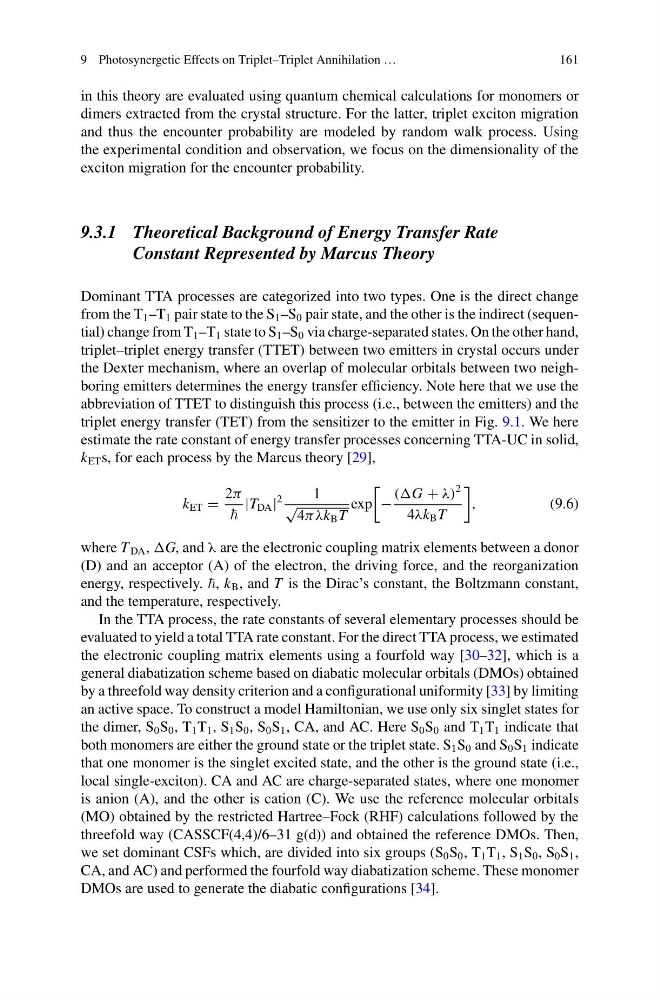
k ET s, for each process by the Marcus theory [29],
k ET =
2π
|T DA |
2
1
√
4πλk B T
exp
−
(G + λ)
2
4λk B T
,
(9.6)
where T DA , G, and λ are the electronic coupling matrix elements between a donor
(D) and an acceptor (A) of the electron, the driving force, and the reorganization
energy, respectively. , k B , and T is the Dirac’s constant, the Boltzmann constant,
and the temperature, respectively.
In the TTA process, the rate constants of several elementary processes should be
evaluated to yield a total TTA rate constant. For the direct TTA process, we estimated
the electronic coupling matrix elements using a fourfold way [30–32], which is a
general diabatization scheme based on diabatic molecular orbitals (DMOs) obtained
by a threefold way density criterion and a configurational uniformity [33] by limiting
an active space. To construct a model Hamiltonian, we use only six singlet states for
the dimer, S 0 S 0 , T 1 T 1 , S 1 S 0 , S 0 S 1 , CA, and AC. Here S 0 S 0 and T 1 T 1 indicate that
both monomers are either the ground state or the triplet state. S 1 S 0 and S 0 S 1 indicate
that one monomer is the singlet excited state, and the other is the ground state (i.e.,
local single-exciton). CA and AC are charge-separated states, where one monomer
is anion (A), and the other is cation (C). We use the reference molecular orbitals
(MO) obtained by the restricted Hartree–Fock (RHF) calculations followed by the
threefold way (CASSCF(4,4)/6–31 g(d)) and obtained the reference DMOs. Then,
we set dominant CSFs which, are divided into six groups (S 0 S 0 , T 1 T 1 , S 1 S 0 , S 0 S 1 ,
CA, and AC) and performed the fourfold way diabatization scheme. These monomer
DMOs are used to generate the diabatic configurations [34].
161
in this theory are evaluated using quantum chemical calculations for monomers or
dimers extracted from the crystal structure. For the latter, triplet exciton migration
and thus the encounter probability are modeled by random walk process. Using
the experimental condition and observation, we focus on the dimensionality of the
exciton migration for the encounter probability.
9.3.1 Theoretical Background of Energy Transfer Rate
Constant Represented by Marcus Theory
Dominant TTA processes are categorized into two types. One is the direct change
from the T 1 –T 1 pair state to the S 1 –S 0 pair state, and the other is the indirect (sequential) change from T 1 –T 1 state to S 1 –S 0 via charge-separated states. On the other hand,
triplet–triplet energy transfer (TTET) between two emitters in crystal occurs under
the Dexter mechanism, where an overlap of molecular orbitals between two neighboring emitters determines the energy transfer efficiency. Note here that we use the
abbreviation of TTET to distinguish this process (i.e., between the emitters) and the
triplet energy transfer (TET) from the sensitizer to the emitter in Fig. 9.1. We here
estimate the rate constant of energy transfer processes concerning TTA-UC in solid,
k ET s, for each process by the Marcus theory [29],
k ET =
2π
|T DA |
2
1
√
4πλk B T
exp
−
(G + λ)
2
4λk B T
,
(9.6)
where T DA , G, and λ are the electronic coupling matrix elements between a donor
(D) and an acceptor (A) of the electron, the driving force, and the reorganization
energy, respectively. , k B , and T is the Dirac’s constant, the Boltzmann constant,
and the temperature, respectively.
In the TTA process, the rate constants of several elementary processes should be
evaluated to yield a total TTA rate constant. For the direct TTA process, we estimated
the electronic coupling matrix elements using a fourfold way [30–32], which is a
general diabatization scheme based on diabatic molecular orbitals (DMOs) obtained
by a threefold way density criterion and a configurational uniformity [33] by limiting
an active space. To construct a model Hamiltonian, we use only six singlet states for
the dimer, S 0 S 0 , T 1 T 1 , S 1 S 0 , S 0 S 1 , CA, and AC. Here S 0 S 0 and T 1 T 1 indicate that
both monomers are either the ground state or the triplet state. S 1 S 0 and S 0 S 1 indicate
that one monomer is the singlet excited state, and the other is the ground state (i.e.,
local single-exciton). CA and AC are charge-separated states, where one monomer
is anion (A), and the other is cation (C). We use the reference molecular orbitals
(MO) obtained by the restricted Hartree–Fock (RHF) calculations followed by the
threefold way (CASSCF(4,4)/6–31 g(d)) and obtained the reference DMOs. Then,
we set dominant CSFs which, are divided into six groups (S 0 S 0 , T 1 T 1 , S 1 S 0 , S 0 S 1 ,
CA, and AC) and performed the fourfold way diabatization scheme. These monomer
DMOs are used to generate the diabatic configurations [34].