

160
K. Kamada et al.
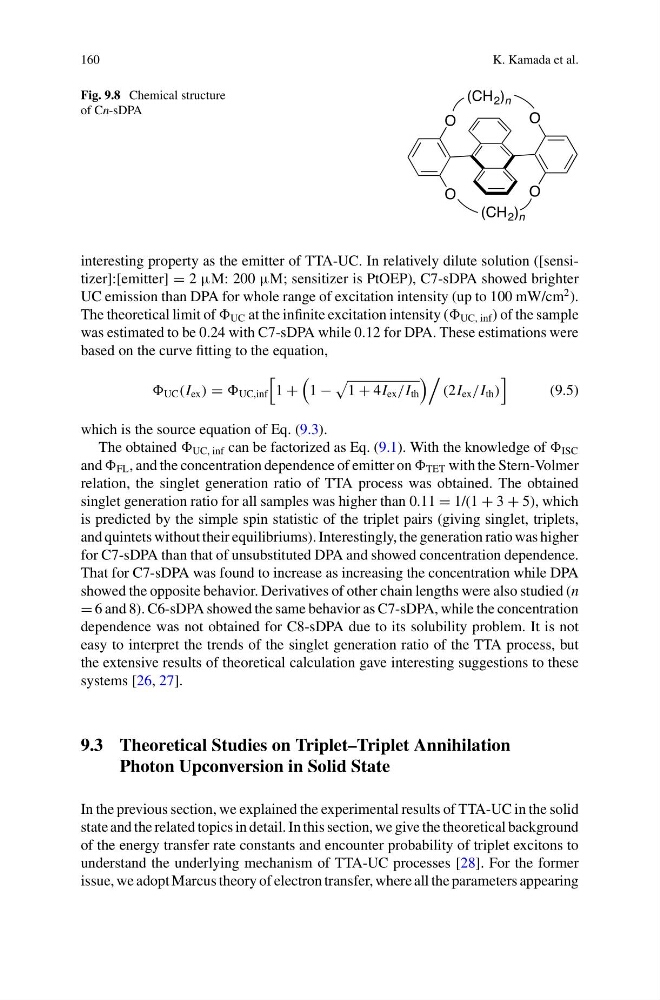
Fig. 9.8 Chemical structure
of Cn-sDPA
interesting property as the emitter of TTA-UC. In relatively dilute solution ([sensitizer]:[emitter] = 2 μM: 200 μM; sensitizer is PtOEP), C7-sDPA showed brighter
UC emission than DPA for whole range of excitation intensity (up to 100 mW/cm
2 ).
The theoretical limit of UC at the infinite excitation intensity ( UC, inf ) of the sample
was estimated to be 0.24 with C7-sDPA while 0.12 for DPA. These estimations were
based on the curve fitting to the equation,
UC (I ex ) = UC,inf
1 +
1 −
1 + 4I ex /I th
(2I ex /I th )
(9.5)
which is the source equation of Eq. (9.3).
The obtained UC, inf can be factorized as Eq. (9.1). With the knowledge of ISC
and FL , and the concentration dependence of emitter on TET with the Stern-Volmer
relation, the singlet generation ratio of TTA process was obtained. The obtained
singlet generation ratio for all samples was higher than 0.11 = 1/(1 + 3 + 5), which
is predicted by the simple spin statistic of the triplet pairs (giving singlet, triplets,
and quintets without their equilibriums). Interestingly, the generation ratio was higher
for C7-sDPA than that of unsubstituted DPA and showed concentration dependence.
That for C7-sDPA was found to increase as increasing the concentration while DPA
showed the opposite behavior. Derivatives of other chain lengths were also studied (n
= 6 and 8). C6-sDPA showed the same behavior as C7-sDPA, while the concentration
dependence was not obtained for C8-sDPA due to its solubility problem. It is not
easy to interpret the trends of the singlet generation ratio of the TTA process, but
the extensive results of theoretical calculation gave interesting suggestions to these
systems [26, 27].
9.3 Theoretical Studies on Triplet–Triplet Annihilation
Photon Upconversion in Solid State
In the previous section, we explained the experimental results of TTA-UC in the solid
state and the related topics in detail. In this section, we give the theoretical background
of the energy transfer rate constants and encounter probability of triplet excitons to
understand the underlying mechanism of TTA-UC processes [28]. For the former
issue, we adopt Marcus theory of electron transfer, where all the parameters appearing
K. Kamada et al.
Fig. 9.8 Chemical structure
of Cn-sDPA
interesting property as the emitter of TTA-UC. In relatively dilute solution ([sensitizer]:[emitter] = 2 μM: 200 μM; sensitizer is PtOEP), C7-sDPA showed brighter
UC emission than DPA for whole range of excitation intensity (up to 100 mW/cm
2 ).
The theoretical limit of UC at the infinite excitation intensity ( UC, inf ) of the sample
was estimated to be 0.24 with C7-sDPA while 0.12 for DPA. These estimations were
based on the curve fitting to the equation,
UC (I ex ) = UC,inf
1 +
1 −
1 + 4I ex /I th
(2I ex /I th )
(9.5)
which is the source equation of Eq. (9.3).
The obtained UC, inf can be factorized as Eq. (9.1). With the knowledge of ISC
and FL , and the concentration dependence of emitter on TET with the Stern-Volmer
relation, the singlet generation ratio of TTA process was obtained. The obtained
singlet generation ratio for all samples was higher than 0.11 = 1/(1 + 3 + 5), which
is predicted by the simple spin statistic of the triplet pairs (giving singlet, triplets,
and quintets without their equilibriums). Interestingly, the generation ratio was higher
for C7-sDPA than that of unsubstituted DPA and showed concentration dependence.
That for C7-sDPA was found to increase as increasing the concentration while DPA
showed the opposite behavior. Derivatives of other chain lengths were also studied (n
= 6 and 8). C6-sDPA showed the same behavior as C7-sDPA, while the concentration
dependence was not obtained for C8-sDPA due to its solubility problem. It is not
easy to interpret the trends of the singlet generation ratio of the TTA process, but
the extensive results of theoretical calculation gave interesting suggestions to these
systems [26, 27].
9.3 Theoretical Studies on Triplet–Triplet Annihilation
Photon Upconversion in Solid State
In the previous section, we explained the experimental results of TTA-UC in the solid
state and the related topics in detail. In this section, we give the theoretical background
of the energy transfer rate constants and encounter probability of triplet excitons to
understand the underlying mechanism of TTA-UC processes [28]. For the former
issue, we adopt Marcus theory of electron transfer, where all the parameters appearing