

9 Photosynergetic Effects on Triplet–Triplet Annihilation …
159
a)
b)
c)
0
0.05
0.1
0.15
0.2
0.25
0.3
0.0001
0.001
0.01
Concentration / M
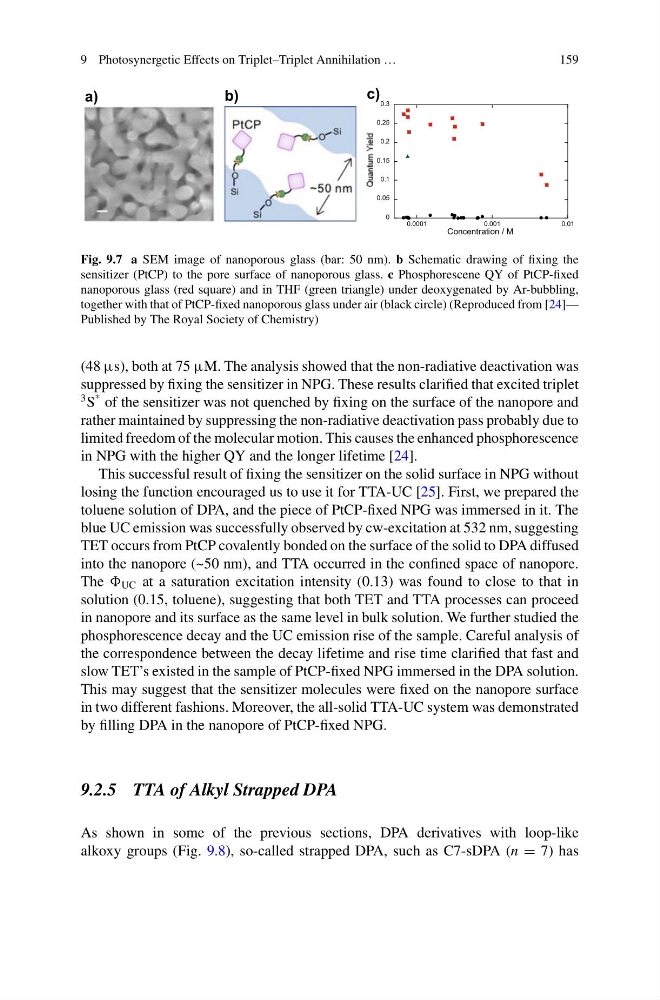
Fig. 9.7 a SEM image of nanoporous glass (bar: 50 nm). b Schematic drawing of fixing the
sensitizer (PtCP) to the pore surface of nanoporous glass. c Phosphorescene QY of PtCP-fixed
nanoporous glass (red square) and in THF (green triangle) under deoxygenated by Ar-bubbling,
together with that of PtCP-fixed nanoporous glass under air (black circle) (Reproduced from [24]—
Published by The Royal Society of Chemistry)
(48 μs), both at 75 μM. The analysis showed that the non-radiative deactivation was
suppressed by fixing the sensitizer in NPG. These results clarified that excited triplet
3 S
* of the sensitizer was not quenched by fixing on the surface of the nanopore and
rather maintained by suppressing the non-radiative deactivation pass probably due to
limited freedom of the molecular motion. This causes the enhanced phosphorescence
in NPG with the higher QY and the longer lifetime [24].
This successful result of fixing the sensitizer on the solid surface in NPG without
losing the function encouraged us to use it for TTA-UC [25]. First, we prepared the
toluene solution of DPA, and the piece of PtCP-fixed NPG was immersed in it. The
blue UC emission was successfully observed by cw-excitation at 532 nm, suggesting
TET occurs from PtCP covalently bonded on the surface of the solid to DPA diffused
into the nanopore (~50 nm), and TTA occurred in the confined space of nanopore.
The UC at a saturation excitation intensity (0.13) was found to close to that in
solution (0.15, toluene), suggesting that both TET and TTA processes can proceed
in nanopore and its surface as the same level in bulk solution. We further studied the
phosphorescence decay and the UC emission rise of the sample. Careful analysis of
the correspondence between the decay lifetime and rise time clarified that fast and
slow TET’s existed in the sample of PtCP-fixed NPG immersed in the DPA solution.
This may suggest that the sensitizer molecules were fixed on the nanopore surface
in two different fashions. Moreover, the all-solid TTA-UC system was demonstrated
by filling DPA in the nanopore of PtCP-fixed NPG.
9.2.5 TTA of Alkyl Strapped DPA
As shown in some of the previous sections, DPA derivatives with loop-like
alkoxy groups (Fig. 9.8), so-called strapped DPA, such as C7-sDPA (n = 7) has
159
a)
b)
c)
0
0.05
0.1
0.15
0.2
0.25
0.3
0.0001
0.001
0.01
Concentration / M
Fig. 9.7 a SEM image of nanoporous glass (bar: 50 nm). b Schematic drawing of fixing the
sensitizer (PtCP) to the pore surface of nanoporous glass. c Phosphorescene QY of PtCP-fixed
nanoporous glass (red square) and in THF (green triangle) under deoxygenated by Ar-bubbling,
together with that of PtCP-fixed nanoporous glass under air (black circle) (Reproduced from [24]—
Published by The Royal Society of Chemistry)
(48 μs), both at 75 μM. The analysis showed that the non-radiative deactivation was
suppressed by fixing the sensitizer in NPG. These results clarified that excited triplet
3 S
* of the sensitizer was not quenched by fixing on the surface of the nanopore and
rather maintained by suppressing the non-radiative deactivation pass probably due to
limited freedom of the molecular motion. This causes the enhanced phosphorescence
in NPG with the higher QY and the longer lifetime [24].
This successful result of fixing the sensitizer on the solid surface in NPG without
losing the function encouraged us to use it for TTA-UC [25]. First, we prepared the
toluene solution of DPA, and the piece of PtCP-fixed NPG was immersed in it. The
blue UC emission was successfully observed by cw-excitation at 532 nm, suggesting
TET occurs from PtCP covalently bonded on the surface of the solid to DPA diffused
into the nanopore (~50 nm), and TTA occurred in the confined space of nanopore.
The UC at a saturation excitation intensity (0.13) was found to close to that in
solution (0.15, toluene), suggesting that both TET and TTA processes can proceed
in nanopore and its surface as the same level in bulk solution. We further studied the
phosphorescence decay and the UC emission rise of the sample. Careful analysis of
the correspondence between the decay lifetime and rise time clarified that fast and
slow TET’s existed in the sample of PtCP-fixed NPG immersed in the DPA solution.
This may suggest that the sensitizer molecules were fixed on the nanopore surface
in two different fashions. Moreover, the all-solid TTA-UC system was demonstrated
by filling DPA in the nanopore of PtCP-fixed NPG.
9.2.5 TTA of Alkyl Strapped DPA
As shown in some of the previous sections, DPA derivatives with loop-like
alkoxy groups (Fig. 9.8), so-called strapped DPA, such as C7-sDPA (n = 7) has