

162
K. Kamada et al.
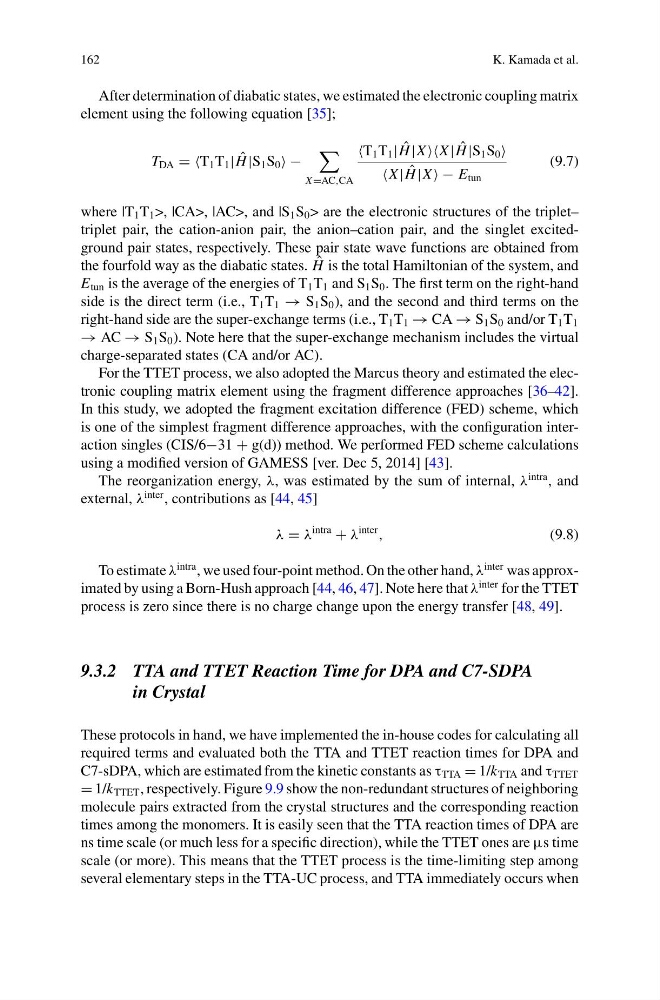
After determination of diabatic states, we estimated the electronic coupling matrix
element using the following equation [35];
T DA = T 1 T 1 | ˆ
H |S 1 S 0 −
X =AC,CA
T 1 T 1 | ˆ
H |X X | ˆ
H |S 1 S 0
X | ˆ
H |X − E tun
(9.7)
where |T 1 T 1 >, |CA>, |AC>, and |S 1 S 0 > are the electronic structures of the triplet–
triplet pair, the cation-anion pair, the anion–cation pair, and the singlet excitedground pair states, respectively. These pair state wave functions are obtained from
the fourfold way as the diabatic states. ˆ
H is the total Hamiltonian of the system, and
E tun is the average of the energies of T 1 T 1 and S 1 S 0 . The first term on the right-hand
side is the direct term (i.e., T 1 T 1 → S 1 S 0 ), and the second and third terms on the
right-hand side are the super-exchange terms (i.e., T 1 T 1 → CA → S 1 S 0 and/or T 1 T 1
→ AC → S 1 S 0 ). Note here that the super-exchange mechanism includes the virtual
charge-separated states (CA and/or AC).
For the TTET process, we also adopted the Marcus theory and estimated the electronic coupling matrix element using the fragment difference approaches [36–42].
In this study, we adopted the fragment excitation difference (FED) scheme, which
is one of the simplest fragment difference approaches, with the configuration interaction singles (CIS/6−31 + g(d)) method. We performed FED scheme calculations
using a modified version of GAMESS [ver. Dec 5, 2014] [43].
The reorganization energy, λ, was estimated by the sum of internal, λ
intra , and
external, λ
inter , contributions as [44, 45]
λ = λ
intra
+ λ
inter
,
(9.8)
To estimate λ
intra , we used four-point method. On the other hand, λ
inter was approximated by using a Born-Hush approach [44, 46, 47]. Note here that λ
inter for the TTET
process is zero since there is no charge change upon the energy transfer [48, 49].
9.3.2 TTA and TTET Reaction Time for DPA and C7-SDPA
in Crystal
These protocols in hand, we have implemented the in-house codes for calculating all
required terms and evaluated both the TTA and TTET reaction times for DPA and
C7-sDPA, which are estimated from the kinetic constants as τ TTA = 1/k TTA and τ TTET
= 1/k TTET , respectively. Figure 9.9 show the non-redundant structures of neighboring
molecule pairs extracted from the crystal structures and the corresponding reaction
times among the monomers. It is easily seen that the TTA reaction times of DPA are
ns time scale (or much less for a specific direction), while the TTET ones are μs time
scale (or more). This means that the TTET process is the time-limiting step among
several elementary steps in the TTA-UC process, and TTA immediately occurs when
K. Kamada et al.
After determination of diabatic states, we estimated the electronic coupling matrix
element using the following equation [35];
T DA = T 1 T 1 | ˆ
H |S 1 S 0 −
X =AC,CA
T 1 T 1 | ˆ
H |X X | ˆ
H |S 1 S 0
X | ˆ
H |X − E tun
(9.7)
where |T 1 T 1 >, |CA>, |AC>, and |S 1 S 0 > are the electronic structures of the triplet–
triplet pair, the cation-anion pair, the anion–cation pair, and the singlet excitedground pair states, respectively. These pair state wave functions are obtained from
the fourfold way as the diabatic states. ˆ
H is the total Hamiltonian of the system, and
E tun is the average of the energies of T 1 T 1 and S 1 S 0 . The first term on the right-hand
side is the direct term (i.e., T 1 T 1 → S 1 S 0 ), and the second and third terms on the
right-hand side are the super-exchange terms (i.e., T 1 T 1 → CA → S 1 S 0 and/or T 1 T 1
→ AC → S 1 S 0 ). Note here that the super-exchange mechanism includes the virtual
charge-separated states (CA and/or AC).
For the TTET process, we also adopted the Marcus theory and estimated the electronic coupling matrix element using the fragment difference approaches [36–42].
In this study, we adopted the fragment excitation difference (FED) scheme, which
is one of the simplest fragment difference approaches, with the configuration interaction singles (CIS/6−31 + g(d)) method. We performed FED scheme calculations
using a modified version of GAMESS [ver. Dec 5, 2014] [43].
The reorganization energy, λ, was estimated by the sum of internal, λ
intra , and
external, λ
inter , contributions as [44, 45]
λ = λ
intra
+ λ
inter
,
(9.8)
To estimate λ
intra , we used four-point method. On the other hand, λ
inter was approximated by using a Born-Hush approach [44, 46, 47]. Note here that λ
inter for the TTET
process is zero since there is no charge change upon the energy transfer [48, 49].
9.3.2 TTA and TTET Reaction Time for DPA and C7-SDPA
in Crystal
These protocols in hand, we have implemented the in-house codes for calculating all
required terms and evaluated both the TTA and TTET reaction times for DPA and
C7-sDPA, which are estimated from the kinetic constants as τ TTA = 1/k TTA and τ TTET
= 1/k TTET , respectively. Figure 9.9 show the non-redundant structures of neighboring
molecule pairs extracted from the crystal structures and the corresponding reaction
times among the monomers. It is easily seen that the TTA reaction times of DPA are
ns time scale (or much less for a specific direction), while the TTET ones are μs time
scale (or more). This means that the TTET process is the time-limiting step among
several elementary steps in the TTA-UC process, and TTA immediately occurs when