

156
K. Kamada et al.
80 °C and may easily melt by mixing with not only PtOEP but also impurities of
oligomers in THF solvent. The microdroplets also showed UC emission under air like
the microcrystals of the other three samples. This may be due to the high viscosity
of the liquid. The I th and UC at the saturation intensity were also characterized for
all samples obtained by the casting. The values of I th for the samples were between
those of PtOEP:C7-sDPA and PtOEP:DPA and tended to be lower for C7-sDPA
derivatives (2p and 2a) than for DPA derivatives (1p and 1a). The binary solid with
2a found to have a comparable value of UC with PtOEP:C7-sDPA, but the others
were in the order of a few percent. These results suggested that C7-sDPA and its
derivatives (2p and 2a) tended to show better TTA-UC performance through the low
I th and relatively high UC at the saturation intensity.
9.2.3 TTA-UC in Binary Solid from Near-Infrared
The rapid-drying casting technique was also applied for fabricating the binary solid
that enables to convert light from near-infrared (NIR) to visible wavelengths [19].
Extending the excitation wavelength to the NIR region is important for the application
such as solar cell. However, NIR-to-Vis conversion by TTA-UC in condensed solids
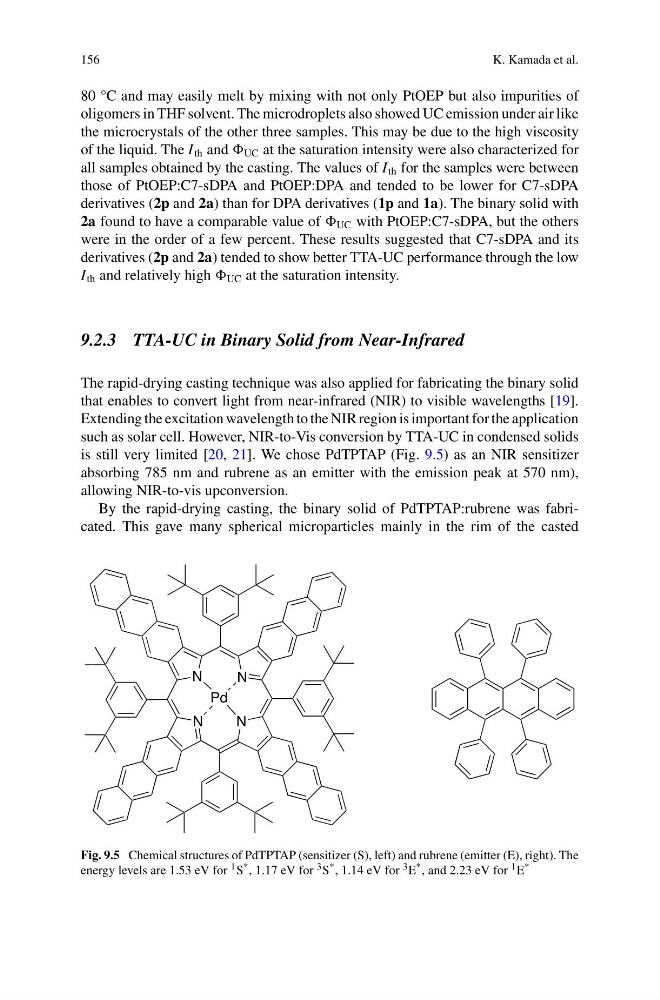
is still very limited [20, 21]. We chose PdTPTAP (Fig. 9.5) as an NIR sensitizer
absorbing 785 nm and rubrene as an emitter with the emission peak at 570 nm),
allowing NIR-to-vis upconversion.
By the rapid-drying casting, the binary solid of PdTPTAP:rubrene was fabricated. This gave many spherical microparticles mainly in the rim of the casted
Fig. 9.5 Chemical structures of PdTPTAP (sensitizer (S), left) and rubrene (emitter (E), right). The
energy levels are 1.53 eV for 1 S * , 1.17 eV for 3 S * , 1.14 eV for 3 E * , and 2.23 eV for 1 E *
K. Kamada et al.
80 °C and may easily melt by mixing with not only PtOEP but also impurities of
oligomers in THF solvent. The microdroplets also showed UC emission under air like
the microcrystals of the other three samples. This may be due to the high viscosity
of the liquid. The I th and UC at the saturation intensity were also characterized for
all samples obtained by the casting. The values of I th for the samples were between
those of PtOEP:C7-sDPA and PtOEP:DPA and tended to be lower for C7-sDPA
derivatives (2p and 2a) than for DPA derivatives (1p and 1a). The binary solid with
2a found to have a comparable value of UC with PtOEP:C7-sDPA, but the others
were in the order of a few percent. These results suggested that C7-sDPA and its
derivatives (2p and 2a) tended to show better TTA-UC performance through the low
I th and relatively high UC at the saturation intensity.
9.2.3 TTA-UC in Binary Solid from Near-Infrared
The rapid-drying casting technique was also applied for fabricating the binary solid
that enables to convert light from near-infrared (NIR) to visible wavelengths [19].
Extending the excitation wavelength to the NIR region is important for the application
such as solar cell. However, NIR-to-Vis conversion by TTA-UC in condensed solids
is still very limited [20, 21]. We chose PdTPTAP (Fig. 9.5) as an NIR sensitizer
absorbing 785 nm and rubrene as an emitter with the emission peak at 570 nm),
allowing NIR-to-vis upconversion.
By the rapid-drying casting, the binary solid of PdTPTAP:rubrene was fabricated. This gave many spherical microparticles mainly in the rim of the casted
Fig. 9.5 Chemical structures of PdTPTAP (sensitizer (S), left) and rubrene (emitter (E), right). The
energy levels are 1.53 eV for 1 S * , 1.17 eV for 3 S * , 1.14 eV for 3 E * , and 2.23 eV for 1 E *