

9 Photosynergetic Effects on Triplet–Triplet Annihilation …
157
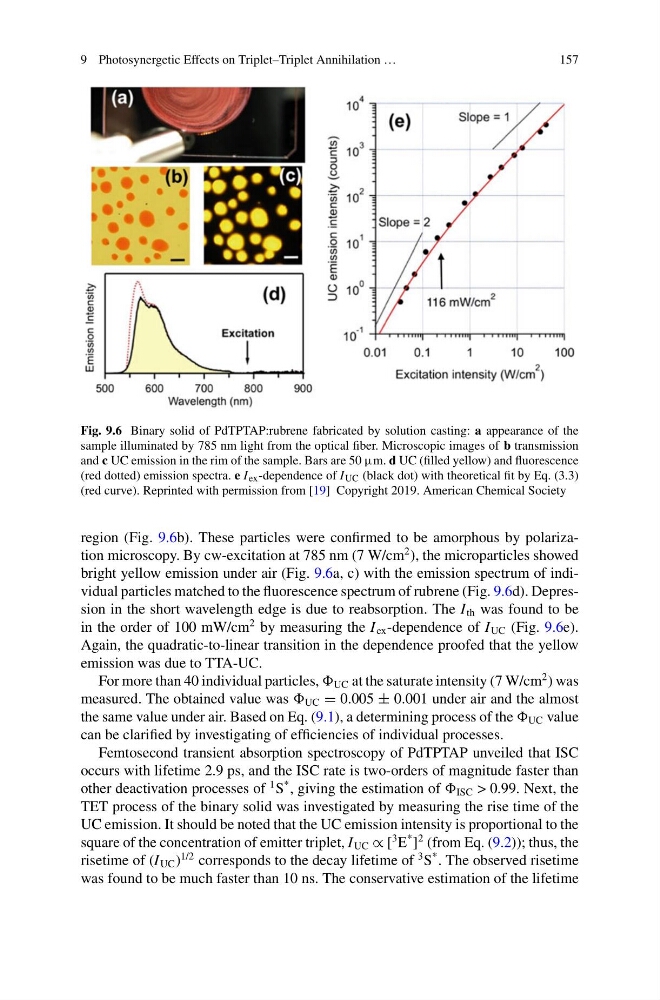
Fig. 9.6 Binary solid of PdTPTAP:rubrene fabricated by solution casting: a appearance of the
sample illuminated by 785 nm light from the optical fiber. Microscopic images of b transmission
and c UC emission in the rim of the sample. Bars are 50 μm. d UC (filled yellow) and fluorescence
(red dotted) emission spectra. e I ex -dependence of I UC (black dot) with theoretical fit by Eq. (3.3)
(red curve). Reprinted with permission from [19] Copyright 2019. American Chemical Society
region (Fig. 9.6b). These particles were confirmed to be amorphous by polarization microscopy. By cw-excitation at 785 nm (7 W/cm
2 ), the microparticles showed
bright yellow emission under air (Fig. 9.6a, c) with the emission spectrum of individual particles matched to the fluorescence spectrum of rubrene (Fig. 9.6d). Depression in the short wavelength edge is due to reabsorption. The I th was found to be
in the order of 100 mW/cm
2 by measuring the I ex -dependence of I UC (Fig. 9.6e).
Again, the quadratic-to-linear transition in the dependence proofed that the yellow
emission was due to TTA-UC.
For more than 40 individual particles, UC at the saturate intensity (7 W/cm
2 ) was
measured. The obtained value was UC = 0.005 ± 0.001 under air and the almost
the same value under air. Based on Eq. (9.1), a determining process of the UC value
can be clarified by investigating of efficiencies of individual processes.
Femtosecond transient absorption spectroscopy of PdTPTAP unveiled that ISC
occurs with lifetime 2.9 ps, and the ISC rate is two-orders of magnitude faster than
other deactivation processes of
1 S
* , giving the estimation of ISC > 0.99. Next, the
TET process of the binary solid was investigated by measuring the rise time of the
UC emission. It should be noted that the UC emission intensity is proportional to the
square of the concentration of emitter triplet, I UC ∝ [
3 E
* ]
2 (from Eq. (9.2)); thus, the
risetime of (I UC )
1/2 corresponds to the decay lifetime of
3 S
* . The observed risetime
was found to be much faster than 10 ns. The conservative estimation of the lifetime
157
Fig. 9.6 Binary solid of PdTPTAP:rubrene fabricated by solution casting: a appearance of the
sample illuminated by 785 nm light from the optical fiber. Microscopic images of b transmission
and c UC emission in the rim of the sample. Bars are 50 μm. d UC (filled yellow) and fluorescence
(red dotted) emission spectra. e I ex -dependence of I UC (black dot) with theoretical fit by Eq. (3.3)
(red curve). Reprinted with permission from [19] Copyright 2019. American Chemical Society
region (Fig. 9.6b). These particles were confirmed to be amorphous by polarization microscopy. By cw-excitation at 785 nm (7 W/cm
2 ), the microparticles showed
bright yellow emission under air (Fig. 9.6a, c) with the emission spectrum of individual particles matched to the fluorescence spectrum of rubrene (Fig. 9.6d). Depression in the short wavelength edge is due to reabsorption. The I th was found to be
in the order of 100 mW/cm
2 by measuring the I ex -dependence of I UC (Fig. 9.6e).
Again, the quadratic-to-linear transition in the dependence proofed that the yellow
emission was due to TTA-UC.
For more than 40 individual particles, UC at the saturate intensity (7 W/cm
2 ) was
measured. The obtained value was UC = 0.005 ± 0.001 under air and the almost
the same value under air. Based on Eq. (9.1), a determining process of the UC value
can be clarified by investigating of efficiencies of individual processes.
Femtosecond transient absorption spectroscopy of PdTPTAP unveiled that ISC
occurs with lifetime 2.9 ps, and the ISC rate is two-orders of magnitude faster than
other deactivation processes of
1 S
* , giving the estimation of ISC > 0.99. Next, the
TET process of the binary solid was investigated by measuring the rise time of the
UC emission. It should be noted that the UC emission intensity is proportional to the
square of the concentration of emitter triplet, I UC ∝ [
3 E
* ]
2 (from Eq. (9.2)); thus, the
risetime of (I UC )
1/2 corresponds to the decay lifetime of
3 S
* . The observed risetime
was found to be much faster than 10 ns. The conservative estimation of the lifetime