

9 Photosynergetic Effects on Triplet–Triplet Annihilation …
155
still aggregated in some degree in those of PtOEP:DPA. These results were supported
by the high magnification spectrographic images of the upconverted emission of the
microparticles. Microparticles of PtOEP:C7-sDPA have uniformly emitted the UC
emission while that of PtOEP:DPA had some bright cores of UC emission. Thus,
aggregation of sensitizer was prevented by the rapid-drying casting technique, but
the degree was different between the emitters and affected the rate of the TET and
the efficiency. Another interesting feature was that triplet diffusion length C7-sDPA
in the crystal was estimated to be ~230 nm from the decay of the UC emission. This
value is much longer than the nanometer-sized grain structure (20–50 nm) of the
microparticle of PtOEP:C7–sDPA and can also enhance TTA process by increasing
the encounters.
9.2.2 Binary Solid with Various Alkyl-Chain-Attached DPAs
As shown in the previous section, the rapid-drying casting technique enables efficient
TTA-UC in binary solid by preventing the segregation of sensitizer and accelerating
the TET process. The addition of loop-like alkoxy groups in C7-sDPA may contribute
to enhance the compatibility with PtOEP. To understand the effect of the introduction
of alkyl chain to sensitizer molecule, we fabricated binary solids and investigated
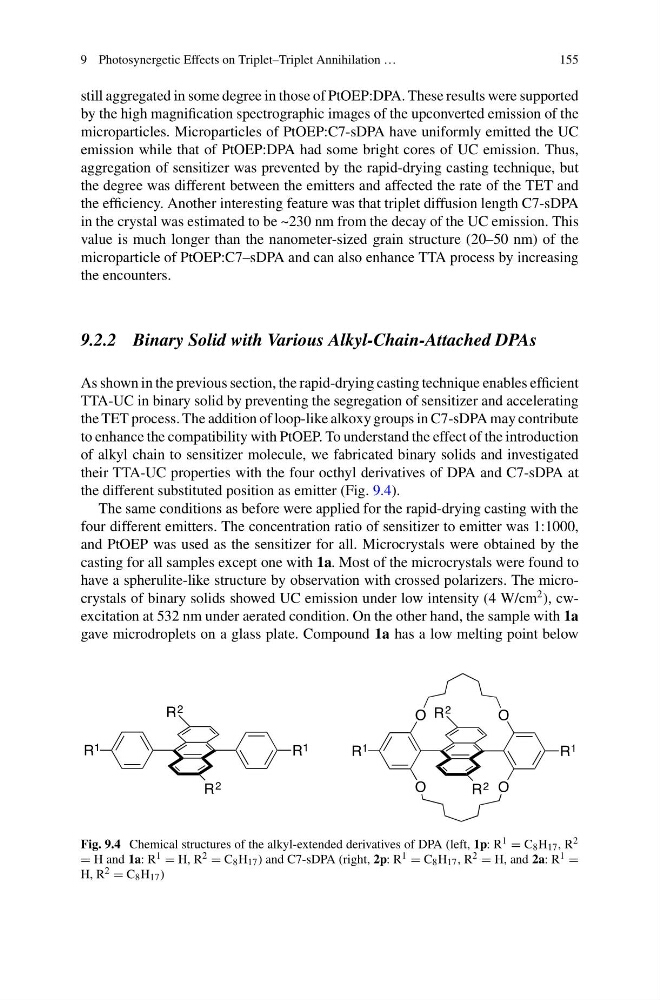
their TTA-UC properties with the four octhyl derivatives of DPA and C7-sDPA at
the different substituted position as emitter (Fig. 9.4).
The same conditions as before were applied for the rapid-drying casting with the
four different emitters. The concentration ratio of sensitizer to emitter was 1:1000,
and PtOEP was used as the sensitizer for all. Microcrystals were obtained by the
casting for all samples except one with 1a. Most of the microcrystals were found to
have a spherulite-like structure by observation with crossed polarizers. The microcrystals of binary solids showed UC emission under low intensity (4 W/cm
2 ), cwexcitation at 532 nm under aerated condition. On the other hand, the sample with 1a
gave microdroplets on a glass plate. Compound 1a has a low melting point below
Fig. 9.4 Chemical structures of the alkyl-extended derivatives of DPA (left, 1p: R 1 = C 8 H 17 , R 2
= H and 1a: R 1 = H, R 2 = C 8 H 17 ) and C7-sDPA (right, 2p: R 1 = C 8 H 17 , R 2 = H, and 2a: R 1 =
H, R 2 = C 8 H 17 )
155
still aggregated in some degree in those of PtOEP:DPA. These results were supported
by the high magnification spectrographic images of the upconverted emission of the
microparticles. Microparticles of PtOEP:C7-sDPA have uniformly emitted the UC
emission while that of PtOEP:DPA had some bright cores of UC emission. Thus,
aggregation of sensitizer was prevented by the rapid-drying casting technique, but
the degree was different between the emitters and affected the rate of the TET and
the efficiency. Another interesting feature was that triplet diffusion length C7-sDPA
in the crystal was estimated to be ~230 nm from the decay of the UC emission. This
value is much longer than the nanometer-sized grain structure (20–50 nm) of the
microparticle of PtOEP:C7–sDPA and can also enhance TTA process by increasing
the encounters.
9.2.2 Binary Solid with Various Alkyl-Chain-Attached DPAs
As shown in the previous section, the rapid-drying casting technique enables efficient
TTA-UC in binary solid by preventing the segregation of sensitizer and accelerating
the TET process. The addition of loop-like alkoxy groups in C7-sDPA may contribute
to enhance the compatibility with PtOEP. To understand the effect of the introduction
of alkyl chain to sensitizer molecule, we fabricated binary solids and investigated
their TTA-UC properties with the four octhyl derivatives of DPA and C7-sDPA at
the different substituted position as emitter (Fig. 9.4).
The same conditions as before were applied for the rapid-drying casting with the
four different emitters. The concentration ratio of sensitizer to emitter was 1:1000,
and PtOEP was used as the sensitizer for all. Microcrystals were obtained by the
casting for all samples except one with 1a. Most of the microcrystals were found to
have a spherulite-like structure by observation with crossed polarizers. The microcrystals of binary solids showed UC emission under low intensity (4 W/cm
2 ), cwexcitation at 532 nm under aerated condition. On the other hand, the sample with 1a
gave microdroplets on a glass plate. Compound 1a has a low melting point below
Fig. 9.4 Chemical structures of the alkyl-extended derivatives of DPA (left, 1p: R 1 = C 8 H 17 , R 2
= H and 1a: R 1 = H, R 2 = C 8 H 17 ) and C7-sDPA (right, 2p: R 1 = C 8 H 17 , R 2 = H, and 2a: R 1 =
H, R 2 = C 8 H 17 )