

150
K. Kamada et al.
singlet (
1 E
* ), which emits a photon that has higher energy than that of incident
photon as fluorescence (FL). Thus, the UC emission is obtained as DF. Of the four
sequential processes (ISC, TET, TTA, FL) consisting of the overall TTA-UC process
after excitation.
The quantum yield of UC emission ( UC ), one of the important parameters of
TTA-UC, can be defined as the number of photons emitted per photon absorbed. This
definition gives 0.5 as the theoretical maximum. However, another definition, where
the value is multiplied by a factor of 2, is often used to scale to unity for full conversion. Here we use the latter convention (i.e., UC = 1 for full conversion). Under
this convention, UC can be represented as the product of the quantum efficiencies
of the four-element processes:
UC = ISC TET TTA FL
(9.1)
In this equation, ISC and FL depend on the molecular property of sensitizer and
emitter, respectively. On the other hand, TET and TTA are based on bimolecular
processes (TET and TTA) and thus depend not only on their molecular properties but also their mutual distance, orientation, and others that relate intermolecular
interaction.
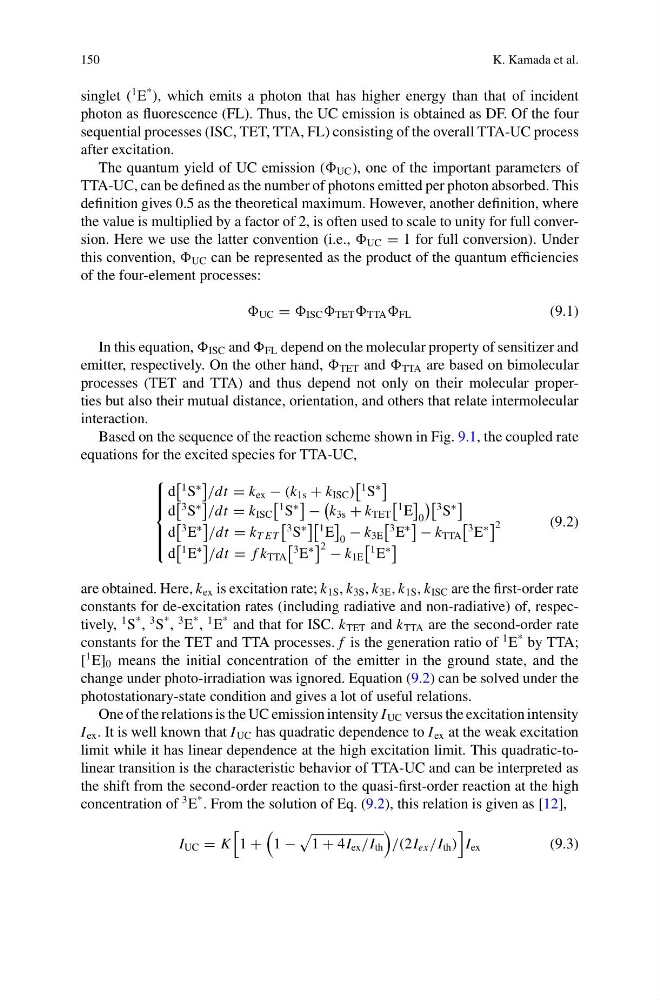
Based on the sequence of the reaction scheme shown in Fig. 9.1, the coupled rate
equations for the excited species for TTA-UC,
⎧
⎪ ⎪ ⎪ ⎨
⎪ ⎪ ⎪ ⎩
d
1 S
∗
/dt = k ex − (k 1s + k ISC )
1 S
∗
d
3 S
∗
/dt = k ISC
1 S
∗
−
k 3s + k TET
1 E
0
3 S
∗
d
3 E
∗
/dt = k T ET
3 S
∗
1 E
0
− k 3E
3 E
∗
− k TTA
3 E
∗
2
d
1 E
∗
/dt = f k TTA
3 E
∗
2 − k 1E
1 E
∗
(9.2)
are obtained. Here, k ex is excitation rate; k 1S , k 3S , k 3E , k 1S , k ISC are the first-order rate
constants for de-excitation rates (including radiative and non-radiative) of, respectively,
1 S
* ,
3 S
* ,
3 E
* ,
1 E
* and that for ISC. k TET and k TTA are the second-order rate
constants for the TET and TTA processes. f is the generation ratio of
1 E
* by TTA;
[
1 E] 0 means the initial concentration of the emitter in the ground state, and the
change under photo-irradiation was ignored. Equation (9.2) can be solved under the
photostationary-state condition and gives a lot of useful relations.
One of the relations is the UC emission intensity I UC versus the excitation intensity
I ex . It is well known that I UC has quadratic dependence to I ex at the weak excitation
limit while it has linear dependence at the high excitation limit. This quadratic-tolinear transition is the characteristic behavior of TTA-UC and can be interpreted as
the shift from the second-order reaction to the quasi-first-order reaction at the high
concentration of
3 E
* . From the solution of Eq. (9.2), this relation is given as [12],
I UC = K
1 +
1 −
1 + 4I ex /I th
/(2I ex /I th )
I ex
(9.3)
K. Kamada et al.
singlet (
1 E
* ), which emits a photon that has higher energy than that of incident
photon as fluorescence (FL). Thus, the UC emission is obtained as DF. Of the four
sequential processes (ISC, TET, TTA, FL) consisting of the overall TTA-UC process
after excitation.
The quantum yield of UC emission ( UC ), one of the important parameters of
TTA-UC, can be defined as the number of photons emitted per photon absorbed. This
definition gives 0.5 as the theoretical maximum. However, another definition, where
the value is multiplied by a factor of 2, is often used to scale to unity for full conversion. Here we use the latter convention (i.e., UC = 1 for full conversion). Under
this convention, UC can be represented as the product of the quantum efficiencies
of the four-element processes:
UC = ISC TET TTA FL
(9.1)
In this equation, ISC and FL depend on the molecular property of sensitizer and
emitter, respectively. On the other hand, TET and TTA are based on bimolecular
processes (TET and TTA) and thus depend not only on their molecular properties but also their mutual distance, orientation, and others that relate intermolecular
interaction.
Based on the sequence of the reaction scheme shown in Fig. 9.1, the coupled rate
equations for the excited species for TTA-UC,
⎧
⎪ ⎪ ⎪ ⎨
⎪ ⎪ ⎪ ⎩
d
1 S
∗
/dt = k ex − (k 1s + k ISC )
1 S
∗
d
3 S
∗
/dt = k ISC
1 S
∗
−
k 3s + k TET
1 E
0
3 S
∗
d
3 E
∗
/dt = k T ET
3 S
∗
1 E
0
− k 3E
3 E
∗
− k TTA
3 E
∗
2
d
1 E
∗
/dt = f k TTA
3 E
∗
2 − k 1E
1 E
∗
(9.2)
are obtained. Here, k ex is excitation rate; k 1S , k 3S , k 3E , k 1S , k ISC are the first-order rate
constants for de-excitation rates (including radiative and non-radiative) of, respectively,
1 S
* ,
3 S
* ,
3 E
* ,
1 E
* and that for ISC. k TET and k TTA are the second-order rate
constants for the TET and TTA processes. f is the generation ratio of
1 E
* by TTA;
[
1 E] 0 means the initial concentration of the emitter in the ground state, and the
change under photo-irradiation was ignored. Equation (9.2) can be solved under the
photostationary-state condition and gives a lot of useful relations.
One of the relations is the UC emission intensity I UC versus the excitation intensity
I ex . It is well known that I UC has quadratic dependence to I ex at the weak excitation
limit while it has linear dependence at the high excitation limit. This quadratic-tolinear transition is the characteristic behavior of TTA-UC and can be interpreted as
the shift from the second-order reaction to the quasi-first-order reaction at the high
concentration of
3 E
* . From the solution of Eq. (9.2), this relation is given as [12],
I UC = K
1 +
1 −
1 + 4I ex /I th
/(2I ex /I th )
I ex
(9.3)