

9 Photosynergetic Effects on Triplet–Triplet Annihilation …
149
TTA process with new molecules in solution and condensed solid, particularly binary
solid as dense solid consisting of chromophores. Since the pages are limited in this
chapter, in the following parts, we will describe the results obtained for TTA-UC in
solid. We will start with the general background of TTA-UC.
9.1.2 Basic Mechanism of Triplet–Triplet Annihilation
Upconversion (TTA-UC)
As described before, TTA, also called as Triplet Fission (TF), is the reverse process
of SF. Once, it was known as an annoying process that quenches triplet state useful
for various photochemical reactions. TTA also caused delayed fluorescence (DF),
i.e., P-type (pyrene-type) DF, which has also been known since the early 1960s [9]
including triplet–sensitized DF [10]. The DF, however, had been generally recognized
as a fancy and rare event of the photophysical process until Castellano and coworkers
found the potential of the process for low-intensity photon upconversion (UC) [11].
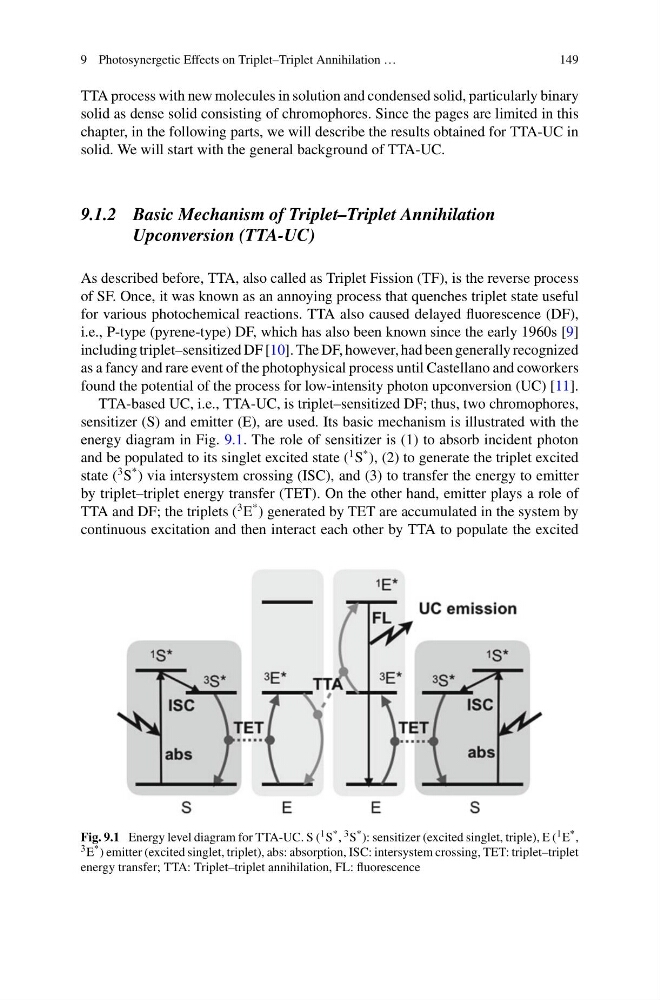
TTA-based UC, i.e., TTA-UC, is triplet–sensitized DF; thus, two chromophores,
sensitizer (S) and emitter (E), are used. Its basic mechanism is illustrated with the
energy diagram in Fig. 9.1. The role of sensitizer is (1) to absorb incident photon
and be populated to its singlet excited state (
1 S
* ), (2) to generate the triplet excited
state (
3 S
* ) via intersystem crossing (ISC), and (3) to transfer the energy to emitter
by triplet–triplet energy transfer (TET). On the other hand, emitter plays a role of
TTA and DF; the triplets (
3 E
* ) generated by TET are accumulated in the system by
continuous excitation and then interact each other by TTA to populate the excited
Fig. 9.1 Energy level diagram for TTA-UC. S ( 1 S * , 3 S * ): sensitizer (excited singlet, triple), E ( 1 E * ,
3 E * ) emitter (excited singlet, triplet), abs: absorption, ISC: intersystem crossing, TET: triplet–triplet
energy transfer; TTA: Triplet–triplet annihilation, FL: fluorescence
149
TTA process with new molecules in solution and condensed solid, particularly binary
solid as dense solid consisting of chromophores. Since the pages are limited in this
chapter, in the following parts, we will describe the results obtained for TTA-UC in
solid. We will start with the general background of TTA-UC.
9.1.2 Basic Mechanism of Triplet–Triplet Annihilation
Upconversion (TTA-UC)
As described before, TTA, also called as Triplet Fission (TF), is the reverse process
of SF. Once, it was known as an annoying process that quenches triplet state useful
for various photochemical reactions. TTA also caused delayed fluorescence (DF),
i.e., P-type (pyrene-type) DF, which has also been known since the early 1960s [9]
including triplet–sensitized DF [10]. The DF, however, had been generally recognized
as a fancy and rare event of the photophysical process until Castellano and coworkers
found the potential of the process for low-intensity photon upconversion (UC) [11].
TTA-based UC, i.e., TTA-UC, is triplet–sensitized DF; thus, two chromophores,
sensitizer (S) and emitter (E), are used. Its basic mechanism is illustrated with the
energy diagram in Fig. 9.1. The role of sensitizer is (1) to absorb incident photon
and be populated to its singlet excited state (
1 S
* ), (2) to generate the triplet excited
state (
3 S
* ) via intersystem crossing (ISC), and (3) to transfer the energy to emitter
by triplet–triplet energy transfer (TET). On the other hand, emitter plays a role of
TTA and DF; the triplets (
3 E
* ) generated by TET are accumulated in the system by
continuous excitation and then interact each other by TTA to populate the excited
Fig. 9.1 Energy level diagram for TTA-UC. S ( 1 S * , 3 S * ): sensitizer (excited singlet, triple), E ( 1 E * ,
3 E * ) emitter (excited singlet, triplet), abs: absorption, ISC: intersystem crossing, TET: triplet–triplet
energy transfer; TTA: Triplet–triplet annihilation, FL: fluorescence