

9 Photosynergetic Effects on Triplet–Triplet Annihilation …
151
where K is the instrumental constant. This equation agreed perfectly with that derived
from the formulation for the relative UC quantum yield reported by Murakami
[13] and gives the quadratic-to-linear change. The threshold intensity I th defined
as the excitation intensity at the crossing point between two extrapolated lines of the
quadratic at low intensity and linear at high intensity [14]. I th governs the quadraticto-linear transition, and low I th means that the TTA-UC system can operate at low
excitation intensity. Conventionally, one can obtain I th by extrapolation of the two
slopes in the double logarithmic plot of I UC against I ex . However, he/she can obtain
in a more reproducible manner by cure fitting with Eq. (9.2).
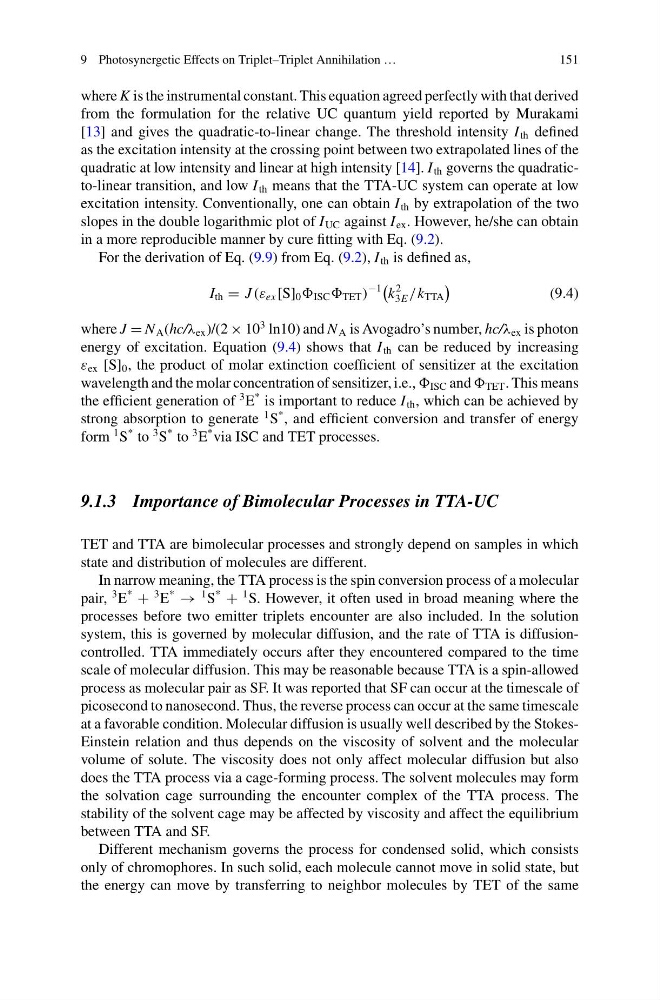
For the derivation of Eq. (9.9) from Eq. (9.2), I th is defined as,
I th = J (ε ex [S] 0 ISC TET )
−1
k
2
3E /k TTA
(9.4)
where J = N A (hc/λ ex )/(2 × 10
3 ln10) and N A is Avogadro’s number, hc/λ ex is photon
energy of excitation. Equation (9.4) shows that I th can be reduced by increasing
ε ex [S] 0 , the product of molar extinction coefficient of sensitizer at the excitation
wavelength and the molar concentration of sensitizer, i.e., ISC and TET . This means
the efficient generation of
3 E
* is important to reduce I th , which can be achieved by
strong absorption to generate
1 S
* , and efficient conversion and transfer of energy
form
1 S
* to
3 S
* to
3 E
* via ISC and TET processes.
9.1.3 Importance of Bimolecular Processes in TTA-UC
TET and TTA are bimolecular processes and strongly depend on samples in which
state and distribution of molecules are different.
In narrow meaning, the TTA process is the spin conversion process of a molecular
pair,
3 E
*
+
3 E
*
→
1 S
*
+
1 S. However, it often used in broad meaning where the
processes before two emitter triplets encounter are also included. In the solution
system, this is governed by molecular diffusion, and the rate of TTA is diffusioncontrolled. TTA immediately occurs after they encountered compared to the time
scale of molecular diffusion. This may be reasonable because TTA is a spin-allowed
process as molecular pair as SF. It was reported that SF can occur at the timescale of
picosecond to nanosecond. Thus, the reverse process can occur at the same timescale
at a favorable condition. Molecular diffusion is usually well described by the StokesEinstein relation and thus depends on the viscosity of solvent and the molecular
volume of solute. The viscosity does not only affect molecular diffusion but also
does the TTA process via a cage-forming process. The solvent molecules may form
the solvation cage surrounding the encounter complex of the TTA process. The
stability of the solvent cage may be affected by viscosity and affect the equilibrium
between TTA and SF.
Different mechanism governs the process for condensed solid, which consists
only of chromophores. In such solid, each molecule cannot move in solid state, but
the energy can move by transferring to neighbor molecules by TET of the same
151
where K is the instrumental constant. This equation agreed perfectly with that derived
from the formulation for the relative UC quantum yield reported by Murakami
[13] and gives the quadratic-to-linear change. The threshold intensity I th defined
as the excitation intensity at the crossing point between two extrapolated lines of the
quadratic at low intensity and linear at high intensity [14]. I th governs the quadraticto-linear transition, and low I th means that the TTA-UC system can operate at low
excitation intensity. Conventionally, one can obtain I th by extrapolation of the two
slopes in the double logarithmic plot of I UC against I ex . However, he/she can obtain
in a more reproducible manner by cure fitting with Eq. (9.2).
For the derivation of Eq. (9.9) from Eq. (9.2), I th is defined as,
I th = J (ε ex [S] 0 ISC TET )
−1
k
2
3E /k TTA
(9.4)
where J = N A (hc/λ ex )/(2 × 10
3 ln10) and N A is Avogadro’s number, hc/λ ex is photon
energy of excitation. Equation (9.4) shows that I th can be reduced by increasing
ε ex [S] 0 , the product of molar extinction coefficient of sensitizer at the excitation
wavelength and the molar concentration of sensitizer, i.e., ISC and TET . This means
the efficient generation of
3 E
* is important to reduce I th , which can be achieved by
strong absorption to generate
1 S
* , and efficient conversion and transfer of energy
form
1 S
* to
3 S
* to
3 E
* via ISC and TET processes.
9.1.3 Importance of Bimolecular Processes in TTA-UC
TET and TTA are bimolecular processes and strongly depend on samples in which
state and distribution of molecules are different.
In narrow meaning, the TTA process is the spin conversion process of a molecular
pair,
3 E
*
+
3 E
*
→
1 S
*
+
1 S. However, it often used in broad meaning where the
processes before two emitter triplets encounter are also included. In the solution
system, this is governed by molecular diffusion, and the rate of TTA is diffusioncontrolled. TTA immediately occurs after they encountered compared to the time
scale of molecular diffusion. This may be reasonable because TTA is a spin-allowed
process as molecular pair as SF. It was reported that SF can occur at the timescale of
picosecond to nanosecond. Thus, the reverse process can occur at the same timescale
at a favorable condition. Molecular diffusion is usually well described by the StokesEinstein relation and thus depends on the viscosity of solvent and the molecular
volume of solute. The viscosity does not only affect molecular diffusion but also
does the TTA process via a cage-forming process. The solvent molecules may form
the solvation cage surrounding the encounter complex of the TTA process. The
stability of the solvent cage may be affected by viscosity and affect the equilibrium
between TTA and SF.
Different mechanism governs the process for condensed solid, which consists
only of chromophores. In such solid, each molecule cannot move in solid state, but
the energy can move by transferring to neighbor molecules by TET of the same