

6
H. Miyasaka et al.
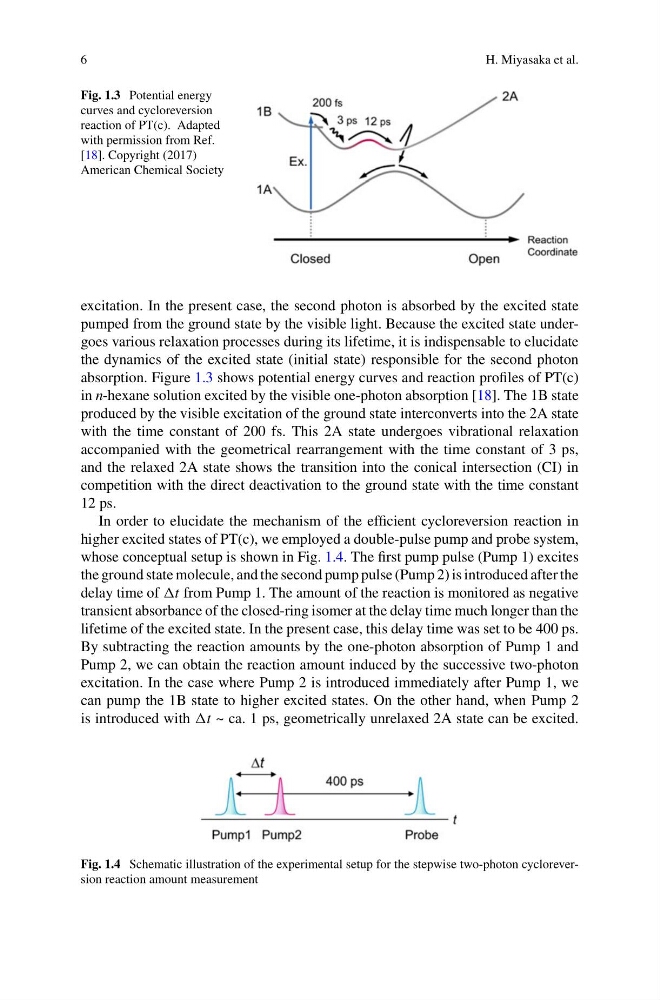
Fig. 1.3 Potential energy
curves and cycloreversion
reaction of PT(c). Adapted
with permission from Ref.
[18]. Copyright (2017)
American Chemical Society
excitation. In the present case, the second photon is absorbed by the excited state
pumped from the ground state by the visible light. Because the excited state undergoes various relaxation processes during its lifetime, it is indispensable to elucidate
the dynamics of the excited state (initial state) responsible for the second photon
absorption. Figure 1.3 shows potential energy curves and reaction profiles of PT(c)
in n-hexane solution excited by the visible one-photon absorption [18]. The 1B state
produced by the visible excitation of the ground state interconverts into the 2A state
with the time constant of 200 fs. This 2A state undergoes vibrational relaxation
accompanied with the geometrical rearrangement with the time constant of 3 ps,
and the relaxed 2A state shows the transition into the conical intersection (CI) in
competition with the direct deactivation to the ground state with the time constant
12 ps.
In order to elucidate the mechanism of the efficient cycloreversion reaction in
higher excited states of PT(c), we employed a double-pulse pump and probe system,
whose conceptual setup is shown in Fig. 1.4. The first pump pulse (Pump 1) excites
the ground state molecule, and the second pump pulse (Pump 2) is introduced after the
delay time of t from Pump 1. The amount of the reaction is monitored as negative
transient absorbance of the closed-ring isomer at the delay time much longer than the
lifetime of the excited state. In the present case, this delay time was set to be 400 ps.
By subtracting the reaction amounts by the one-photon absorption of Pump 1 and
Pump 2, we can obtain the reaction amount induced by the successive two-photon
excitation. In the case where Pump 2 is introduced immediately after Pump 1, we
can pump the 1B state to higher excited states. On the other hand, when Pump 2
is introduced with t ~ ca. 1 ps, geometrically unrelaxed 2A state can be excited.
Fig. 1.4 Schematic illustration of the experimental setup for the stepwise two-photon cycloreversion reaction amount measurement
H. Miyasaka et al.
Fig. 1.3 Potential energy
curves and cycloreversion
reaction of PT(c). Adapted
with permission from Ref.
[18]. Copyright (2017)
American Chemical Society
excitation. In the present case, the second photon is absorbed by the excited state
pumped from the ground state by the visible light. Because the excited state undergoes various relaxation processes during its lifetime, it is indispensable to elucidate
the dynamics of the excited state (initial state) responsible for the second photon
absorption. Figure 1.3 shows potential energy curves and reaction profiles of PT(c)
in n-hexane solution excited by the visible one-photon absorption [18]. The 1B state
produced by the visible excitation of the ground state interconverts into the 2A state
with the time constant of 200 fs. This 2A state undergoes vibrational relaxation
accompanied with the geometrical rearrangement with the time constant of 3 ps,
and the relaxed 2A state shows the transition into the conical intersection (CI) in
competition with the direct deactivation to the ground state with the time constant
12 ps.
In order to elucidate the mechanism of the efficient cycloreversion reaction in
higher excited states of PT(c), we employed a double-pulse pump and probe system,
whose conceptual setup is shown in Fig. 1.4. The first pump pulse (Pump 1) excites
the ground state molecule, and the second pump pulse (Pump 2) is introduced after the
delay time of t from Pump 1. The amount of the reaction is monitored as negative
transient absorbance of the closed-ring isomer at the delay time much longer than the
lifetime of the excited state. In the present case, this delay time was set to be 400 ps.
By subtracting the reaction amounts by the one-photon absorption of Pump 1 and
Pump 2, we can obtain the reaction amount induced by the successive two-photon
excitation. In the case where Pump 2 is introduced immediately after Pump 1, we
can pump the 1B state to higher excited states. On the other hand, when Pump 2
is introduced with t ~ ca. 1 ps, geometrically unrelaxed 2A state can be excited.
Fig. 1.4 Schematic illustration of the experimental setup for the stepwise two-photon cycloreversion reaction amount measurement