

1 Advanced Control of Photochemical Reactions …
5
Fig. 1.1 Stepwise two-photon cycloreversion reaction of diarylethene and fulgide derivatives
1.2.1 Stepwise Two-Photon Cycloreversion Reactions
in Diarylethene Derivatives
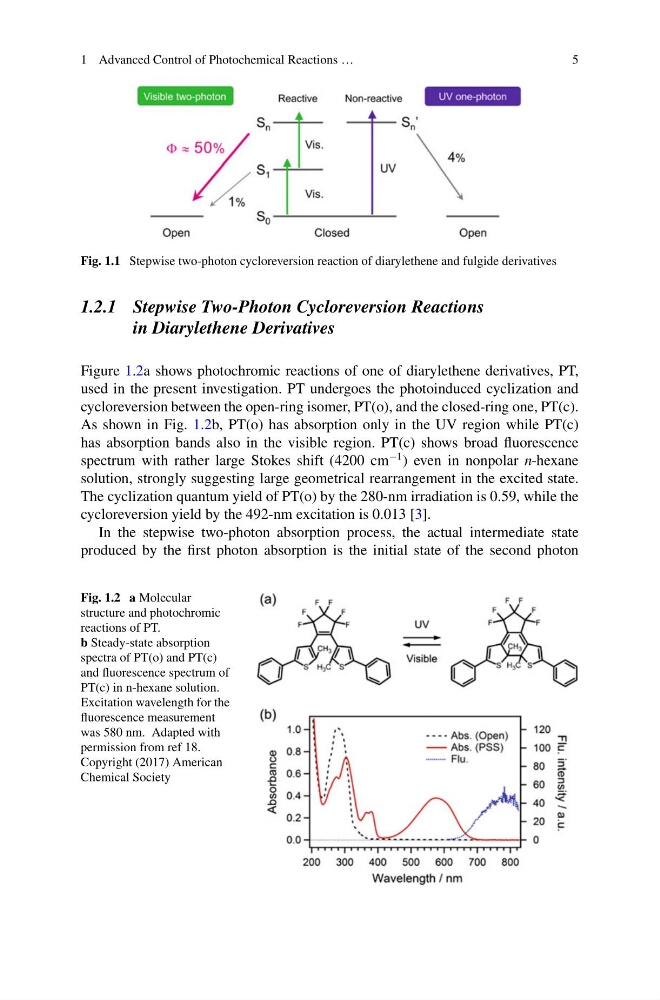
Figure 1.2a shows photochromic reactions of one of diarylethene derivatives, PT,
used in the present investigation. PT undergoes the photoinduced cyclization and
cycloreversion between the open-ring isomer, PT(o), and the closed-ring one, PT(c).
As shown in Fig. 1.2b, PT(o) has absorption only in the UV region while PT(c)
has absorption bands also in the visible region. PT(c) shows broad fluorescence
spectrum with rather large Stokes shift (4200 cm
−1 ) even in nonpolar n-hexane
solution, strongly suggesting large geometrical rearrangement in the excited state.
The cyclization quantum yield of PT(o) by the 280-nm irradiation is 0.59, while the
cycloreversion yield by the 492-nm excitation is 0.013 [3].
In the stepwise two-photon absorption process, the actual intermediate state
produced by the first photon absorption is the initial state of the second photon
Fig. 1.2 a Molecular
structure and photochromic
reactions of PT.
b Steady-state absorption
spectra of PT(o) and PT(c)
and fluorescence spectrum of
PT(c) in n-hexane solution.
Excitation wavelength for the
fluorescence measurement
was 580 nm. Adapted with
permission from ref 18.
Copyright (2017) American
Chemical Society
5
Fig. 1.1 Stepwise two-photon cycloreversion reaction of diarylethene and fulgide derivatives
1.2.1 Stepwise Two-Photon Cycloreversion Reactions
in Diarylethene Derivatives
Figure 1.2a shows photochromic reactions of one of diarylethene derivatives, PT,
used in the present investigation. PT undergoes the photoinduced cyclization and
cycloreversion between the open-ring isomer, PT(o), and the closed-ring one, PT(c).
As shown in Fig. 1.2b, PT(o) has absorption only in the UV region while PT(c)
has absorption bands also in the visible region. PT(c) shows broad fluorescence
spectrum with rather large Stokes shift (4200 cm
−1 ) even in nonpolar n-hexane
solution, strongly suggesting large geometrical rearrangement in the excited state.
The cyclization quantum yield of PT(o) by the 280-nm irradiation is 0.59, while the
cycloreversion yield by the 492-nm excitation is 0.013 [3].
In the stepwise two-photon absorption process, the actual intermediate state
produced by the first photon absorption is the initial state of the second photon
Fig. 1.2 a Molecular
structure and photochromic
reactions of PT.
b Steady-state absorption
spectra of PT(o) and PT(c)
and fluorescence spectrum of
PT(c) in n-hexane solution.
Excitation wavelength for the
fluorescence measurement
was 580 nm. Adapted with
permission from ref 18.
Copyright (2017) American
Chemical Society