

8 Modulations of Electronic States in Plasmonic Strong Coupling …
141
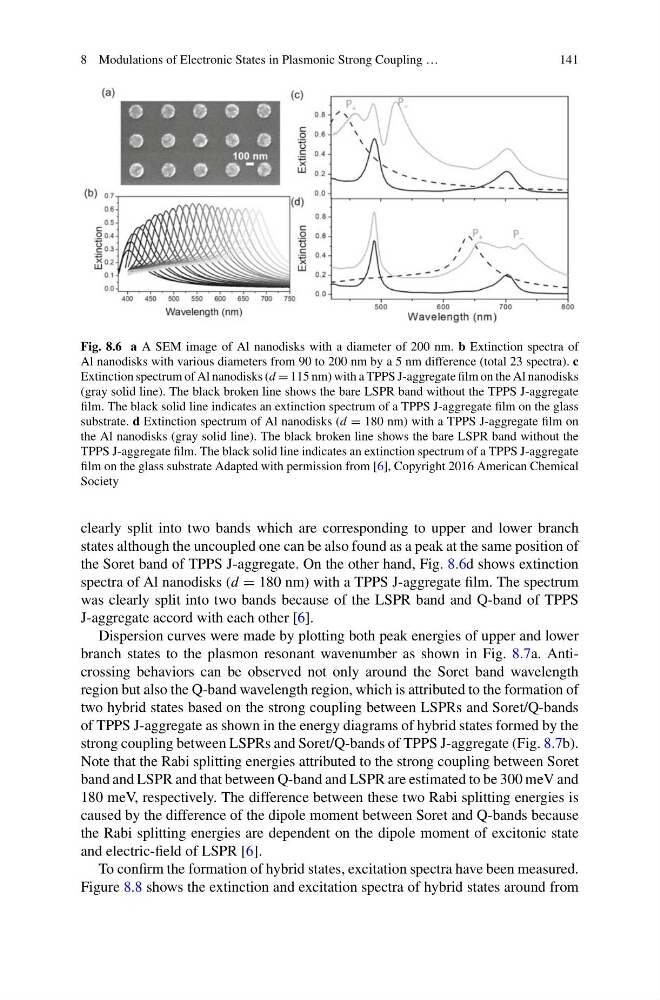
Fig. 8.6 a A SEM image of Al nanodisks with a diameter of 200 nm. b Extinction spectra of
Al nanodisks with various diameters from 90 to 200 nm by a 5 nm difference (total 23 spectra). c
Extinction spectrum of Al nanodisks (d = 115 nm) with a TPPS J-aggregate film on the Al nanodisks
(gray solid line). The black broken line shows the bare LSPR band without the TPPS J-aggregate
film. The black solid line indicates an extinction spectrum of a TPPS J-aggregate film on the glass
substrate. d Extinction spectrum of Al nanodisks (d = 180 nm) with a TPPS J-aggregate film on
the Al nanodisks (gray solid line). The black broken line shows the bare LSPR band without the
TPPS J-aggregate film. The black solid line indicates an extinction spectrum of a TPPS J-aggregate
film on the glass substrate Adapted with permission from [6], Copyright 2016 American Chemical
Society
clearly split into two bands which are corresponding to upper and lower branch
states although the uncoupled one can be also found as a peak at the same position of
the Soret band of TPPS J-aggregate. On the other hand, Fig. 8.6d shows extinction
spectra of Al nanodisks (d = 180 nm) with a TPPS J-aggregate film. The spectrum
was clearly split into two bands because of the LSPR band and Q-band of TPPS
J-aggregate accord with each other [6].
Dispersion curves were made by plotting both peak energies of upper and lower
branch states to the plasmon resonant wavenumber as shown in Fig. 8.7a. Anticrossing behaviors can be observed not only around the Soret band wavelength
region but also the Q-band wavelength region, which is attributed to the formation of
two hybrid states based on the strong coupling between LSPRs and Soret/Q-bands
of TPPS J-aggregate as shown in the energy diagrams of hybrid states formed by the
strong coupling between LSPRs and Soret/Q-bands of TPPS J-aggregate (Fig. 8.7b).
Note that the Rabi splitting energies attributed to the strong coupling between Soret
band and LSPR and that between Q-band and LSPR are estimated to be 300 meV and
180 meV, respectively. The difference between these two Rabi splitting energies is
caused by the difference of the dipole moment between Soret and Q-bands because
the Rabi splitting energies are dependent on the dipole moment of excitonic state
and electric-field of LSPR [6].
To confirm the formation of hybrid states, excitation spectra have been measured.
Figure 8.8 shows the extinction and excitation spectra of hybrid states around from
141
Fig. 8.6 a A SEM image of Al nanodisks with a diameter of 200 nm. b Extinction spectra of
Al nanodisks with various diameters from 90 to 200 nm by a 5 nm difference (total 23 spectra). c
Extinction spectrum of Al nanodisks (d = 115 nm) with a TPPS J-aggregate film on the Al nanodisks
(gray solid line). The black broken line shows the bare LSPR band without the TPPS J-aggregate
film. The black solid line indicates an extinction spectrum of a TPPS J-aggregate film on the glass
substrate. d Extinction spectrum of Al nanodisks (d = 180 nm) with a TPPS J-aggregate film on
the Al nanodisks (gray solid line). The black broken line shows the bare LSPR band without the
TPPS J-aggregate film. The black solid line indicates an extinction spectrum of a TPPS J-aggregate
film on the glass substrate Adapted with permission from [6], Copyright 2016 American Chemical
Society
clearly split into two bands which are corresponding to upper and lower branch
states although the uncoupled one can be also found as a peak at the same position of
the Soret band of TPPS J-aggregate. On the other hand, Fig. 8.6d shows extinction
spectra of Al nanodisks (d = 180 nm) with a TPPS J-aggregate film. The spectrum
was clearly split into two bands because of the LSPR band and Q-band of TPPS
J-aggregate accord with each other [6].
Dispersion curves were made by plotting both peak energies of upper and lower
branch states to the plasmon resonant wavenumber as shown in Fig. 8.7a. Anticrossing behaviors can be observed not only around the Soret band wavelength
region but also the Q-band wavelength region, which is attributed to the formation of
two hybrid states based on the strong coupling between LSPRs and Soret/Q-bands
of TPPS J-aggregate as shown in the energy diagrams of hybrid states formed by the
strong coupling between LSPRs and Soret/Q-bands of TPPS J-aggregate (Fig. 8.7b).
Note that the Rabi splitting energies attributed to the strong coupling between Soret
band and LSPR and that between Q-band and LSPR are estimated to be 300 meV and
180 meV, respectively. The difference between these two Rabi splitting energies is
caused by the difference of the dipole moment between Soret and Q-bands because
the Rabi splitting energies are dependent on the dipole moment of excitonic state
and electric-field of LSPR [6].
To confirm the formation of hybrid states, excitation spectra have been measured.
Figure 8.8 shows the extinction and excitation spectra of hybrid states around from