

7 Plasmon-Associated Control of Chemical Reaction at Nanometer …
127
source. Fluorescence spectra taken at the excitation end, body part, and distal end are
shown in Fig. 7.9c. Unlike SHG experiments, fluorescence signals could be observed
both at the end and middle part. This result indicates that Rhodamine 6G molecules
at body parts are most likely excited via 2-photon absorption of 820 nm, instead
of one-photon absorption of SHG light, 410 nm. This site dependence on nonlinear
interactions between dipole molecules and plasmonic waveguide provides a unique
opportunity for control of photochemical reactions along AgNWs.
7.4 Multiphoton Photochromic Reaction on Silver
Nanowire
Diarylethene (DAE) derivatives have attracted great attention as thermally
irreversible but photochemically reversible (so-called as P-type) photochromic
molecules with excellent thermal stability and light durability. Many studies on
DAE photochromism have been reported not only for application as photo-functional
materials but also for a basic understanding of photochemical reactions [21]. In
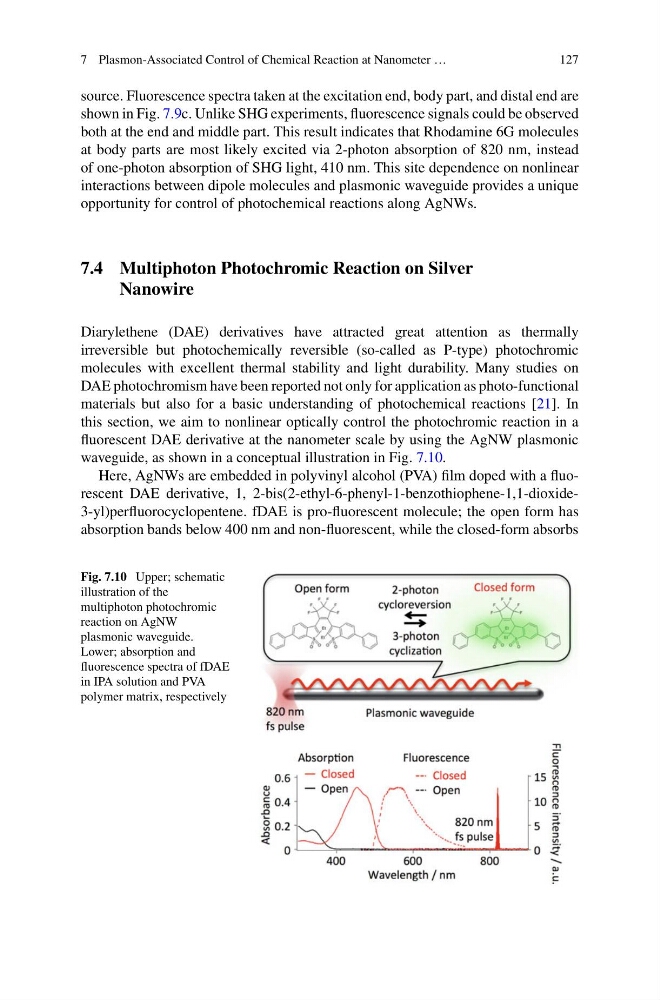
this section, we aim to nonlinear optically control the photochromic reaction in a
fluorescent DAE derivative at the nanometer scale by using the AgNW plasmonic
waveguide, as shown in a conceptual illustration in Fig. 7.10.
Here, AgNWs are embedded in polyvinyl alcohol (PVA) film doped with a fluorescent DAE derivative, 1, 2-bis(2-ethyl-6-phenyl-1-benzothiophene-1,1-dioxide3-yl)perfluorocyclopentene. fDAE is pro-fluorescent molecule; the open form has
absorption bands below 400 nm and non-fluorescent, while the closed-form absorbs
Fig. 7.10 Upper; schematic
illustration of the
multiphoton photochromic
reaction on AgNW
plasmonic waveguide.
Lower; absorption and
fluorescence spectra of fDAE
in IPA solution and PVA
polymer matrix, respectively
127
source. Fluorescence spectra taken at the excitation end, body part, and distal end are
shown in Fig. 7.9c. Unlike SHG experiments, fluorescence signals could be observed
both at the end and middle part. This result indicates that Rhodamine 6G molecules
at body parts are most likely excited via 2-photon absorption of 820 nm, instead
of one-photon absorption of SHG light, 410 nm. This site dependence on nonlinear
interactions between dipole molecules and plasmonic waveguide provides a unique
opportunity for control of photochemical reactions along AgNWs.
7.4 Multiphoton Photochromic Reaction on Silver
Nanowire
Diarylethene (DAE) derivatives have attracted great attention as thermally
irreversible but photochemically reversible (so-called as P-type) photochromic
molecules with excellent thermal stability and light durability. Many studies on
DAE photochromism have been reported not only for application as photo-functional
materials but also for a basic understanding of photochemical reactions [21]. In
this section, we aim to nonlinear optically control the photochromic reaction in a
fluorescent DAE derivative at the nanometer scale by using the AgNW plasmonic
waveguide, as shown in a conceptual illustration in Fig. 7.10.
Here, AgNWs are embedded in polyvinyl alcohol (PVA) film doped with a fluorescent DAE derivative, 1, 2-bis(2-ethyl-6-phenyl-1-benzothiophene-1,1-dioxide3-yl)perfluorocyclopentene. fDAE is pro-fluorescent molecule; the open form has
absorption bands below 400 nm and non-fluorescent, while the closed-form absorbs
Fig. 7.10 Upper; schematic
illustration of the
multiphoton photochromic
reaction on AgNW
plasmonic waveguide.
Lower; absorption and
fluorescence spectra of fDAE
in IPA solution and PVA
polymer matrix, respectively