

128
S. Toyouchi et al.
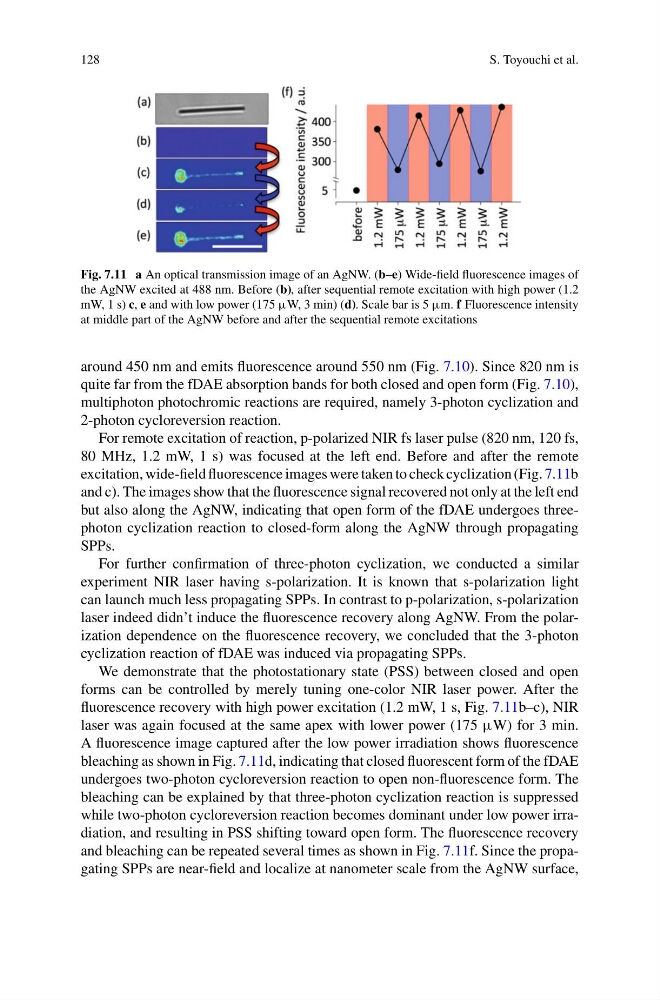
Fig. 7.11 a An optical transmission image of an AgNW. (b–e) Wide-field fluorescence images of
the AgNW excited at 488 nm. Before (b), after sequential remote excitation with high power (1.2
mW, 1 s) c, e and with low power (175 µW, 3 min) (d). Scale bar is 5 µm. f Fluorescence intensity
at middle part of the AgNW before and after the sequential remote excitations
around 450 nm and emits fluorescence around 550 nm (Fig. 7.10). Since 820 nm is
quite far from the fDAE absorption bands for both closed and open form (Fig. 7.10),
multiphoton photochromic reactions are required, namely 3-photon cyclization and
2-photon cycloreversion reaction.
For remote excitation of reaction, p-polarized NIR fs laser pulse (820 nm, 120 fs,
80 MHz, 1.2 mW, 1 s) was focused at the left end. Before and after the remote
excitation, wide-field fluorescence images were taken to check cyclization (Fig. 7.11b
and c). The images show that the fluorescence signal recovered not only at the left end
but also along the AgNW, indicating that open form of the fDAE undergoes threephoton cyclization reaction to closed-form along the AgNW through propagating
SPPs.
For further confirmation of three-photon cyclization, we conducted a similar
experiment NIR laser having s-polarization. It is known that s-polarization light
can launch much less propagating SPPs. In contrast to p-polarization, s-polarization
laser indeed didn’t induce the fluorescence recovery along AgNW. From the polarization dependence on the fluorescence recovery, we concluded that the 3-photon
cyclization reaction of fDAE was induced via propagating SPPs.
We demonstrate that the photostationary state (PSS) between closed and open
forms can be controlled by merely tuning one-color NIR laser power. After the
fluorescence recovery with high power excitation (1.2 mW, 1 s, Fig. 7.11b–c), NIR
laser was again focused at the same apex with lower power (175 µW) for 3 min.
A fluorescence image captured after the low power irradiation shows fluorescence
bleaching as shown in Fig. 7.11d, indicating that closed fluorescent form of the fDAE
undergoes two-photon cycloreversion reaction to open non-fluorescence form. The
bleaching can be explained by that three-photon cyclization reaction is suppressed
while two-photon cycloreversion reaction becomes dominant under low power irradiation, and resulting in PSS shifting toward open form. The fluorescence recovery
and bleaching can be repeated several times as shown in Fig. 7.11f. Since the propagating SPPs are near-field and localize at nanometer scale from the AgNW surface,
S. Toyouchi et al.
Fig. 7.11 a An optical transmission image of an AgNW. (b–e) Wide-field fluorescence images of
the AgNW excited at 488 nm. Before (b), after sequential remote excitation with high power (1.2
mW, 1 s) c, e and with low power (175 µW, 3 min) (d). Scale bar is 5 µm. f Fluorescence intensity
at middle part of the AgNW before and after the sequential remote excitations
around 450 nm and emits fluorescence around 550 nm (Fig. 7.10). Since 820 nm is
quite far from the fDAE absorption bands for both closed and open form (Fig. 7.10),
multiphoton photochromic reactions are required, namely 3-photon cyclization and
2-photon cycloreversion reaction.
For remote excitation of reaction, p-polarized NIR fs laser pulse (820 nm, 120 fs,
80 MHz, 1.2 mW, 1 s) was focused at the left end. Before and after the remote
excitation, wide-field fluorescence images were taken to check cyclization (Fig. 7.11b
and c). The images show that the fluorescence signal recovered not only at the left end
but also along the AgNW, indicating that open form of the fDAE undergoes threephoton cyclization reaction to closed-form along the AgNW through propagating
SPPs.
For further confirmation of three-photon cyclization, we conducted a similar
experiment NIR laser having s-polarization. It is known that s-polarization light
can launch much less propagating SPPs. In contrast to p-polarization, s-polarization
laser indeed didn’t induce the fluorescence recovery along AgNW. From the polarization dependence on the fluorescence recovery, we concluded that the 3-photon
cyclization reaction of fDAE was induced via propagating SPPs.
We demonstrate that the photostationary state (PSS) between closed and open
forms can be controlled by merely tuning one-color NIR laser power. After the
fluorescence recovery with high power excitation (1.2 mW, 1 s, Fig. 7.11b–c), NIR
laser was again focused at the same apex with lower power (175 µW) for 3 min.
A fluorescence image captured after the low power irradiation shows fluorescence
bleaching as shown in Fig. 7.11d, indicating that closed fluorescent form of the fDAE
undergoes two-photon cycloreversion reaction to open non-fluorescence form. The
bleaching can be explained by that three-photon cyclization reaction is suppressed
while two-photon cycloreversion reaction becomes dominant under low power irradiation, and resulting in PSS shifting toward open form. The fluorescence recovery
and bleaching can be repeated several times as shown in Fig. 7.11f. Since the propagating SPPs are near-field and localize at nanometer scale from the AgNW surface,