

7 Plasmon-Associated Control of Chemical Reaction at Nanometer …
125
constructing an SHG intensity map, in which p-polarized excitation light focus was
scanned over an AgNW (Fig. 7.6d). In contrast to this, almost no position dependence
with very low SHG efficiency was confirmed with excitation polarized perpendicular
to the longitudinal axis (s-polarization) as shown in Fig. 7.6e. This position and polarization dependence can be explained by the excitation efficiency of SPPs along an
AgNW as well as symmetry selectivity of NLO. p-polarized light efficiently couple
with SPPs mainly at apexes but much less at the middle part of AgNWs due to the
momentum matching condition between far-field light and SPPs, suggesting higher
and lower SHG efficiency at apexes and the middle part of AgNWs, respectively. In
addition to this, SHG requires a break of centro-symmetry because it is second-order
nonlinear optical effect. AgNW apexes seemingly work as a symmetry breaking
point for p-polarized excitation light, resulting in a higher yield of SHG. In contrast,
the middle part is almost symmetry for p-polarized light causing significantly lower
SHG efficiency. In the case of s-polarized excitation, transverse SPPs are excited at
the entire AgNW and its surface could be centro-symmetry breakpoint. This could
be the reason for relatively weak SHG at the entire part of the AgNW.
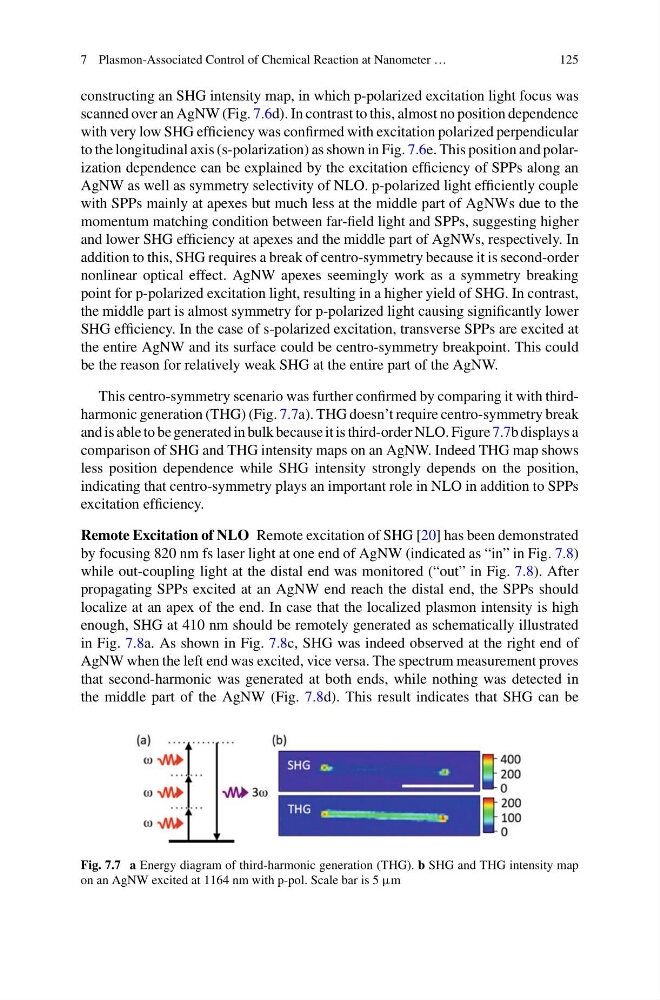
This centro-symmetry scenario was further confirmed by comparing it with thirdharmonic generation (THG) (Fig. 7.7a). THG doesn’t require centro-symmetry break
and is able to be generated in bulk because it is third-order NLO. Figure 7.7b displays a
comparison of SHG and THG intensity maps on an AgNW. Indeed THG map shows
less position dependence while SHG intensity strongly depends on the position,
indicating that centro-symmetry plays an important role in NLO in addition to SPPs
excitation efficiency.
Remote Excitation of NLO Remote excitation of SHG [20] has been demonstrated
by focusing 820 nm fs laser light at one end of AgNW (indicated as “in” in Fig. 7.8)
while out-coupling light at the distal end was monitored (“out” in Fig. 7.8). After
propagating SPPs excited at an AgNW end reach the distal end, the SPPs should
localize at an apex of the end. In case that the localized plasmon intensity is high
enough, SHG at 410 nm should be remotely generated as schematically illustrated
in Fig. 7.8a. As shown in Fig. 7.8c, SHG was indeed observed at the right end of
AgNW when the left end was excited, vice versa. The spectrum measurement proves
that second-harmonic was generated at both ends, while nothing was detected in
the middle part of the AgNW (Fig. 7.8d). This result indicates that SHG can be
Fig. 7.7 a Energy diagram of third-harmonic generation (THG). b SHG and THG intensity map
on an AgNW excited at 1164 nm with p-pol. Scale bar is 5 µm
125
constructing an SHG intensity map, in which p-polarized excitation light focus was
scanned over an AgNW (Fig. 7.6d). In contrast to this, almost no position dependence
with very low SHG efficiency was confirmed with excitation polarized perpendicular
to the longitudinal axis (s-polarization) as shown in Fig. 7.6e. This position and polarization dependence can be explained by the excitation efficiency of SPPs along an
AgNW as well as symmetry selectivity of NLO. p-polarized light efficiently couple
with SPPs mainly at apexes but much less at the middle part of AgNWs due to the
momentum matching condition between far-field light and SPPs, suggesting higher
and lower SHG efficiency at apexes and the middle part of AgNWs, respectively. In
addition to this, SHG requires a break of centro-symmetry because it is second-order
nonlinear optical effect. AgNW apexes seemingly work as a symmetry breaking
point for p-polarized excitation light, resulting in a higher yield of SHG. In contrast,
the middle part is almost symmetry for p-polarized light causing significantly lower
SHG efficiency. In the case of s-polarized excitation, transverse SPPs are excited at
the entire AgNW and its surface could be centro-symmetry breakpoint. This could
be the reason for relatively weak SHG at the entire part of the AgNW.
This centro-symmetry scenario was further confirmed by comparing it with thirdharmonic generation (THG) (Fig. 7.7a). THG doesn’t require centro-symmetry break
and is able to be generated in bulk because it is third-order NLO. Figure 7.7b displays a
comparison of SHG and THG intensity maps on an AgNW. Indeed THG map shows
less position dependence while SHG intensity strongly depends on the position,
indicating that centro-symmetry plays an important role in NLO in addition to SPPs
excitation efficiency.
Remote Excitation of NLO Remote excitation of SHG [20] has been demonstrated
by focusing 820 nm fs laser light at one end of AgNW (indicated as “in” in Fig. 7.8)
while out-coupling light at the distal end was monitored (“out” in Fig. 7.8). After
propagating SPPs excited at an AgNW end reach the distal end, the SPPs should
localize at an apex of the end. In case that the localized plasmon intensity is high
enough, SHG at 410 nm should be remotely generated as schematically illustrated
in Fig. 7.8a. As shown in Fig. 7.8c, SHG was indeed observed at the right end of
AgNW when the left end was excited, vice versa. The spectrum measurement proves
that second-harmonic was generated at both ends, while nothing was detected in
the middle part of the AgNW (Fig. 7.8d). This result indicates that SHG can be
Fig. 7.7 a Energy diagram of third-harmonic generation (THG). b SHG and THG intensity map
on an AgNW excited at 1164 nm with p-pol. Scale bar is 5 µm