

124
S. Toyouchi et al.
7.3 Direct/Remote Excitation of Second-Harmonic
Generation, Multiphoton Fluorescence
Recently nonlinear optics (NLO) has merged with plasmonics, known as nonlinear
plasmonics, shed light on new technologies and applications [19]. Nonlinear plasmonics have been regarded as one of the important fields in modern nanophotonics. In
this section, we are aiming to expend the AgNW plasmonic waveguiding effect from
linear to nonlinear regimes. Since AgNWs serve as excellent plasmonic waveguide
due to their well-defined crystal structure and atomically smooth surface [4, 6, 7], we
investigated the possibility of remote excitation of NLO, as analogous to one-photon
SERS and fluorescence discussed in the previous section.
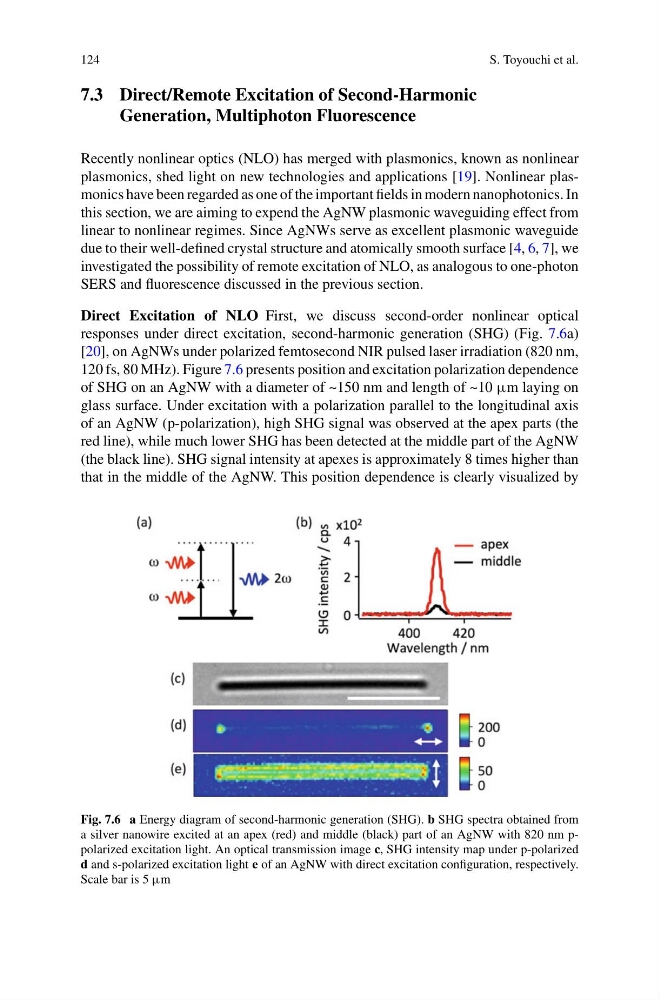
Direct Excitation of NLO First, we discuss second-order nonlinear optical
responses under direct excitation, second-harmonic generation (SHG) (Fig. 7.6a)
[20], on AgNWs under polarized femtosecond NIR pulsed laser irradiation (820 nm,
120 fs, 80 MHz). Figure 7.6 presents position and excitation polarization dependence
of SHG on an AgNW with a diameter of ~150 nm and length of ~10 µm laying on
glass surface. Under excitation with a polarization parallel to the longitudinal axis
of an AgNW (p-polarization), high SHG signal was observed at the apex parts (the
red line), while much lower SHG has been detected at the middle part of the AgNW
(the black line). SHG signal intensity at apexes is approximately 8 times higher than
that in the middle of the AgNW. This position dependence is clearly visualized by
Fig. 7.6 a Energy diagram of second-harmonic generation (SHG). b SHG spectra obtained from
a silver nanowire excited at an apex (red) and middle (black) part of an AgNW with 820 nm ppolarized excitation light. An optical transmission image c, SHG intensity map under p-polarized
d and s-polarized excitation light e of an AgNW with direct excitation configuration, respectively.
Scale bar is 5 µm
S. Toyouchi et al.
7.3 Direct/Remote Excitation of Second-Harmonic
Generation, Multiphoton Fluorescence
Recently nonlinear optics (NLO) has merged with plasmonics, known as nonlinear
plasmonics, shed light on new technologies and applications [19]. Nonlinear plasmonics have been regarded as one of the important fields in modern nanophotonics. In
this section, we are aiming to expend the AgNW plasmonic waveguiding effect from
linear to nonlinear regimes. Since AgNWs serve as excellent plasmonic waveguide
due to their well-defined crystal structure and atomically smooth surface [4, 6, 7], we
investigated the possibility of remote excitation of NLO, as analogous to one-photon
SERS and fluorescence discussed in the previous section.
Direct Excitation of NLO First, we discuss second-order nonlinear optical
responses under direct excitation, second-harmonic generation (SHG) (Fig. 7.6a)
[20], on AgNWs under polarized femtosecond NIR pulsed laser irradiation (820 nm,
120 fs, 80 MHz). Figure 7.6 presents position and excitation polarization dependence
of SHG on an AgNW with a diameter of ~150 nm and length of ~10 µm laying on
glass surface. Under excitation with a polarization parallel to the longitudinal axis
of an AgNW (p-polarization), high SHG signal was observed at the apex parts (the
red line), while much lower SHG has been detected at the middle part of the AgNW
(the black line). SHG signal intensity at apexes is approximately 8 times higher than
that in the middle of the AgNW. This position dependence is clearly visualized by
Fig. 7.6 a Energy diagram of second-harmonic generation (SHG). b SHG spectra obtained from
a silver nanowire excited at an apex (red) and middle (black) part of an AgNW with 820 nm ppolarized excitation light. An optical transmission image c, SHG intensity map under p-polarized
d and s-polarized excitation light e of an AgNW with direct excitation configuration, respectively.
Scale bar is 5 µm