

102
K. Imaeda and K. Imura
x- and y-vector components, and hence can be assigned as in-plane polarized modes.
These eigenmodes are optically allowed by the in-plane electric field components,
and thus can be excited by polarized light from normal incidence. On the other
hand, the eigenmode with the irreducible representation of A 1 is assigned as the outof-plane polarized mode. According to the conventional optical selection rule, this
eigenmode is only accessible by an out-of-plane electric field component. Therefore,
the eigenmode in Fig. 6.6h is forbidden for normal plane wave incidence. In the case
of the aperture-type SNOM, both in-plane and out-of-plane electric field components
are generated in the vicinity of the aperture [62], and thereby, both out-of-plane and
in-plane modes are experimentally observable in the near-field images.
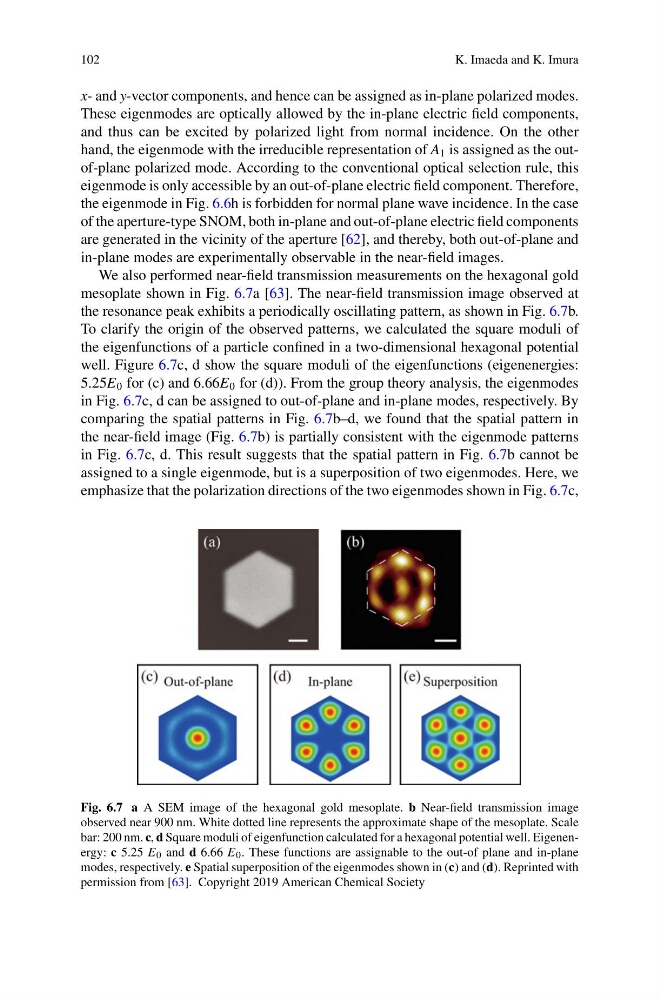
We also performed near-field transmission measurements on the hexagonal gold
mesoplate shown in Fig. 6.7a [63]. The near-field transmission image observed at
the resonance peak exhibits a periodically oscillating pattern, as shown in Fig. 6.7b.
To clarify the origin of the observed patterns, we calculated the square moduli of
the eigenfunctions of a particle confined in a two-dimensional hexagonal potential
well. Figure 6.7c, d show the square moduli of the eigenfunctions (eigenenergies:
5.25E 0 for (c) and 6.66E 0 for (d)). From the group theory analysis, the eigenmodes
in Fig. 6.7c, d can be assigned to out-of-plane and in-plane modes, respectively. By
comparing the spatial patterns in Fig. 6.7b–d, we found that the spatial pattern in
the near-field image (Fig. 6.7b) is partially consistent with the eigenmode patterns
in Fig. 6.7c, d. This result suggests that the spatial pattern in Fig. 6.7b cannot be
assigned to a single eigenmode, but is a superposition of two eigenmodes. Here, we
emphasize that the polarization directions of the two eigenmodes shown in Fig. 6.7c,
Fig. 6.7 a A SEM image of the hexagonal gold mesoplate. b Near-field transmission image
observed near 900 nm. White dotted line represents the approximate shape of the mesoplate. Scale
bar: 200 nm. c, d Square moduli of eigenfunction calculated for a hexagonal potential well. Eigenenergy: c 5.25 E 0 and d 6.66 E 0 . These functions are assignable to the out-of plane and in-plane
modes, respectively. e Spatial superposition of the eigenmodes shown in (c) and (d). Reprinted with
permission from [63]. Copyright 2019 American Chemical Society
K. Imaeda and K. Imura
x- and y-vector components, and hence can be assigned as in-plane polarized modes.
These eigenmodes are optically allowed by the in-plane electric field components,
and thus can be excited by polarized light from normal incidence. On the other
hand, the eigenmode with the irreducible representation of A 1 is assigned as the outof-plane polarized mode. According to the conventional optical selection rule, this
eigenmode is only accessible by an out-of-plane electric field component. Therefore,
the eigenmode in Fig. 6.6h is forbidden for normal plane wave incidence. In the case
of the aperture-type SNOM, both in-plane and out-of-plane electric field components
are generated in the vicinity of the aperture [62], and thereby, both out-of-plane and
in-plane modes are experimentally observable in the near-field images.
We also performed near-field transmission measurements on the hexagonal gold
mesoplate shown in Fig. 6.7a [63]. The near-field transmission image observed at
the resonance peak exhibits a periodically oscillating pattern, as shown in Fig. 6.7b.
To clarify the origin of the observed patterns, we calculated the square moduli of
the eigenfunctions of a particle confined in a two-dimensional hexagonal potential
well. Figure 6.7c, d show the square moduli of the eigenfunctions (eigenenergies:
5.25E 0 for (c) and 6.66E 0 for (d)). From the group theory analysis, the eigenmodes
in Fig. 6.7c, d can be assigned to out-of-plane and in-plane modes, respectively. By
comparing the spatial patterns in Fig. 6.7b–d, we found that the spatial pattern in
the near-field image (Fig. 6.7b) is partially consistent with the eigenmode patterns
in Fig. 6.7c, d. This result suggests that the spatial pattern in Fig. 6.7b cannot be
assigned to a single eigenmode, but is a superposition of two eigenmodes. Here, we
emphasize that the polarization directions of the two eigenmodes shown in Fig. 6.7c,
Fig. 6.7 a A SEM image of the hexagonal gold mesoplate. b Near-field transmission image
observed near 900 nm. White dotted line represents the approximate shape of the mesoplate. Scale
bar: 200 nm. c, d Square moduli of eigenfunction calculated for a hexagonal potential well. Eigenenergy: c 5.25 E 0 and d 6.66 E 0 . These functions are assignable to the out-of plane and in-plane
modes, respectively. e Spatial superposition of the eigenmodes shown in (c) and (d). Reprinted with
permission from [63]. Copyright 2019 American Chemical Society