

313
Water Dissociation Technologies for Hydrogen
Chemical equilibrium calculations for the reaction between ZnO and (NH 4 ) 2 SO 4
indicate that both ZnSO 4 and ZnO.2ZnSO 4 can form stable reaction products. More
than 20 sulfuric acid and/or metal sulfate decomposition-based TCWSCs have been
reported. Major issue remains to be electrolytic oxidation of sulfur dioxide. The use
of a depolarized electrolyzer as well as addition of a third process step such as S–I,
S–Br, and S–Fe cycles has also been attempted. Some of these are described below
[91,107]:
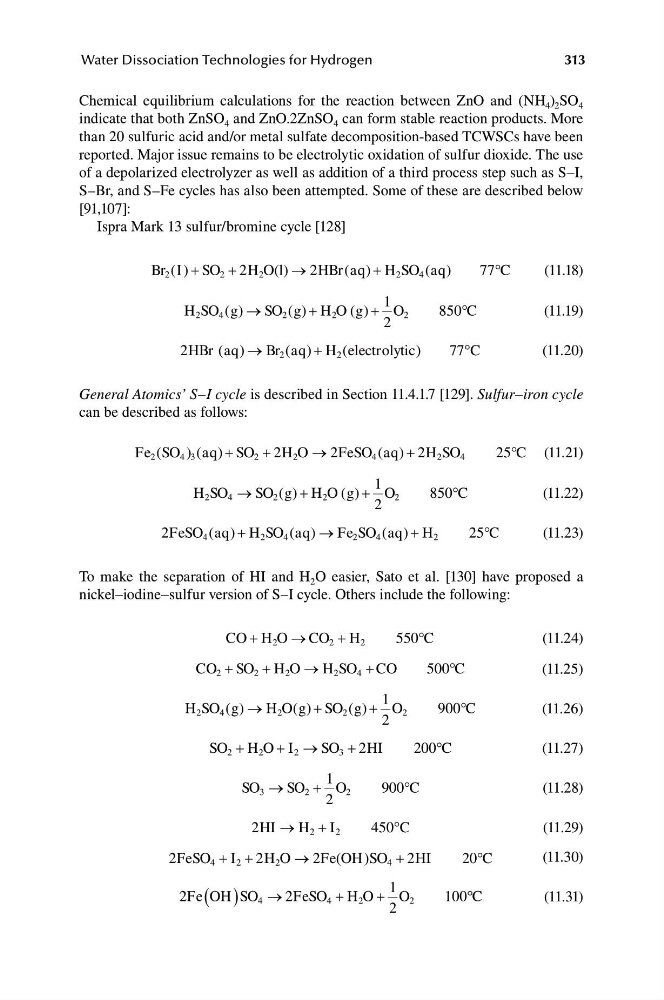
Ispra Mark 13 sulfur/bromine cycle [128]
Br 2 (I ) + SO 2 + 2H 2 O(l) → 2HBr (aq) + H 2 SO 4 (aq)
77°C
(11.18)
1
H 2 SO 4 (g) → SO 2 (g) + H 2 O (g) + O 2
850°C
(11.19)
2
2HBr (aq) → Br 2 (aq) + H 2 (electrolytic)
77°C
(11.20)
General Atomics’ S–I cycle is described in Section 11.4.1.7 [129]. Sulfur–iron cycle
can be described as follows:
Fe 2 (SO 4 ) 3 (aq) + SO 2 + 2H 2 O → 2FeSO 4 (aq) + 2H 2 SO 4
25°C (11.21)
1
H 2 SO 4 → SO 2 (g) + H 2 O (g) + O 2
850°C
(11.22)
2
2FeSO 4 (aq) + H 2 SO 4 (aq) → Fe 2 SO 4 (aq) + H 2
25°C
(11.23)
To make the separation of HI and H 2 O easier, Sato et al. [130] have proposed a
nickel–iodine–sulfur version of S–I cycle. Others include the following:
CO + H 2 O → CO 2 + H 2
550°C
(11.24)
CO 2 + SO 2 + H 2 O → H 2 SO 4 + CO
500°C
(11.25)
1
H 2 SO 4 (g) → H 2 O(g) + SO 2 (g) + O 2
900°C
(11.26)
2
SO 2 + H 2 O + I 2 → SO 3 + 2HI
200°C
(11.27)
1
SO 3 → SO 2 + O 2
900°C
(11.28)
2
2HI → H 2 + I 2
450°C
(11.29)
2FeSO 4 + I 2 + 2H 2 O → 2Fe(OH )SO 4 + 2HI
20°C
(11.30)
1
2Fe(OH )SO4 → 2FeSO 4 + H 2 O + O
2
2
100°C
(11.31)
Water Dissociation Technologies for Hydrogen
Chemical equilibrium calculations for the reaction between ZnO and (NH 4 ) 2 SO 4
indicate that both ZnSO 4 and ZnO.2ZnSO 4 can form stable reaction products. More
than 20 sulfuric acid and/or metal sulfate decomposition-based TCWSCs have been
reported. Major issue remains to be electrolytic oxidation of sulfur dioxide. The use
of a depolarized electrolyzer as well as addition of a third process step such as S–I,
S–Br, and S–Fe cycles has also been attempted. Some of these are described below
[91,107]:
Ispra Mark 13 sulfur/bromine cycle [128]
Br 2 (I ) + SO 2 + 2H 2 O(l) → 2HBr (aq) + H 2 SO 4 (aq)
77°C
(11.18)
1
H 2 SO 4 (g) → SO 2 (g) + H 2 O (g) + O 2
850°C
(11.19)
2
2HBr (aq) → Br 2 (aq) + H 2 (electrolytic)
77°C
(11.20)
General Atomics’ S–I cycle is described in Section 11.4.1.7 [129]. Sulfur–iron cycle
can be described as follows:
Fe 2 (SO 4 ) 3 (aq) + SO 2 + 2H 2 O → 2FeSO 4 (aq) + 2H 2 SO 4
25°C (11.21)
1
H 2 SO 4 → SO 2 (g) + H 2 O (g) + O 2
850°C
(11.22)
2
2FeSO 4 (aq) + H 2 SO 4 (aq) → Fe 2 SO 4 (aq) + H 2
25°C
(11.23)
To make the separation of HI and H 2 O easier, Sato et al. [130] have proposed a
nickel–iodine–sulfur version of S–I cycle. Others include the following:
CO + H 2 O → CO 2 + H 2
550°C
(11.24)
CO 2 + SO 2 + H 2 O → H 2 SO 4 + CO
500°C
(11.25)
1
H 2 SO 4 (g) → H 2 O(g) + SO 2 (g) + O 2
900°C
(11.26)
2
SO 2 + H 2 O + I 2 → SO 3 + 2HI
200°C
(11.27)
1
SO 3 → SO 2 + O 2
900°C
(11.28)
2
2HI → H 2 + I 2
450°C
(11.29)
2FeSO 4 + I 2 + 2H 2 O → 2Fe(OH )SO 4 + 2HI
20°C
(11.30)
1
2Fe(OH )SO4 → 2FeSO 4 + H 2 O + O
2
2
100°C
(11.31)