

312
Water for Energy and Fuel Production
Inoue et al. [89] examined mixed ZnO/MnFe 2 O 4 system for two-step thermochemical cycle for the dissociation of water. This system among many other mixed oxide
system is workable for producing hydrogen by thermochemical cycle. At 1000°C, the
mixture of ZnO and MnFe 2 O 4 reacted with water to generate hydrogen gas with 60%
yield. The oxygen was produced around 1027°C completing a two-step cycle.
11.4.1.5 Carbothermal reduction of metal Oxides
In the recent years, under the European Union’s R&D project SOLZINC (2001–
2005), a 300-kW solar chemical reactor at the solar power research facility of the
Weizmann Institute of Science (WIS) in Israel at temperatures ranging from 1000°C
to 1200°C yielded up to 50 kg/h of 95% purity Zn and energy conversion efficiency
of around 30% [1,90,95,106,121–124]. The process carried out carbothermal reduction of metal oxide (ZnO) using coke, natural gas, and other carbonaceous materials
as reducing agents. This brings down the reduction of oxides even to lower temperatures. Carbothermal reductions of metal oxides such as iron oxide, manganese
oxide, and zinc oxide with carbon and natural gas to produce the metals and the
use of syngas were demonstrated in the solar furnaces. Such a solar chemical reactor
concept—PSI’s “two-cavity” solar reactor based on the indirect irradiation of ZnO
and carbon (C) for producing Zn and carbon monoxide (CO)—was scaled up in the
SOLZINC project [1,90,95,121–124].
11.4.1.6 sulfur Family thermochemical Water splitting Cycles
All sulfur family thermochemical water splitting cycles (TCWSCs) depend on
concentration and decomposition of sulfuric acid for the oxygen evolution step of
the cycle [91,95–105,107,128–131]. The sulfuric acid decomposition step presents
serious materials and catalyst deactivation challenges. The most active Pt catalysts deactivate very rapidly. Metal sulfate-based TCWSCs overcome this difficulty, but they use thermal input, thus degrading photonic energy. T-Raissi et al.
[107] introduced FSEC’s (Florida Energy Systems Consortium) metal sulfate–
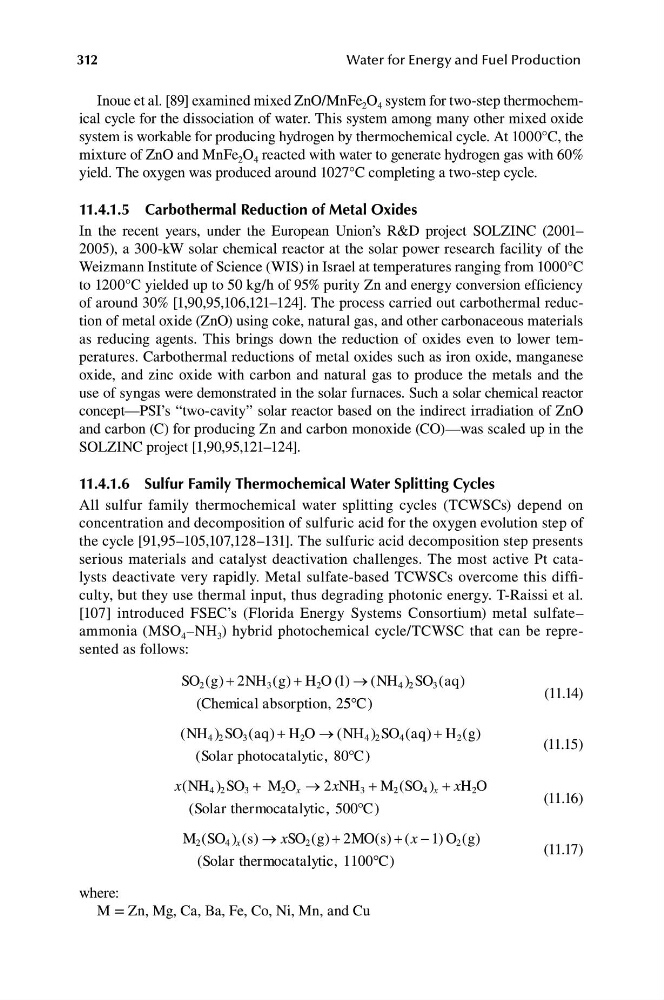
ammonia (MSO 4 –NH 3 ) hybrid photochemical cycle/TCWSC that can be represented as follows:
SO 2 (g) + 2NH 3 (g) + H 2 O (l) → (NH 4 ) 2 SO 3 (aq)
(11.14)
(Chemical absorption, 25 5°C)
(NH 4 ) 2 SO 3 (aq) + H 2 O → (NH 4 ) 2 SO 4 (aq) + H g)
2 (
(11.15)
(Solar photocatalytic, , 80°C)
x(NH 4 ) 2 SO 3 + M 2 O x → 2xNH 3 + M 2 (SO 4 ) x + xH 2 O
(11.16)
(Solar thermocatalytic, , 500°C)
M 2 (SO 4 ) x (s) → xSO 2 (g) + 2MO(s) + (x − 1) O 2 (g)
(11.17)
(Solar thermocatalytic c, 1100°C)
where:
M = Zn, Mg, Ca, Ba, Fe, Co, Ni, Mn, and Cu
Water for Energy and Fuel Production
Inoue et al. [89] examined mixed ZnO/MnFe 2 O 4 system for two-step thermochemical cycle for the dissociation of water. This system among many other mixed oxide
system is workable for producing hydrogen by thermochemical cycle. At 1000°C, the
mixture of ZnO and MnFe 2 O 4 reacted with water to generate hydrogen gas with 60%
yield. The oxygen was produced around 1027°C completing a two-step cycle.
11.4.1.5 Carbothermal reduction of metal Oxides
In the recent years, under the European Union’s R&D project SOLZINC (2001–
2005), a 300-kW solar chemical reactor at the solar power research facility of the
Weizmann Institute of Science (WIS) in Israel at temperatures ranging from 1000°C
to 1200°C yielded up to 50 kg/h of 95% purity Zn and energy conversion efficiency
of around 30% [1,90,95,106,121–124]. The process carried out carbothermal reduction of metal oxide (ZnO) using coke, natural gas, and other carbonaceous materials
as reducing agents. This brings down the reduction of oxides even to lower temperatures. Carbothermal reductions of metal oxides such as iron oxide, manganese
oxide, and zinc oxide with carbon and natural gas to produce the metals and the
use of syngas were demonstrated in the solar furnaces. Such a solar chemical reactor
concept—PSI’s “two-cavity” solar reactor based on the indirect irradiation of ZnO
and carbon (C) for producing Zn and carbon monoxide (CO)—was scaled up in the
SOLZINC project [1,90,95,121–124].
11.4.1.6 sulfur Family thermochemical Water splitting Cycles
All sulfur family thermochemical water splitting cycles (TCWSCs) depend on
concentration and decomposition of sulfuric acid for the oxygen evolution step of
the cycle [91,95–105,107,128–131]. The sulfuric acid decomposition step presents
serious materials and catalyst deactivation challenges. The most active Pt catalysts deactivate very rapidly. Metal sulfate-based TCWSCs overcome this difficulty, but they use thermal input, thus degrading photonic energy. T-Raissi et al.
[107] introduced FSEC’s (Florida Energy Systems Consortium) metal sulfate–
ammonia (MSO 4 –NH 3 ) hybrid photochemical cycle/TCWSC that can be represented as follows:
SO 2 (g) + 2NH 3 (g) + H 2 O (l) → (NH 4 ) 2 SO 3 (aq)
(11.14)
(Chemical absorption, 25 5°C)
(NH 4 ) 2 SO 3 (aq) + H 2 O → (NH 4 ) 2 SO 4 (aq) + H g)
2 (
(11.15)
(Solar photocatalytic, , 80°C)
x(NH 4 ) 2 SO 3 + M 2 O x → 2xNH 3 + M 2 (SO 4 ) x + xH 2 O
(11.16)
(Solar thermocatalytic, , 500°C)
M 2 (SO 4 ) x (s) → xSO 2 (g) + 2MO(s) + (x − 1) O 2 (g)
(11.17)
(Solar thermocatalytic c, 1100°C)
where:
M = Zn, Mg, Ca, Ba, Fe, Co, Ni, Mn, and Cu