

Four-way
valve
To mass
Steam
N 2
H 2
N 2 (O 2 )
spectrometer
Ducts for feed
gases
Inlet for feed
gases
Steam
Four-way
valve
Double tube
for feed gas
preheating
Cylindrical
Sealing
SiC housing
Quartz windows
Coated honeycomb structure
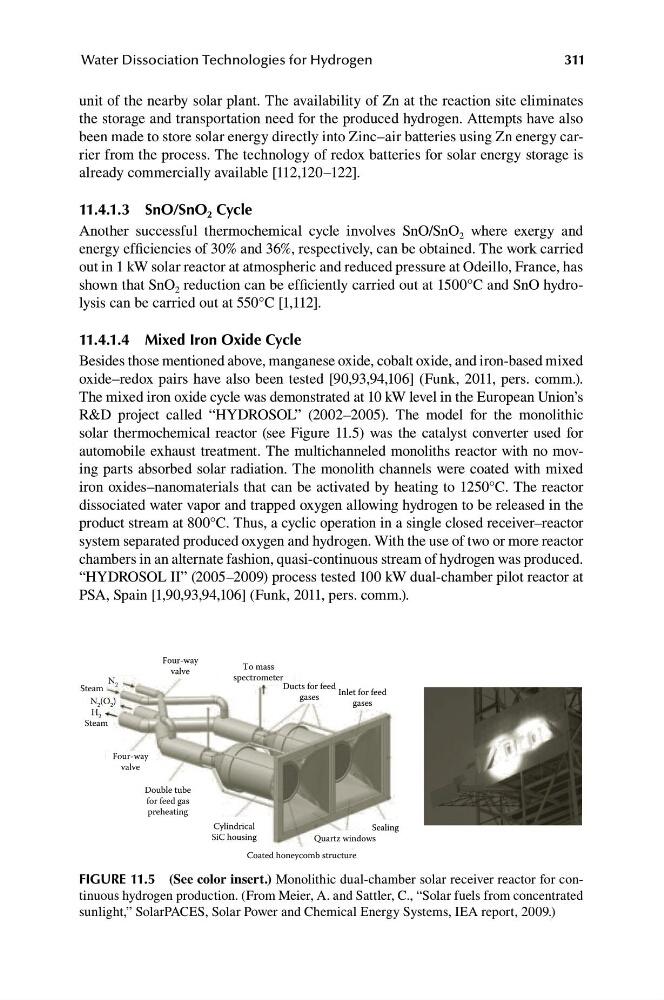
FiGUre 11.5 (See color insert.) Monolithic dual-chamber solar receiver reactor for continuous hydrogen production. (From Meier, A. and Sattler, C., “Solar fuels from concentrated
sunlight,” SolarPACES, Solar Power and Chemical Energy Systems, IEA report, 2009.)
311
Water Dissociation Technologies for Hydrogen
unit of the nearby solar plant. The availability of Zn at the reaction site eliminates
the storage and transportation need for the produced hydrogen. Attempts have also
been made to store solar energy directly into Zinc–air batteries using Zn energy carrier from the process. The technology of redox batteries for solar energy storage is
already commercially available [112,120–122].
11.4.1.3 snO/snO 2 Cycle
Another successful thermochemical cycle involves SnO/SnO 2 where exergy and
energy efficiencies of 30% and 36%, respectively, can be obtained. The work carried
out in 1 kW solar reactor at atmospheric and reduced pressure at Odeillo, France, has
shown that SnO 2 reduction can be efficiently carried out at 1500°C and SnO hydrolysis can be carried out at 550°C [1,112].
11.4.1.4 mixed iron Oxide Cycle
Besides those mentioned above, manganese oxide, cobalt oxide, and iron-based mixed
oxide–redox pairs have also been tested [90,93,94,106] (Funk, 2011, pers. comm.).
The mixed iron oxide cycle was demonstrated at 10 kW level in the European Union’s
R&D project called “HYDROSOL” (2002–2005). The model for the monolithic
solar thermochemical reactor (see Figure 11.5) was the catalyst converter used for
automobile exhaust treatment. The multichanneled monoliths reactor with no moving parts absorbed solar radiation. The monolith channels were coated with mixed
iron oxides–nanomaterials that can be activated by heating to 1250°C. The reactor
dissociated water vapor and trapped oxygen allowing hydrogen to be released in the
product stream at 800°C. Thus, a cyclic operation in a single closed receiver–reactor
system separated produced oxygen and hydrogen. With the use of two or more reactor
chambers in an alternate fashion, quasi-continuous stream of hydrogen was produced.
“HYDROSOL II” (2005–2009) process tested 100 kW dual-chamber pilot reactor at
PSA, Spain [1,90,93,94,106] (Funk, 2011, pers. comm.).
valve
To mass
Steam
N 2
H 2
N 2 (O 2 )
spectrometer
Ducts for feed
gases
Inlet for feed
gases
Steam
Four-way
valve
Double tube
for feed gas
preheating
Cylindrical
Sealing
SiC housing
Quartz windows
Coated honeycomb structure
FiGUre 11.5 (See color insert.) Monolithic dual-chamber solar receiver reactor for continuous hydrogen production. (From Meier, A. and Sattler, C., “Solar fuels from concentrated
sunlight,” SolarPACES, Solar Power and Chemical Energy Systems, IEA report, 2009.)
311
Water Dissociation Technologies for Hydrogen
unit of the nearby solar plant. The availability of Zn at the reaction site eliminates
the storage and transportation need for the produced hydrogen. Attempts have also
been made to store solar energy directly into Zinc–air batteries using Zn energy carrier from the process. The technology of redox batteries for solar energy storage is
already commercially available [112,120–122].
11.4.1.3 snO/snO 2 Cycle
Another successful thermochemical cycle involves SnO/SnO 2 where exergy and
energy efficiencies of 30% and 36%, respectively, can be obtained. The work carried
out in 1 kW solar reactor at atmospheric and reduced pressure at Odeillo, France, has
shown that SnO 2 reduction can be efficiently carried out at 1500°C and SnO hydrolysis can be carried out at 550°C [1,112].
11.4.1.4 mixed iron Oxide Cycle
Besides those mentioned above, manganese oxide, cobalt oxide, and iron-based mixed
oxide–redox pairs have also been tested [90,93,94,106] (Funk, 2011, pers. comm.).
The mixed iron oxide cycle was demonstrated at 10 kW level in the European Union’s
R&D project called “HYDROSOL” (2002–2005). The model for the monolithic
solar thermochemical reactor (see Figure 11.5) was the catalyst converter used for
automobile exhaust treatment. The multichanneled monoliths reactor with no moving parts absorbed solar radiation. The monolith channels were coated with mixed
iron oxides–nanomaterials that can be activated by heating to 1250°C. The reactor
dissociated water vapor and trapped oxygen allowing hydrogen to be released in the
product stream at 800°C. Thus, a cyclic operation in a single closed receiver–reactor
system separated produced oxygen and hydrogen. With the use of two or more reactor
chambers in an alternate fashion, quasi-continuous stream of hydrogen was produced.
“HYDROSOL II” (2005–2009) process tested 100 kW dual-chamber pilot reactor at
PSA, Spain [1,90,93,94,106] (Funk, 2011, pers. comm.).