

Rotary
joint
Water/gas
Feeder
Ceramic
inlets/outlets
insulation
ZnO
1
Zn + O 2
Cavity2
receiver
Quartz
window
Concentrated
solar
radiation
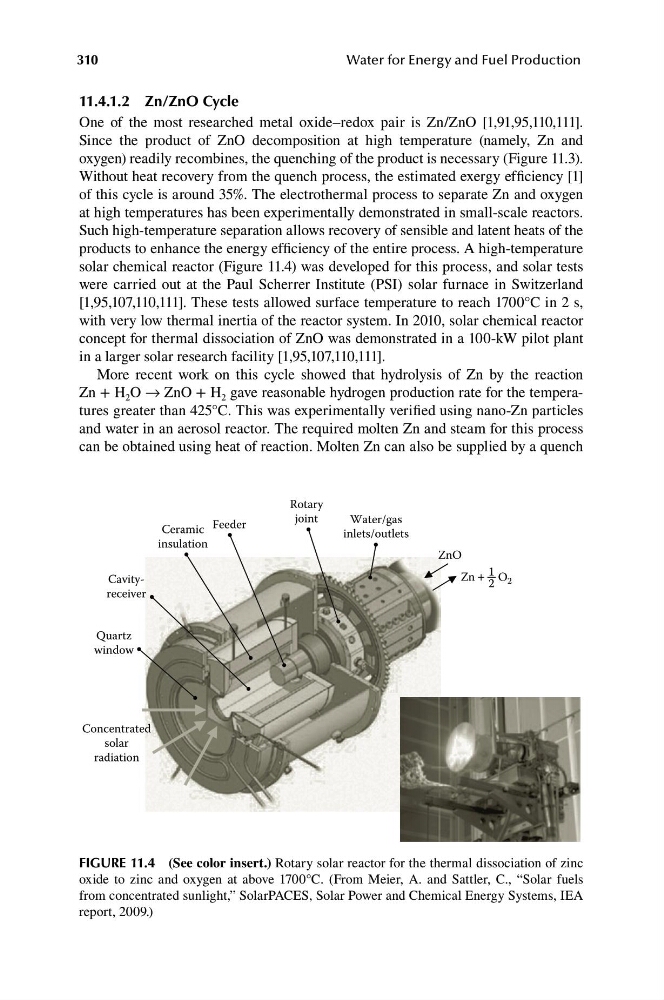
FiGUre 11.4 (See color insert.) Rotary solar reactor for the thermal dissociation of zinc
oxide to zinc and oxygen at above 1700°C. (From Meier, A. and Sattler, C., “Solar fuels
from concentrated sunlight,” SolarPACES, Solar Power and Chemical Energy Systems, IEA
report, 2009.)
310
Water for Energy and Fuel Production
11.4.1.2 Zn/ZnO Cycle
One of the most researched metal oxide–redox pair is Zn/ZnO [1,91,95,110,111].
Since the product of ZnO decomposition at high temperature (namely, Zn and
oxygen) readily recombines, the quenching of the product is necessary (Figure 11.3).
Without heat recovery from the quench process, the estimated exergy efficiency [1]
of this cycle is around 35%. The electrothermal process to separate Zn and oxygen
at high temperatures has been experimentally demonstrated in small-scale reactors.
Such high-temperature separation allows recovery of sensible and latent heats of the
products to enhance the energy efficiency of the entire process. A high-temperature
solar chemical reactor (Figure 11.4) was developed for this process, and solar tests
were carried out at the Paul Scherrer Institute (PSI) solar furnace in Switzerland
[1,95,107,110,111]. These tests allowed surface temperature to reach 1700°C in 2 s,
with very low thermal inertia of the reactor system. In 2010, solar chemical reactor
concept for thermal dissociation of ZnO was demonstrated in a 100-kW pilot plant
in a larger solar research facility [1,95,107,110,111].
More recent work on this cycle showed that hydrolysis of Zn by the reaction
Zn + H 2 O → ZnO + H 2 gave reasonable hydrogen production rate for the temperatures greater than 425°C. This was experimentally verified using nano-Zn particles
and water in an aerosol reactor. The required molten Zn and steam for this process
can be obtained using heat of reaction. Molten Zn can also be supplied by a quench