

314
Water for Energy and Fuel Production
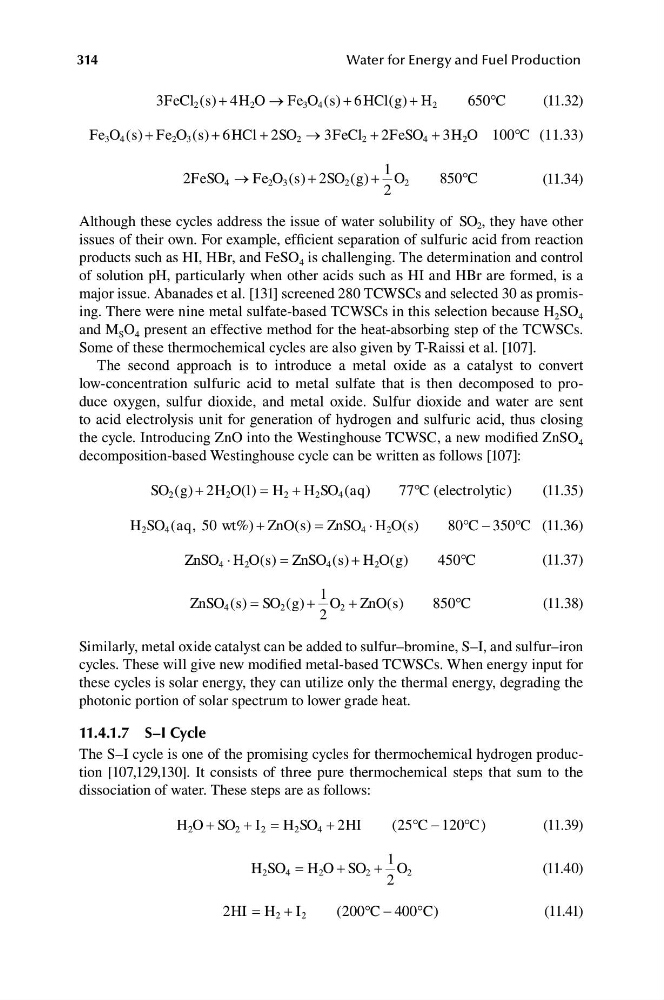
3FeCl 2 (s) + 4H 2 O → Fe 3 O 4 (s) + 6 HCl(g) + H 2
650°C
(11.32)
Fe 3 O 4 (s) + Fe 2 O 3 (s) + 6 HCl + 2SO 2 → 3FeCl 2 + 2FeSO 4 + 3H 2 O 100°C (11.33)
1
2FeSO 4 → Fe 2 O 3 (s) + 2SO 2 (g) + O 2
850°C
(11.34)
2
Although these cycles address the issue of water solubility of SO 2 , they have other
issues of their own. For example, efficient separation of sulfuric acid from reaction
products such as HI, HBr, and FeSO 4 is challenging. The determination and control
of solution pH, particularly when other acids such as HI and HBr are formed, is a
major issue. Abanades et al. [131] screened 280 TCWSCs and selected 30 as promising. There were nine metal sulfate-based TCWSCs in this selection because H 2 SO 4
and M S O 4 present an effective method for the heat-absorbing step of the TCWSCs.
Some of these thermochemical cycles are also given by T-Raissi et al. [107].
The second approach is to introduce a metal oxide as a catalyst to convert
low-c oncentration sulfuric acid to metal sulfate that is then decomposed to produce oxygen, sulfur dioxide, and metal oxide. Sulfur dioxide and water are sent
to acid electrolysis unit for generation of hydrogen and sulfuric acid, thus closing
the cycle. Introducing ZnO into the Westinghouse TCWSC, a new modified ZnSO 4
decomposition-based Westinghouse cycle can be written as follows [107]:
SO 2 (g) + 2H 2 O(l) = H 2 + H 2 SO 4 (aq)
77°C (electrolytic)
(11.35)
H 2 SO 4 (aq, 50 wt%) + ZnO(s) = ZnSO 4 ⋅ H 2 O(s)
80°C − 350°C (11.36)
ZnSO 4 ⋅ H 2 O(s) = ZnSO 4 (s) + H 2 O(g)
450°C
(11.37)
1
ZnSO 4 (s) = SO 2 (g) + O 2 + ZnO(s)
850°C
(11.38)
2
Similarly, metal oxide catalyst can be added to sulfur–bromine, S–I, and sulfur–iron
cycles. These will give new modified metal-based TCWSCs. When energy input for
these cycles is solar energy, they can utilize only the thermal energy, degrading the
photonic portion of solar spectrum to lower grade heat.
11.4.1.7 s–i Cycle
The S–I cycle is one of the promising cycles for thermochemical hydrogen production [107,129,130]. It consists of three pure thermochemical steps that sum to the
dissociation of water. These steps are as follows:
H 2 O + SO 2 + I 2 = H 2 SO 4 + 2HI
(25°C − 120°C)
(11.39)
1
H 2 SO 4 = H 2 O + SO 2 + O 2
(11.40)
2
2HI = H 2 + I 2
(200°C − 400°C)
(11.41)
Water for Energy and Fuel Production
3FeCl 2 (s) + 4H 2 O → Fe 3 O 4 (s) + 6 HCl(g) + H 2
650°C
(11.32)
Fe 3 O 4 (s) + Fe 2 O 3 (s) + 6 HCl + 2SO 2 → 3FeCl 2 + 2FeSO 4 + 3H 2 O 100°C (11.33)
1
2FeSO 4 → Fe 2 O 3 (s) + 2SO 2 (g) + O 2
850°C
(11.34)
2
Although these cycles address the issue of water solubility of SO 2 , they have other
issues of their own. For example, efficient separation of sulfuric acid from reaction
products such as HI, HBr, and FeSO 4 is challenging. The determination and control
of solution pH, particularly when other acids such as HI and HBr are formed, is a
major issue. Abanades et al. [131] screened 280 TCWSCs and selected 30 as promising. There were nine metal sulfate-based TCWSCs in this selection because H 2 SO 4
and M S O 4 present an effective method for the heat-absorbing step of the TCWSCs.
Some of these thermochemical cycles are also given by T-Raissi et al. [107].
The second approach is to introduce a metal oxide as a catalyst to convert
low-c oncentration sulfuric acid to metal sulfate that is then decomposed to produce oxygen, sulfur dioxide, and metal oxide. Sulfur dioxide and water are sent
to acid electrolysis unit for generation of hydrogen and sulfuric acid, thus closing
the cycle. Introducing ZnO into the Westinghouse TCWSC, a new modified ZnSO 4
decomposition-based Westinghouse cycle can be written as follows [107]:
SO 2 (g) + 2H 2 O(l) = H 2 + H 2 SO 4 (aq)
77°C (electrolytic)
(11.35)
H 2 SO 4 (aq, 50 wt%) + ZnO(s) = ZnSO 4 ⋅ H 2 O(s)
80°C − 350°C (11.36)
ZnSO 4 ⋅ H 2 O(s) = ZnSO 4 (s) + H 2 O(g)
450°C
(11.37)
1
ZnSO 4 (s) = SO 2 (g) + O 2 + ZnO(s)
850°C
(11.38)
2
Similarly, metal oxide catalyst can be added to sulfur–bromine, S–I, and sulfur–iron
cycles. These will give new modified metal-based TCWSCs. When energy input for
these cycles is solar energy, they can utilize only the thermal energy, degrading the
photonic portion of solar spectrum to lower grade heat.
11.4.1.7 s–i Cycle
The S–I cycle is one of the promising cycles for thermochemical hydrogen production [107,129,130]. It consists of three pure thermochemical steps that sum to the
dissociation of water. These steps are as follows:
H 2 O + SO 2 + I 2 = H 2 SO 4 + 2HI
(25°C − 120°C)
(11.39)
1
H 2 SO 4 = H 2 O + SO 2 + O 2
(11.40)
2
2HI = H 2 + I 2
(200°C − 400°C)
(11.41)