

282
Water for Energy and Fuel Production
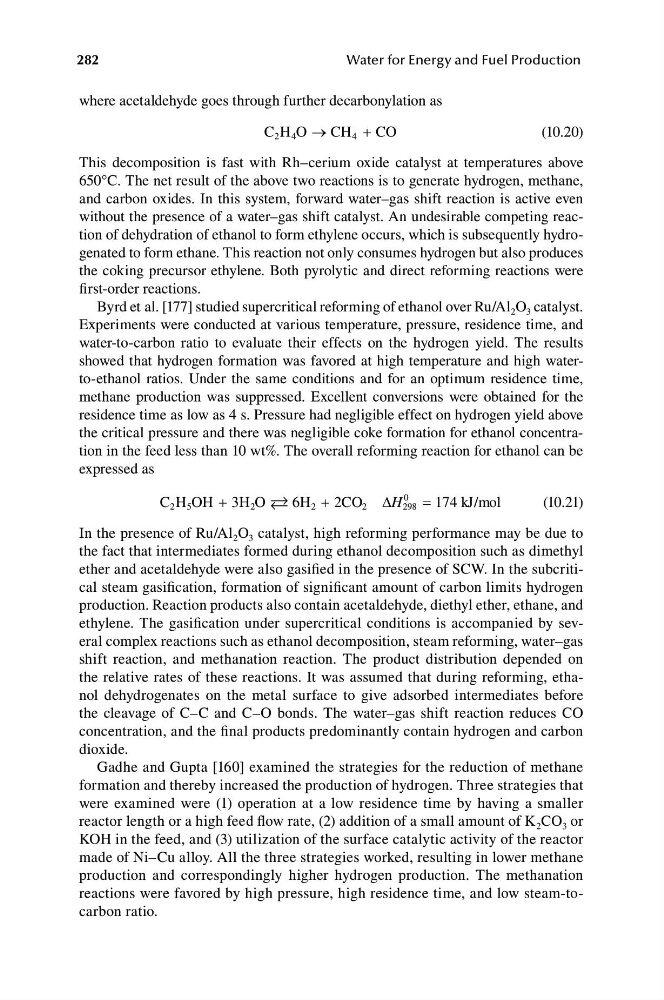
where acetaldehyde goes through further decarbonylation as
C
+
2 H 4 O → CH 4 CO
(10.20)
This decomposition is fast with Rh–cerium oxide catalyst at temperatures above
650°C. The net result of the above two reactions is to generate hydrogen, methane,
and carbon oxides. In this system, forward water–gas shift reaction is active even
without the presence of a water–gas shift catalyst. An undesirable competing reaction of dehydration of ethanol to form ethylene occurs, which is subsequently hydrogenated to form ethane. This reaction not only consumes hydrogen but also produces
the coking precursor ethylene. Both pyrolytic and direct reforming reactions were
first-order reactions.
Byrd et al. [177] studied supercritical reforming of ethanol over Ru/Al 2 O 3 catalyst.
Experiments were conducted at various temperature, pressure, residence time, and
water-to-carbon ratio to evaluate their effects on the hydrogen yield. The results
showed that hydrogen formation was favored at high temperature and high waterto-ethanol ratios. Under the same conditions and for an optimum residence time,
methane production was suppressed. Excellent conversions were obtained for the
residence time as low as 4 s. Pressure had negligible effect on hydrogen yield above
the critical pressure and there was negligible coke formation for ethanol concentration in the feed less than 10 wt%. The overall reforming reaction for ethanol can be
expressed as
C 2 H 5 OH + 3H 2 O 6H 2 + 2CO 2 ∆H
0
298 = 174 kJ/mol
(10.21)
In the presence of Ru/Al 2 O 3 catalyst, high reforming performance may be due to
the fact that intermediates formed during ethanol decomposition such as dimethyl
ether and acetaldehyde were also gasified in the presence of SCW. In the subcritical steam gasification, formation of significant amount of carbon limits hydrogen
production. Reaction products also contain acetaldehyde, diethyl ether, ethane, and
ethylene. The gasification under supercritical conditions is accompanied by several complex reactions such as ethanol decomposition, steam reforming, water–gas
shift reaction, and methanation reaction. The product distribution depended on
the relative rates of these reactions. It was assumed that during reforming, ethanol dehydrogenates on the metal surface to give adsorbed intermediates before
the cleavage of C–C and C–O bonds. The water–gas shift reaction reduces CO
concentration, and the final products predominantly contain hydrogen and carbon
dioxide.
Gadhe and Gupta [160] examined the strategies for the reduction of methane
formation and thereby increased the production of hydrogen. Three strategies that
were examined were (1) operation at a low residence time by having a smaller
reactor length or a high feed flow rate, (2) addition of a small amount of K 2 CO 3 or
KOH in the feed, and (3) utilization of the surface catalytic activity of the reactor
made of Ni–Cu alloy. All the three strategies worked, resulting in lower methane
production and correspondingly higher hydrogen production. The methanation
reactions were favored by high pressure, high residence time, and low steam-tocarbon ratio.
Water for Energy and Fuel Production
where acetaldehyde goes through further decarbonylation as
C
+
2 H 4 O → CH 4 CO
(10.20)
This decomposition is fast with Rh–cerium oxide catalyst at temperatures above
650°C. The net result of the above two reactions is to generate hydrogen, methane,
and carbon oxides. In this system, forward water–gas shift reaction is active even
without the presence of a water–gas shift catalyst. An undesirable competing reaction of dehydration of ethanol to form ethylene occurs, which is subsequently hydrogenated to form ethane. This reaction not only consumes hydrogen but also produces
the coking precursor ethylene. Both pyrolytic and direct reforming reactions were
first-order reactions.
Byrd et al. [177] studied supercritical reforming of ethanol over Ru/Al 2 O 3 catalyst.
Experiments were conducted at various temperature, pressure, residence time, and
water-to-carbon ratio to evaluate their effects on the hydrogen yield. The results
showed that hydrogen formation was favored at high temperature and high waterto-ethanol ratios. Under the same conditions and for an optimum residence time,
methane production was suppressed. Excellent conversions were obtained for the
residence time as low as 4 s. Pressure had negligible effect on hydrogen yield above
the critical pressure and there was negligible coke formation for ethanol concentration in the feed less than 10 wt%. The overall reforming reaction for ethanol can be
expressed as
C 2 H 5 OH + 3H 2 O 6H 2 + 2CO 2 ∆H
0
298 = 174 kJ/mol
(10.21)
In the presence of Ru/Al 2 O 3 catalyst, high reforming performance may be due to
the fact that intermediates formed during ethanol decomposition such as dimethyl
ether and acetaldehyde were also gasified in the presence of SCW. In the subcritical steam gasification, formation of significant amount of carbon limits hydrogen
production. Reaction products also contain acetaldehyde, diethyl ether, ethane, and
ethylene. The gasification under supercritical conditions is accompanied by several complex reactions such as ethanol decomposition, steam reforming, water–gas
shift reaction, and methanation reaction. The product distribution depended on
the relative rates of these reactions. It was assumed that during reforming, ethanol dehydrogenates on the metal surface to give adsorbed intermediates before
the cleavage of C–C and C–O bonds. The water–gas shift reaction reduces CO
concentration, and the final products predominantly contain hydrogen and carbon
dioxide.
Gadhe and Gupta [160] examined the strategies for the reduction of methane
formation and thereby increased the production of hydrogen. Three strategies that
were examined were (1) operation at a low residence time by having a smaller
reactor length or a high feed flow rate, (2) addition of a small amount of K 2 CO 3 or
KOH in the feed, and (3) utilization of the surface catalytic activity of the reactor
made of Ni–Cu alloy. All the three strategies worked, resulting in lower methane
production and correspondingly higher hydrogen production. The methanation
reactions were favored by high pressure, high residence time, and low steam-tocarbon ratio.