

283
Fuel Production by Supercritical Water
10.8 tri-reFOrminG in sCW
Fundamentally, there are three types of high-temperature reforming processes:
stream reforming, dry reforming, and partial oxidation [170–176]. The term
“ tri-reforming” is applied to the process in which all of these reforming processes
are combined in a single use. The three reforming processes are expressed by the
following set of chemical reactions:
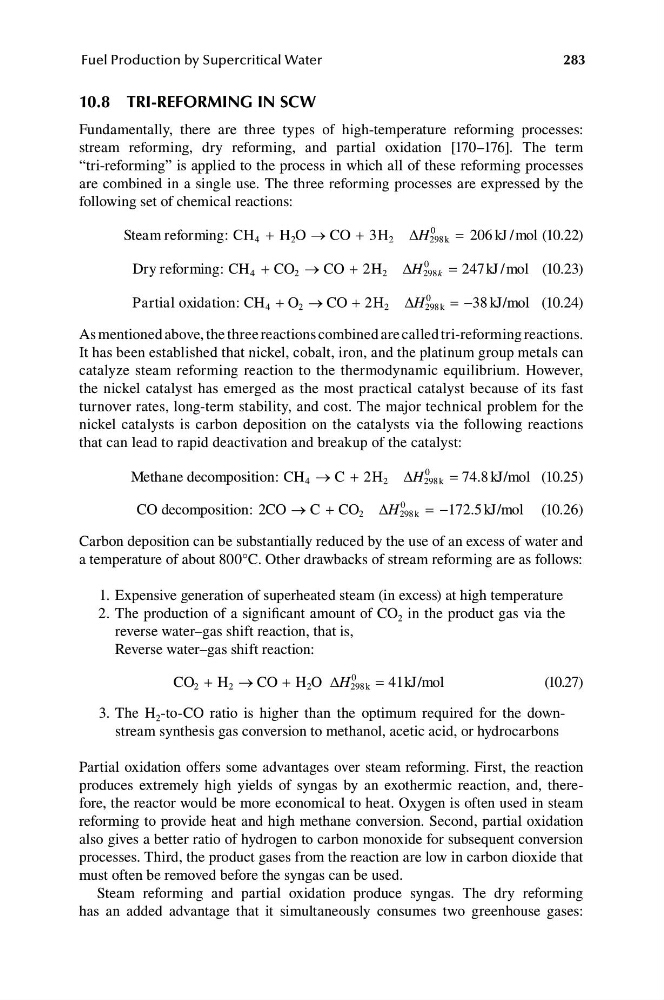
Steam reforming: CH 4 + H 2 O → CO + 3H 2 ∆H
0
298 k = 206 kJ /mol (10.22)
Dry reforming: CH +
2
O
H 2
H
0
4
CO → C + 2
∆ 298 k = 247kJ /mol (10.23)
Partial oxidation: CH 4 + O 2 → CO + 2H
0
2
∆H 298 k = −38 kJ/mol (10.24)
As mentioned above, the three reactions combined are called tri-reforming r eactions.
It has been established that nickel, cobalt, iron, and the platinum group metals can
catalyze steam reforming reaction to the thermodynamic equilibrium. However,
the nickel catalyst has emerged as the most practical catalyst because of its fast
turnover rates, long-term stability, and cost. The major technical problem for the
nickel catalysts is carbon deposition on the catalysts via the following reactions
that can lead to rapid deactivation and breakup of the catalyst:
Methane decomposition: CH → C + 2H ∆H
0
4
k
.8 k /mol
2
2
298 = 74 J
(10. 5)
CO decomposition: 2CO → C + CO 2 ∆H
0
298 k = −172.5 kJ/mol (10.26)
Carbon deposition can be substantially reduced by the use of an excess of water and
a temperature of about 800°C. Other drawbacks of stream reforming are as follows:
1. Expensive generation of superheated steam (in excess) at high temperature
2. The production of a significant amount of CO 2 in the product gas via the
reverse water–gas shift reaction, that is,
Reverse water–gas shift reaction:
CO
+
H
0
2 + H 2 → CO H 2 O ∆ 298 k = 41kJ/mol
(10.27)
3. The H 2 -to-CO ratio is higher than the optimum required for the downstream synthesis gas conversion to methanol, acetic acid, or hydrocarbons
Partial oxidation offers some advantages over steam reforming. First, the reaction
produces extremely high yields of syngas by an exothermic reaction, and, therefore, the reactor would be more economical to heat. Oxygen is often used in steam
reforming to provide heat and high methane conversion. Second, partial oxidation
also gives a better ratio of hydrogen to carbon monoxide for subsequent conversion
processes. Third, the product gases from the reaction are low in carbon dioxide that
must often be removed before the syngas can be used.
Steam reforming and partial oxidation produce syngas. The dry reforming
has an added advantage that it simultaneously consumes two greenhouse gases:
Fuel Production by Supercritical Water
10.8 tri-reFOrminG in sCW
Fundamentally, there are three types of high-temperature reforming processes:
stream reforming, dry reforming, and partial oxidation [170–176]. The term
“ tri-reforming” is applied to the process in which all of these reforming processes
are combined in a single use. The three reforming processes are expressed by the
following set of chemical reactions:
Steam reforming: CH 4 + H 2 O → CO + 3H 2 ∆H
0
298 k = 206 kJ /mol (10.22)
Dry reforming: CH +
2
O
H 2
H
0
4
CO → C + 2
∆ 298 k = 247kJ /mol (10.23)
Partial oxidation: CH 4 + O 2 → CO + 2H
0
2
∆H 298 k = −38 kJ/mol (10.24)
As mentioned above, the three reactions combined are called tri-reforming r eactions.
It has been established that nickel, cobalt, iron, and the platinum group metals can
catalyze steam reforming reaction to the thermodynamic equilibrium. However,
the nickel catalyst has emerged as the most practical catalyst because of its fast
turnover rates, long-term stability, and cost. The major technical problem for the
nickel catalysts is carbon deposition on the catalysts via the following reactions
that can lead to rapid deactivation and breakup of the catalyst:
Methane decomposition: CH → C + 2H ∆H
0
4
k
.8 k /mol
2
2
298 = 74 J
(10. 5)
CO decomposition: 2CO → C + CO 2 ∆H
0
298 k = −172.5 kJ/mol (10.26)
Carbon deposition can be substantially reduced by the use of an excess of water and
a temperature of about 800°C. Other drawbacks of stream reforming are as follows:
1. Expensive generation of superheated steam (in excess) at high temperature
2. The production of a significant amount of CO 2 in the product gas via the
reverse water–gas shift reaction, that is,
Reverse water–gas shift reaction:
CO
+
H
0
2 + H 2 → CO H 2 O ∆ 298 k = 41kJ/mol
(10.27)
3. The H 2 -to-CO ratio is higher than the optimum required for the downstream synthesis gas conversion to methanol, acetic acid, or hydrocarbons
Partial oxidation offers some advantages over steam reforming. First, the reaction
produces extremely high yields of syngas by an exothermic reaction, and, therefore, the reactor would be more economical to heat. Oxygen is often used in steam
reforming to provide heat and high methane conversion. Second, partial oxidation
also gives a better ratio of hydrogen to carbon monoxide for subsequent conversion
processes. Third, the product gases from the reaction are low in carbon dioxide that
must often be removed before the syngas can be used.
Steam reforming and partial oxidation produce syngas. The dry reforming
has an added advantage that it simultaneously consumes two greenhouse gases: