

281
Fuel Production by Supercritical Water
CH 3 OH CO + 2H 2 ∆H
0
298 = 91.7 kJ/mol
(10.14)
CO + H 2 O → CO 2 + H 2 ∆H
0
298 = − 41 kJ/mol
(10.15)
CH
H
0
3 OH + H 2 O CO 2 + 3H 2 ∆ 298 = 50.7 kJ/mol
(10.16)
CO + 3H
CH
H O
0
2
4 + 2
∆H 298 = − 211 kJ/mol
(10.17)
CO + 4H CH + 2H O ∆H
0
= − 223 kJ/mol
(10.18)
2
2
4
2
298
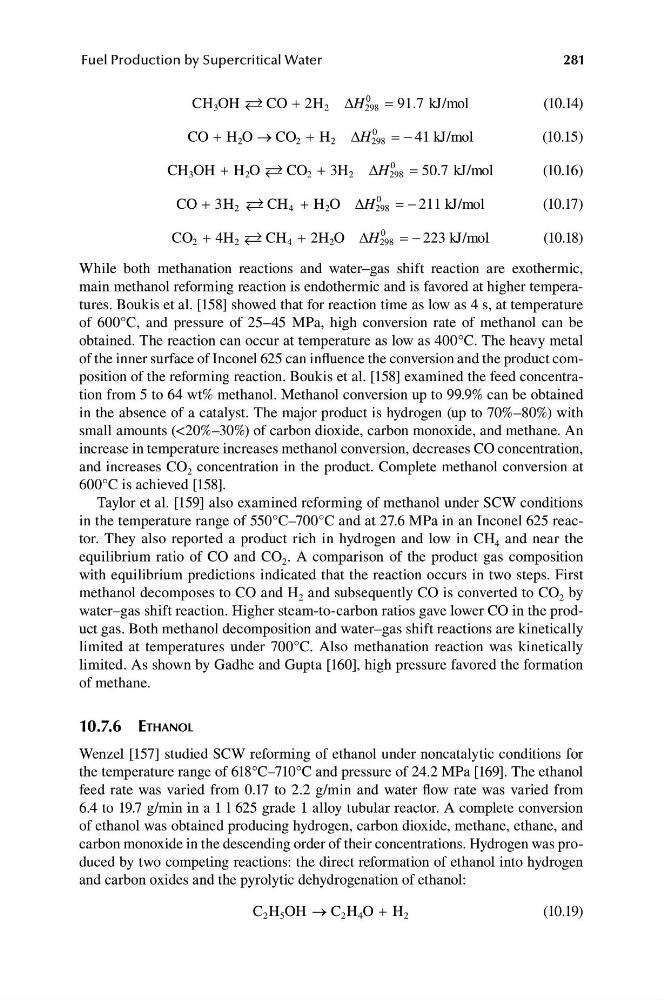
While both methanation reactions and water–gas shift reaction are exothermic,
main methanol reforming reaction is endothermic and is favored at higher temperatures. Boukis et al. [158] showed that for reaction time as low as 4 s, at temperature
of 600°C, and pressure of 25–45 MPa, high conversion rate of methanol can be
obtained. The reaction can occur at temperature as low as 400°C. The heavy metal
of the inner surface of Inconel 625 can influence the conversion and the product composition of the reforming reaction. Boukis et al. [158] examined the feed concentration from 5 to 64 wt% methanol. Methanol conversion up to 99.9% can be obtained
in the absence of a catalyst. The major product is hydrogen (up to 70%–80%) with
small amounts (<20%–30%) of carbon dioxide, carbon monoxide, and methane. An
increase in temperature increases methanol conversion, decreases CO concentration,
and increases CO 2 concentration in the product. Complete methanol conversion at
600°C is achieved [158].
Taylor et al. [159] also examined reforming of methanol under SCW conditions
in the temperature range of 550°C–700°C and at 27.6 MPa in an Inconel 625 reactor. They also reported a product rich in hydrogen and low in CH 4 and near the
equilibrium ratio of CO and CO 2 . A comparison of the product gas composition
with equilibrium predictions indicated that the reaction occurs in two steps. First
methanol decomposes to CO and H 2 and subsequently CO is converted to CO 2 by
water–gas shift reaction. Higher steam-to-carbon ratios gave lower CO in the product gas. Both methanol decomposition and water–gas shift reactions are kinetically
limited at temperatures under 700°C. Also methanation reaction was kinetically
limited. As shown by Gadhe and Gupta [160], high pressure favored the formation
of methane.
10.7.6 eThAnol
Wenzel [157] studied SCW reforming of ethanol under noncatalytic conditions for
the temperature range of 618°C–710°C and pressure of 24.2 MPa [169]. The ethanol
feed rate was varied from 0.17 to 2.2 g/min and water flow rate was varied from
6.4 to 19.7 g/min in a 1 l 625 grade 1 alloy tubular reactor. A complete conversion
of ethanol was obtained producing hydrogen, carbon dioxide, methane, ethane, and
carbon monoxide in the descending order of their concentrations. Hydrogen was produced by two competing reactions: the direct reformation of ethanol into hydrogen
and carbon oxides and the pyrolytic dehydrogenation of ethanol:
C 2 H 5 OH → C 2 H 4 O + H 2
(10.19)
Fuel Production by Supercritical Water
CH 3 OH CO + 2H 2 ∆H
0
298 = 91.7 kJ/mol
(10.14)
CO + H 2 O → CO 2 + H 2 ∆H
0
298 = − 41 kJ/mol
(10.15)
CH
H
0
3 OH + H 2 O CO 2 + 3H 2 ∆ 298 = 50.7 kJ/mol
(10.16)
CO + 3H
CH
H O
0
2
4 + 2
∆H 298 = − 211 kJ/mol
(10.17)
CO + 4H CH + 2H O ∆H
0
= − 223 kJ/mol
(10.18)
2
2
4
2
298
While both methanation reactions and water–gas shift reaction are exothermic,
main methanol reforming reaction is endothermic and is favored at higher temperatures. Boukis et al. [158] showed that for reaction time as low as 4 s, at temperature
of 600°C, and pressure of 25–45 MPa, high conversion rate of methanol can be
obtained. The reaction can occur at temperature as low as 400°C. The heavy metal
of the inner surface of Inconel 625 can influence the conversion and the product composition of the reforming reaction. Boukis et al. [158] examined the feed concentration from 5 to 64 wt% methanol. Methanol conversion up to 99.9% can be obtained
in the absence of a catalyst. The major product is hydrogen (up to 70%–80%) with
small amounts (<20%–30%) of carbon dioxide, carbon monoxide, and methane. An
increase in temperature increases methanol conversion, decreases CO concentration,
and increases CO 2 concentration in the product. Complete methanol conversion at
600°C is achieved [158].
Taylor et al. [159] also examined reforming of methanol under SCW conditions
in the temperature range of 550°C–700°C and at 27.6 MPa in an Inconel 625 reactor. They also reported a product rich in hydrogen and low in CH 4 and near the
equilibrium ratio of CO and CO 2 . A comparison of the product gas composition
with equilibrium predictions indicated that the reaction occurs in two steps. First
methanol decomposes to CO and H 2 and subsequently CO is converted to CO 2 by
water–gas shift reaction. Higher steam-to-carbon ratios gave lower CO in the product gas. Both methanol decomposition and water–gas shift reactions are kinetically
limited at temperatures under 700°C. Also methanation reaction was kinetically
limited. As shown by Gadhe and Gupta [160], high pressure favored the formation
of methane.
10.7.6 eThAnol
Wenzel [157] studied SCW reforming of ethanol under noncatalytic conditions for
the temperature range of 618°C–710°C and pressure of 24.2 MPa [169]. The ethanol
feed rate was varied from 0.17 to 2.2 g/min and water flow rate was varied from
6.4 to 19.7 g/min in a 1 l 625 grade 1 alloy tubular reactor. A complete conversion
of ethanol was obtained producing hydrogen, carbon dioxide, methane, ethane, and
carbon monoxide in the descending order of their concentrations. Hydrogen was produced by two competing reactions: the direct reformation of ethanol into hydrogen
and carbon oxides and the pyrolytic dehydrogenation of ethanol:
C 2 H 5 OH → C 2 H 4 O + H 2
(10.19)