

207
Anaerobic Digestion of Aqueous Waste for Methane and Hydrogen
Second, it provided the readily available organic nitrogen such as soluble proteins
and amino acids to microorganisms. Thus, the existence of protein in the substrate of
biohydrogen production is important. To get the maximum hydrogen production from
carbohydrates, the protein content in feedstock should be optimized. Organic nitrogen in proteins is transformed into inorganic ammonia nitrogen in anaerobic degradation. Ammonia and amino groups released from proteins neutralize the potential pH
decrease imposed by volatile fatty acids. Thus, proteins can maintain a suitable pH by
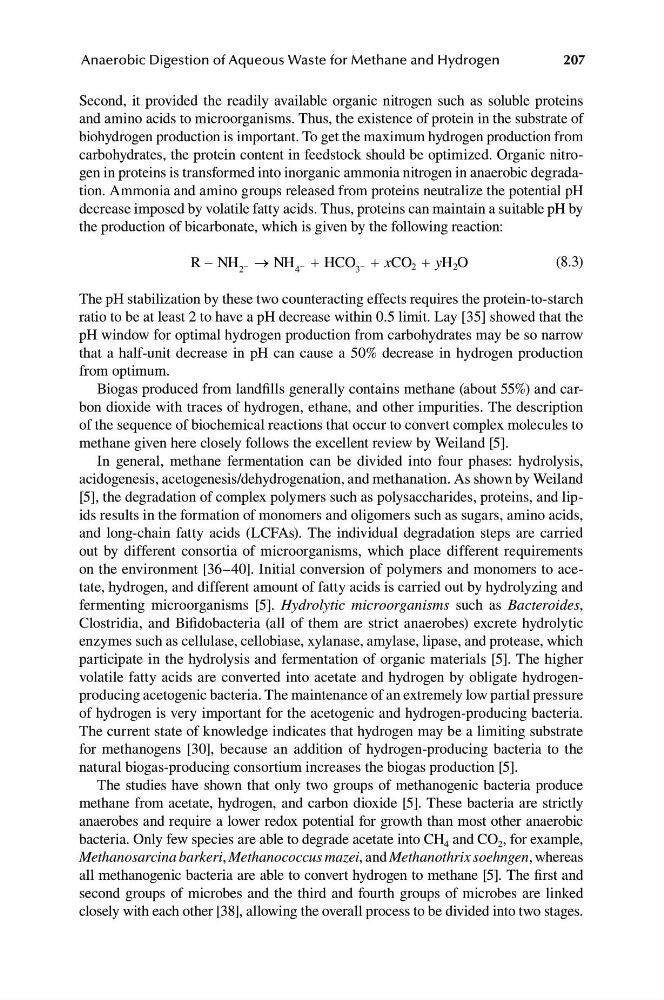
the production of bicarbonate, which is given by the following reaction:
(8.3)
The pH stabilization by these two counteracting effects requires the protein-to-starch
ratio to be at least 2 to have a pH decrease within 0.5 limit. Lay [35] showed that the
pH window for optimal hydrogen production from carbohydrates may be so narrow
that a half-unit decrease in pH can cause a 50% decrease in hydrogen production
from optimum.
Biogas produced from landfills generally contains methane (about 55%) and carbon dioxide with traces of hydrogen, ethane, and other impurities. The description
of the sequence of biochemical reactions that occur to convert complex molecules to
methane given here closely follows the excellent review by Weiland [5].
In general, methane fermentation can be divided into four phases: hydrolysis,
acidogenesis, acetogenesis/dehydrogenation, and methanation. As shown by Weiland
[5], the degradation of complex polymers such as polysaccharides, proteins, and lipids results in the formation of monomers and oligomers such as sugars, amino acids,
and long-chain fatty acids (LCFAs). The individual degradation steps are carried
out by different consortia of microorganisms, which place different requirements
on the environment [36–40]. Initial conversion of polymers and monomers to acetate, hydrogen, and different amount of fatty acids is carried out by hydrolyzing and
fermenting microorganisms [5]. Hydrolytic microorganisms such as Bacteroides,
Clostridia, and Bifidobacteria (all of them are strict anaerobes) excrete hydrolytic
enzymes such as cellulase, cellobiase, xylanase, amylase, lipase, and protease, which
participate in the hydrolysis and fermentation of organic materials [5]. The higher
volatile fatty acids are converted into acetate and hydrogen by obligate hydrogenproducing acetogenic bacteria. The maintenance of an extremely low partial pressure
of hydrogen is very important for the acetogenic and hydrogen-producing bacteria.
The current state of knowledge indicates that hydrogen may be a limiting substrate
for methanogens [30], because an addition of hydrogen-producing bacteria to the
natural biogas-producing consortium increases the biogas production [5].
The studies have shown that only two groups of methanogenic bacteria produce
methane from acetate, hydrogen, and carbon dioxide [5]. These bacteria are strictly
anaerobes and require a lower redox potential for growth than most other anaerobic
bacteria. Only few species are able to degrade acetate into CH 4 and CO 2 , for example,
Methanosarcina barkeri, Methanococcus mazei, and Methanothrix soehngen, whereas
all methanogenic bacteria are able to convert hydrogen to methane [5]. The first and
second groups of microbes and the third and fourth groups of microbes are linked
closely with each other [38], allowing the overall process to be divided into two stages.
R NH
NH
HCO
CO
H O
2
−
+
+
+
→
−
−
−
2
4
3
2
x
y
Anaerobic Digestion of Aqueous Waste for Methane and Hydrogen
Second, it provided the readily available organic nitrogen such as soluble proteins
and amino acids to microorganisms. Thus, the existence of protein in the substrate of
biohydrogen production is important. To get the maximum hydrogen production from
carbohydrates, the protein content in feedstock should be optimized. Organic nitrogen in proteins is transformed into inorganic ammonia nitrogen in anaerobic degradation. Ammonia and amino groups released from proteins neutralize the potential pH
decrease imposed by volatile fatty acids. Thus, proteins can maintain a suitable pH by
the production of bicarbonate, which is given by the following reaction:
(8.3)
The pH stabilization by these two counteracting effects requires the protein-to-starch
ratio to be at least 2 to have a pH decrease within 0.5 limit. Lay [35] showed that the
pH window for optimal hydrogen production from carbohydrates may be so narrow
that a half-unit decrease in pH can cause a 50% decrease in hydrogen production
from optimum.
Biogas produced from landfills generally contains methane (about 55%) and carbon dioxide with traces of hydrogen, ethane, and other impurities. The description
of the sequence of biochemical reactions that occur to convert complex molecules to
methane given here closely follows the excellent review by Weiland [5].
In general, methane fermentation can be divided into four phases: hydrolysis,
acidogenesis, acetogenesis/dehydrogenation, and methanation. As shown by Weiland
[5], the degradation of complex polymers such as polysaccharides, proteins, and lipids results in the formation of monomers and oligomers such as sugars, amino acids,
and long-chain fatty acids (LCFAs). The individual degradation steps are carried
out by different consortia of microorganisms, which place different requirements
on the environment [36–40]. Initial conversion of polymers and monomers to acetate, hydrogen, and different amount of fatty acids is carried out by hydrolyzing and
fermenting microorganisms [5]. Hydrolytic microorganisms such as Bacteroides,
Clostridia, and Bifidobacteria (all of them are strict anaerobes) excrete hydrolytic
enzymes such as cellulase, cellobiase, xylanase, amylase, lipase, and protease, which
participate in the hydrolysis and fermentation of organic materials [5]. The higher
volatile fatty acids are converted into acetate and hydrogen by obligate hydrogenproducing acetogenic bacteria. The maintenance of an extremely low partial pressure
of hydrogen is very important for the acetogenic and hydrogen-producing bacteria.
The current state of knowledge indicates that hydrogen may be a limiting substrate
for methanogens [30], because an addition of hydrogen-producing bacteria to the
natural biogas-producing consortium increases the biogas production [5].
The studies have shown that only two groups of methanogenic bacteria produce
methane from acetate, hydrogen, and carbon dioxide [5]. These bacteria are strictly
anaerobes and require a lower redox potential for growth than most other anaerobic
bacteria. Only few species are able to degrade acetate into CH 4 and CO 2 , for example,
Methanosarcina barkeri, Methanococcus mazei, and Methanothrix soehngen, whereas
all methanogenic bacteria are able to convert hydrogen to methane [5]. The first and
second groups of microbes and the third and fourth groups of microbes are linked
closely with each other [38], allowing the overall process to be divided into two stages.
R NH
NH
HCO
CO
H O
2
−
+
+
+
→
−
−
−
2
4
3
2
x
y