

206
Water for Energy and Fuel Production
in the United States is close to 250 million tons per year, and globally, this number
will soon reach one billion tons per year. Biogas is an effective way to convert this
waste into useful and environmentally acceptable form of energy for growing waste
industry. Since every country in the world has waste problem, biogas industry is
universally applied [5].
The literature on biogas deals with both biomethanation and biohydrogenation. As
will be discussed later, the hydrolysis of organic waste followed by anaerobic digestion can produce hydrogen or methane depending on the nature of operating conditions, the nature of microorganisms present, and the nature of feedstock. It should
also be noted that methane can be converted to hydrogen by reforming reactions.
8.2 BasiC PrinCiPles OF anaerOBiC diGestiOn
Anaerobic digestion (in the absence of oxygen) with anaerobic bacteria or methane
fermentation is used worldwide for disposal of domestic, municipal, agricultural,
and industrial biomass wastes. This reaction generally produces methane and carbon dioxide, and it also occurs in the ecosystem as well as in the digestive tract. As
shown by the following reactions, hydrogen along with acetic and butyric acids can
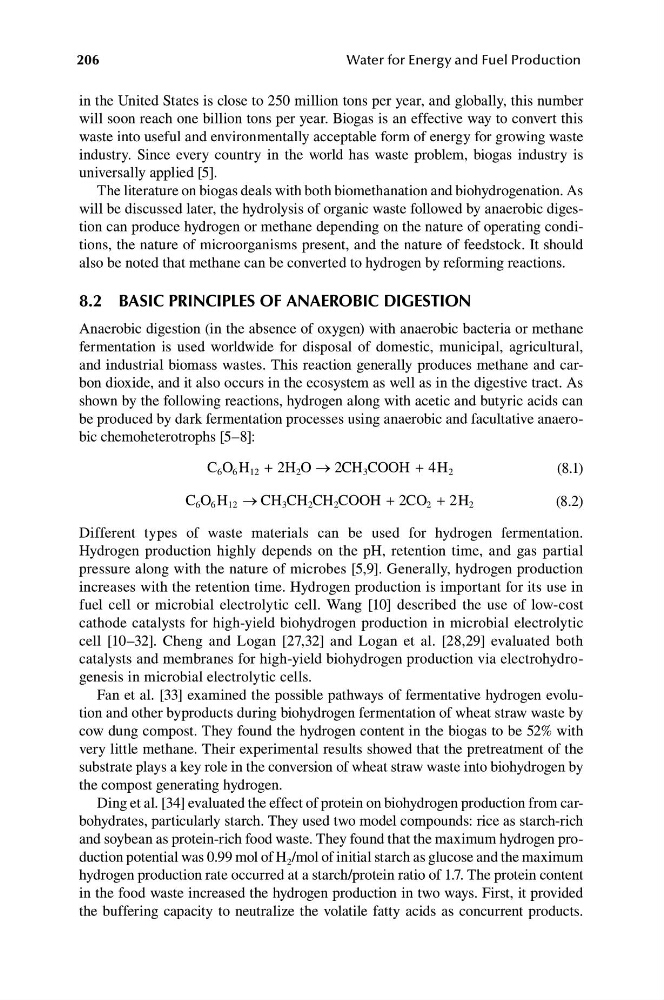
be produced by dark fermentation processes using anaerobic and facultative anaerobic chemoheterotrophs [5–8]:
(8.1)
(8.2)
Different types of waste materials can be used for hydrogen fermentation.
Hydrogen production highly depends on the pH, retention time, and gas partial
pressure along with the nature of microbes [5,9]. Generally, hydrogen production
increases with the retention time. Hydrogen production is important for its use in
fuel cell or microbial electrolytic cell. Wang [10] described the use of low-cost
cathode catalysts for high-yield biohydrogen production in microbial electrolytic
cell [10–32]. Cheng and Logan [27,32] and Logan et al. [28,29] evaluated both
catalysts and membranes for high-yield biohydrogen production via electrohydrogenesis in microbial electrolytic cells.
Fan et al. [33] examined the possible pathways of fermentative hydrogen evolution and other byproducts during biohydrogen fermentation of wheat straw waste by
cow dung compost. They found the hydrogen content in the biogas to be 52% with
very little methane. Their experimental results showed that the pretreatment of the
substrate plays a key role in the conversion of wheat straw waste into biohydrogen by
the compost generating hydrogen.
Ding et al. [34] evaluated the effect of protein on biohydrogen production from carbohydrates, particularly starch. They used two model compounds: rice as starch-rich
and soybean as protein-rich food waste. They found that the maximum hydrogen production potential was 0.99 mol of H 2 /mol of initial starch as glucose and the maximum
hydrogen production rate occurred at a starch/protein ratio of 1.7. The protein content
in the food waste increased the hydrogen production in two ways. First, it provided
the buffering capacity to neutralize the volatile fatty acids as concurrent products.
C O H
2H O
CH COOH
H
6 6 12
2
3
+
→
+
2
4 2
C O H
CH CH CH COOH
CO
H
6 6 12
3
2
2
2
2
2
2
→
+
+