

Pt–Re/C
Syngas
FT
OH
C–C
cleavage
Fuel cells
HO
OH
Pt/Al 2 O 3
H 2 production
Aqueous-phase reforming
Liquid fuels
HO
HO
OH
O
OH
OH
C–O
cleavage
Pt–Re/C
Monofunctionals
Pt–SiO 2 /Al 2 O 3
Light alkanes
160
Water for Energy and Fuel Production
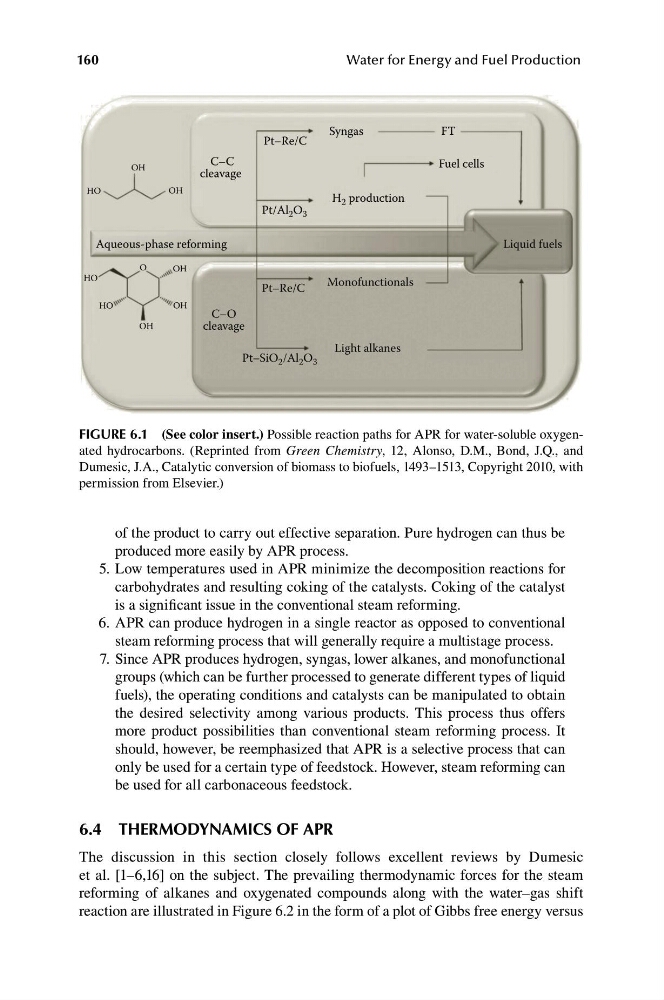
FiGUre 6.1 (See color insert.) Possible reaction paths for APR for water-soluble oxygenated hydrocarbons. (Reprinted from Green Chemistry, 12, Alonso, D.M., Bond, J.Q., and
Dumesic, J.A., Catalytic conversion of biomass to biofuels, 1493–1513, Copyright 2010, with
permission from Elsevier.)
of the product to carry out effective separation. Pure hydrogen can thus be
produced more easily by APR process.
5. Low temperatures used in APR minimize the decomposition reactions for
carbohydrates and resulting coking of the catalysts. Coking of the catalyst
is a significant issue in the conventional steam reforming.
6. APR can produce hydrogen in a single reactor as opposed to conventional
steam reforming process that will generally require a multistage process.
7. Since APR produces hydrogen, syngas, lower alkanes, and monofunctional
groups (which can be further processed to generate different types of liquid
fuels), the operating conditions and catalysts can be manipulated to obtain
the desired selectivity among various products. This process thus offers
more product possibilities than conventional steam reforming process. It
should, however, be reemphasized that APR is a selective process that can
only be used for a certain type of feedstock. However, steam reforming can
be used for all carbonaceous feedstock.
6.4 thermOdynamiCs OF aPr
The discussion in this section closely follows excellent reviews by Dumesic
et al. [1–6,16] on the subject. The prevailing thermodynamic forces for the steam
reforming of alkanes and oxygenated compounds along with the water–gas shift
reaction are illustrated in Figure 6.2 in the form of a plot of Gibbs free energy versus
Syngas
FT
OH
C–C
cleavage
Fuel cells
HO
OH
Pt/Al 2 O 3
H 2 production
Aqueous-phase reforming
Liquid fuels
HO
HO
OH
O
OH
OH
C–O
cleavage
Pt–Re/C
Monofunctionals
Pt–SiO 2 /Al 2 O 3
Light alkanes
160
Water for Energy and Fuel Production
FiGUre 6.1 (See color insert.) Possible reaction paths for APR for water-soluble oxygenated hydrocarbons. (Reprinted from Green Chemistry, 12, Alonso, D.M., Bond, J.Q., and
Dumesic, J.A., Catalytic conversion of biomass to biofuels, 1493–1513, Copyright 2010, with
permission from Elsevier.)
of the product to carry out effective separation. Pure hydrogen can thus be
produced more easily by APR process.
5. Low temperatures used in APR minimize the decomposition reactions for
carbohydrates and resulting coking of the catalysts. Coking of the catalyst
is a significant issue in the conventional steam reforming.
6. APR can produce hydrogen in a single reactor as opposed to conventional
steam reforming process that will generally require a multistage process.
7. Since APR produces hydrogen, syngas, lower alkanes, and monofunctional
groups (which can be further processed to generate different types of liquid
fuels), the operating conditions and catalysts can be manipulated to obtain
the desired selectivity among various products. This process thus offers
more product possibilities than conventional steam reforming process. It
should, however, be reemphasized that APR is a selective process that can
only be used for a certain type of feedstock. However, steam reforming can
be used for all carbonaceous feedstock.
6.4 thermOdynamiCs OF aPr
The discussion in this section closely follows excellent reviews by Dumesic
et al. [1–6,16] on the subject. The prevailing thermodynamic forces for the steam
reforming of alkanes and oxygenated compounds along with the water–gas shift
reaction are illustrated in Figure 6.2 in the form of a plot of Gibbs free energy versus