

Primary Feedstock
Water-soluble oxygenated hydrocarbons such as sugars, sugar alcohols, saccharides, and other
polyhydric alcohols
secondary Feedstock a
Sugar crops
Grain crops
Agricultural waste (cornstalks, straw, seed hulls, sugarcane leavings)
Bagasse, nutshells, manure (from cattle, poultry, and hogs)
Wood materials (wood or bark, sawdust, timber slash, mill scrap)
Municipal waste (waste paper, yard clippings)
Energy crops (poplars, willows, alfalfa, switchgrass, prairie bluestem, corn, soybean)
Source: Huber, G.W., Cortright, R.D., and Dumesic J.A., Angewandte Chemie International Edition, 43,
1549–1551, 2004. With permission; Davda, R. and Dumesic, J., Angewandte Chemie
International Edition, 42, 4068, 2003. With permission; Tao, J., Shishi, C., and Fahai, C.,
Chemical Industry and Engineering Progress, 31, 1010–1017, 2012. With permission; Alonso,
D.M., Bond, J.Q., and Dumesic, J.A., Green Chemistry, 12, 1493–1513, 2010. With permission;
Cortright, R., Davda, R., and Dumesic, J., Nature, 418, 964–967, 2002. With permission;
Huber, G. and Dumesic, J., Catalysis Today, 111, 119–132, 2006. With permission; Blommel,
P.G. and Cortright, R.D., “Production of conventional liquid fuels from sugars,” A White Paper
for European Platform on Biofuels, 2012. With permission.
a These are used to generate primary feedstock.
159
Aqueous-Phase Reforming and BioForming Process
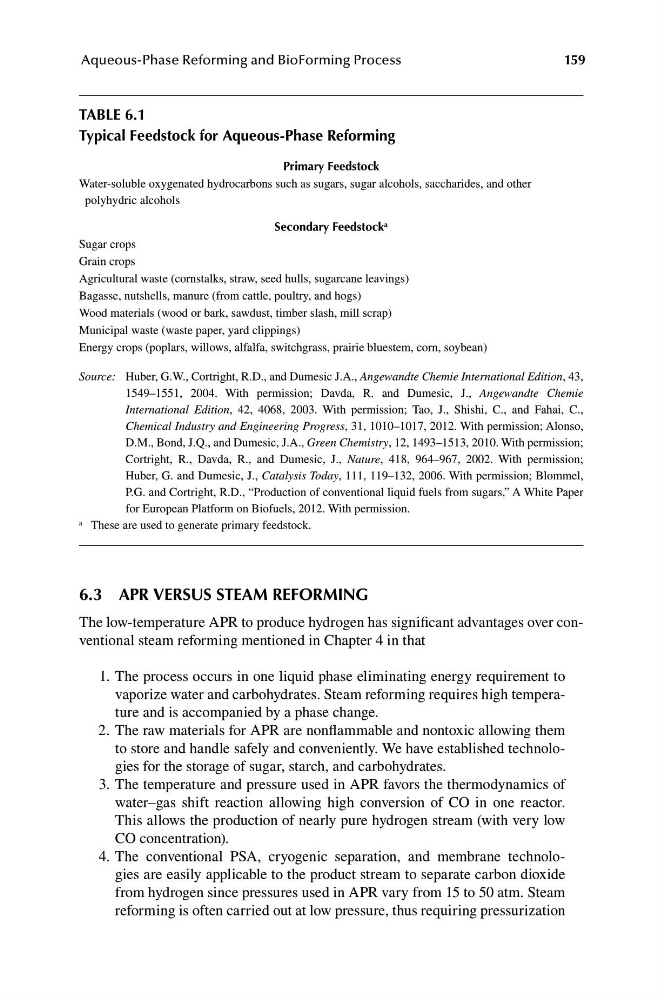
taBle 6.1
typical Feedstock for aqueous-Phase reforming
6.3 aPr VersUs steam reFOrminG
The low-temperature APR to produce hydrogen has significant advantages over conventional steam reforming mentioned in Chapter 4 in that
1. The process occurs in one liquid phase eliminating energy requirement to
vaporize water and carbohydrates. Steam reforming requires high temperature and is accompanied by a phase change.
2. The raw materials for APR are nonflammable and nontoxic allowing them
to store and handle safely and conveniently. We have established technologies for the storage of sugar, starch, and carbohydrates.
3. The temperature and pressure used in APR favors the thermodynamics of
water–gas shift reaction allowing high conversion of CO in one reactor.
This allows the production of nearly pure hydrogen stream (with very low
CO concentration).
4. The conventional PSA, cryogenic separation, and membrane technologies are easily applicable to the product stream to separate carbon dioxide
from hydrogen since pressures used in APR vary from 15 to 50 atm. Steam
reforming is often carried out at low pressure, thus requiring pressurization
Water-soluble oxygenated hydrocarbons such as sugars, sugar alcohols, saccharides, and other
polyhydric alcohols
secondary Feedstock a
Sugar crops
Grain crops
Agricultural waste (cornstalks, straw, seed hulls, sugarcane leavings)
Bagasse, nutshells, manure (from cattle, poultry, and hogs)
Wood materials (wood or bark, sawdust, timber slash, mill scrap)
Municipal waste (waste paper, yard clippings)
Energy crops (poplars, willows, alfalfa, switchgrass, prairie bluestem, corn, soybean)
Source: Huber, G.W., Cortright, R.D., and Dumesic J.A., Angewandte Chemie International Edition, 43,
1549–1551, 2004. With permission; Davda, R. and Dumesic, J., Angewandte Chemie
International Edition, 42, 4068, 2003. With permission; Tao, J., Shishi, C., and Fahai, C.,
Chemical Industry and Engineering Progress, 31, 1010–1017, 2012. With permission; Alonso,
D.M., Bond, J.Q., and Dumesic, J.A., Green Chemistry, 12, 1493–1513, 2010. With permission;
Cortright, R., Davda, R., and Dumesic, J., Nature, 418, 964–967, 2002. With permission;
Huber, G. and Dumesic, J., Catalysis Today, 111, 119–132, 2006. With permission; Blommel,
P.G. and Cortright, R.D., “Production of conventional liquid fuels from sugars,” A White Paper
for European Platform on Biofuels, 2012. With permission.
a These are used to generate primary feedstock.
159
Aqueous-Phase Reforming and BioForming Process
taBle 6.1
typical Feedstock for aqueous-Phase reforming
6.3 aPr VersUs steam reFOrminG
The low-temperature APR to produce hydrogen has significant advantages over conventional steam reforming mentioned in Chapter 4 in that
1. The process occurs in one liquid phase eliminating energy requirement to
vaporize water and carbohydrates. Steam reforming requires high temperature and is accompanied by a phase change.
2. The raw materials for APR are nonflammable and nontoxic allowing them
to store and handle safely and conveniently. We have established technologies for the storage of sugar, starch, and carbohydrates.
3. The temperature and pressure used in APR favors the thermodynamics of
water–gas shift reaction allowing high conversion of CO in one reactor.
This allows the production of nearly pure hydrogen stream (with very low
CO concentration).
4. The conventional PSA, cryogenic separation, and membrane technologies are easily applicable to the product stream to separate carbon dioxide
from hydrogen since pressures used in APR vary from 15 to 50 atm. Steam
reforming is often carried out at low pressure, thus requiring pressurization