

20
15
5
−5
−10
−15
−20
0
ΔG°/RT
or In(P)
WGS
In(P)
CH 3 (OH):C 6 H 8 (OH) 6
CH 4 :C 6 H 14
10
300
400
500
600
700
800
900
1000
Temperature (K)
161
Aqueous-Phase Reforming and BioForming Process
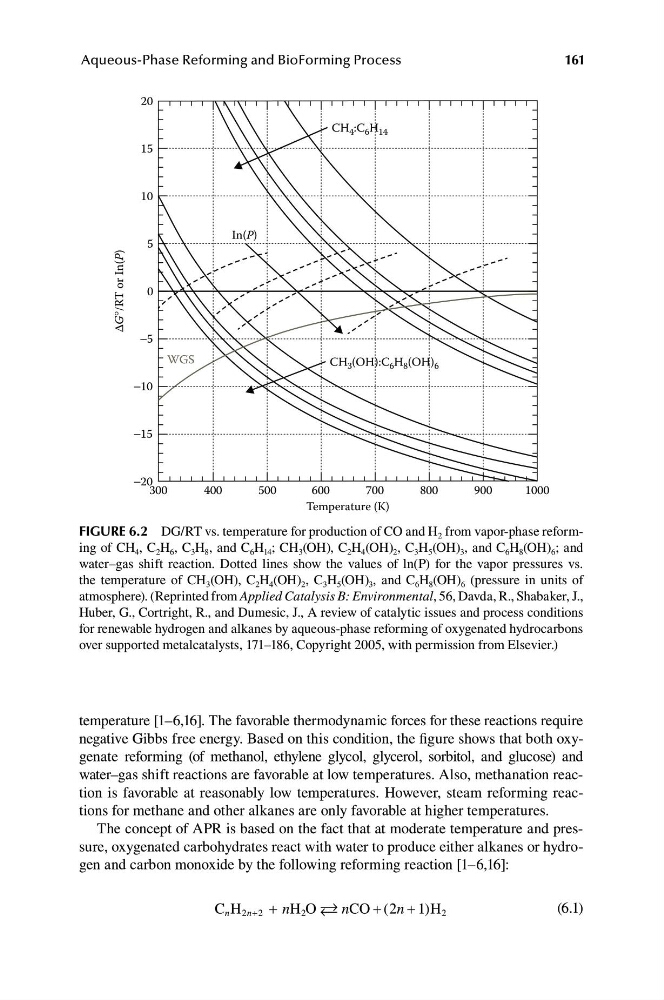
FiGUre 6.2 DG/RT vs. temperature for production of CO and H 2 from vapor-phase reforming of CH 4 , C 2 H 6 , C 3 H 8 , and C 6 H 14 ; CH 3 (OH), C 2 H 4 (OH) 2 , C 3 H 5 (OH) 3 , and C 6 H 8 (OH) 6 ; and
water–gas shift reaction. Dotted lines show the values of ln(P) for the vapor pressures vs.
the temperature of CH 3 (OH), C 2 H 4 (OH) 2 , C 3 H 5 (OH) 3 , and C 6 H 8 (OH) 6 (pressure in units of
atmosphere). (Reprinted from Applied Catalysis B: Environmental, 56, Davda, R., Shabaker, J.,
Huber, G., Cortright, R., and Dumesic, J., A review of catalytic issues and process conditions
for renewable hydrogen and alkanes by aqueous-phase reforming of oxygenated hydrocarbons
over supported metalcatalysts, 171–186, Copyright 2005, with permission from Elsevier.)
temperature [1–6,16]. The favorable thermodynamic forces for these reactions require
negative Gibbs free energy. Based on this condition, the figure shows that both oxygenate reforming (of methanol, ethylene glycol, glycerol, sorbitol, and glucose) and
water–gas shift reactions are favorable at low temperatures. Also, methanation reaction is favorable at reasonably low temperatures. However, steam reforming reactions for methane and other alkanes are only favorable at higher temperatures.
The concept of APR is based on the fact that at moderate temperature and pressure, oxygenated carbohydrates react with water to produce either alkanes or hydrogen and carbon monoxide by the following reforming reaction [1–6,16]:
C H
+ nH O nCO + (2n + 1)H
(6.1)
n 2n+2
2
2
15
5
−5
−10
−15
−20
0
ΔG°/RT
or In(P)
WGS
In(P)
CH 3 (OH):C 6 H 8 (OH) 6
CH 4 :C 6 H 14
10
300
400
500
600
700
800
900
1000
Temperature (K)
161
Aqueous-Phase Reforming and BioForming Process
FiGUre 6.2 DG/RT vs. temperature for production of CO and H 2 from vapor-phase reforming of CH 4 , C 2 H 6 , C 3 H 8 , and C 6 H 14 ; CH 3 (OH), C 2 H 4 (OH) 2 , C 3 H 5 (OH) 3 , and C 6 H 8 (OH) 6 ; and
water–gas shift reaction. Dotted lines show the values of ln(P) for the vapor pressures vs.
the temperature of CH 3 (OH), C 2 H 4 (OH) 2 , C 3 H 5 (OH) 3 , and C 6 H 8 (OH) 6 (pressure in units of
atmosphere). (Reprinted from Applied Catalysis B: Environmental, 56, Davda, R., Shabaker, J.,
Huber, G., Cortright, R., and Dumesic, J., A review of catalytic issues and process conditions
for renewable hydrogen and alkanes by aqueous-phase reforming of oxygenated hydrocarbons
over supported metalcatalysts, 171–186, Copyright 2005, with permission from Elsevier.)
temperature [1–6,16]. The favorable thermodynamic forces for these reactions require
negative Gibbs free energy. Based on this condition, the figure shows that both oxygenate reforming (of methanol, ethylene glycol, glycerol, sorbitol, and glucose) and
water–gas shift reactions are favorable at low temperatures. Also, methanation reaction is favorable at reasonably low temperatures. However, steam reforming reactions for methane and other alkanes are only favorable at higher temperatures.
The concept of APR is based on the fact that at moderate temperature and pressure, oxygenated carbohydrates react with water to produce either alkanes or hydrogen and carbon monoxide by the following reforming reaction [1–6,16]:
C H
+ nH O nCO + (2n + 1)H
(6.1)
n 2n+2
2
2