

solubility (kg/kg)
temperature (°C)
Coconut Fatty acids
tallow Fatty acids
100
0.05
0.01
150
0.075
0.02
200
0.1
0.05
250
0.28
0.1
300 a
0.70
0.23
Increase b
14
23
Source: Peterson, A., Vogel, F., Lachance, R., Frolling, M., Antal, M., and
Tester, J., Energy & Environmental Science, 1, 32–65, 2008. With
permission.
a The best extrapolated estimates from the graphical data.
b Increase ratio indicates solubility at 300°C/solubility at 100°C.
117
Hydrothermal Processes in Subcritical Water
taBle 5.3
Water Concentration in two Fatty acids at different
temperatures and at the Vapor Pressure of the system
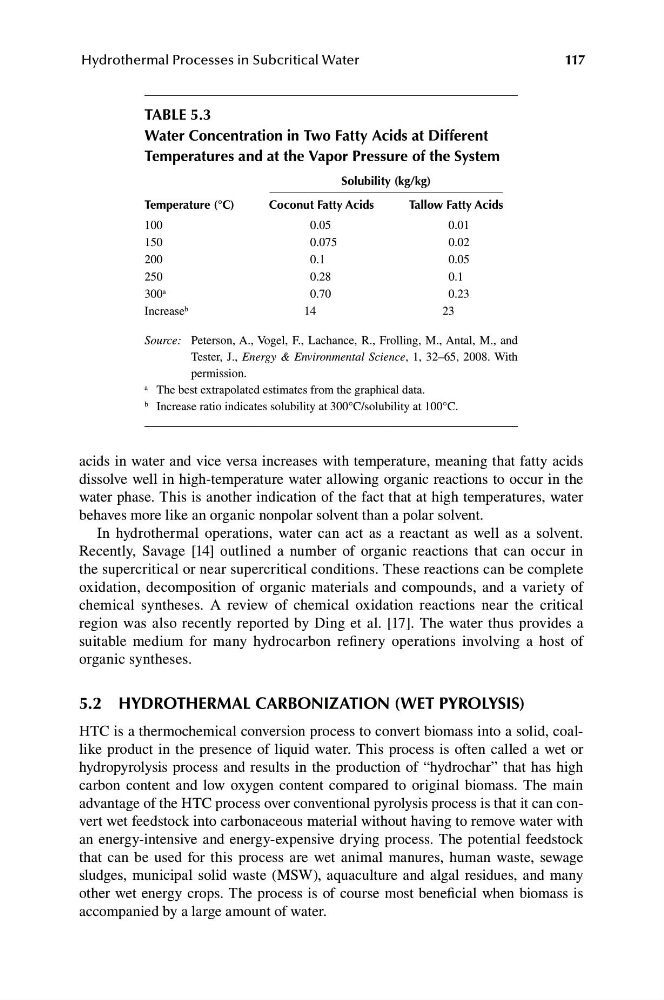
acids in water and vice versa increases with temperature, meaning that fatty acids
dissolve well in high-temperature water allowing organic reactions to occur in the
water phase. This is another indication of the fact that at high temperatures, water
behaves more like an organic nonpolar solvent than a polar solvent.
In hydrothermal operations, water can act as a reactant as well as a solvent.
Recently, Savage [14] outlined a number of organic reactions that can occur in
the supercritical or near supercritical conditions. These reactions can be complete
oxidation, decomposition of organic materials and compounds, and a variety of
chemical syntheses. A review of chemical oxidation reactions near the critical
region was also recently reported by Ding et al. [17]. The water thus provides a
suitable medium for many hydrocarbon refinery operations involving a host of
organic syntheses.
5.2 hydrOthermal CarBOniZatiOn (Wet PyrOlysis)
HTC is a thermochemical conversion process to convert biomass into a solid, coallike product in the presence of liquid water. This process is often called a wet or
hydropyrolysis process and results in the production of “hydrochar” that has high
carbon content and low oxygen content compared to original biomass. The main
advantage of the HTC process over conventional pyrolysis process is that it can convert wet feedstock into carbonaceous material without having to remove water with
an energy-intensive and energy-expensive drying process. The potential feedstock
that can be used for this process are wet animal manures, human waste, sewage
sludges, municipal solid waste (MSW), aquaculture and algal residues, and many
other wet energy crops. The process is of course most beneficial when biomass is
accompanied by a large amount of water.
temperature (°C)
Coconut Fatty acids
tallow Fatty acids
100
0.05
0.01
150
0.075
0.02
200
0.1
0.05
250
0.28
0.1
300 a
0.70
0.23
Increase b
14
23
Source: Peterson, A., Vogel, F., Lachance, R., Frolling, M., Antal, M., and
Tester, J., Energy & Environmental Science, 1, 32–65, 2008. With
permission.
a The best extrapolated estimates from the graphical data.
b Increase ratio indicates solubility at 300°C/solubility at 100°C.
117
Hydrothermal Processes in Subcritical Water
taBle 5.3
Water Concentration in two Fatty acids at different
temperatures and at the Vapor Pressure of the system
acids in water and vice versa increases with temperature, meaning that fatty acids
dissolve well in high-temperature water allowing organic reactions to occur in the
water phase. This is another indication of the fact that at high temperatures, water
behaves more like an organic nonpolar solvent than a polar solvent.
In hydrothermal operations, water can act as a reactant as well as a solvent.
Recently, Savage [14] outlined a number of organic reactions that can occur in
the supercritical or near supercritical conditions. These reactions can be complete
oxidation, decomposition of organic materials and compounds, and a variety of
chemical syntheses. A review of chemical oxidation reactions near the critical
region was also recently reported by Ding et al. [17]. The water thus provides a
suitable medium for many hydrocarbon refinery operations involving a host of
organic syntheses.
5.2 hydrOthermal CarBOniZatiOn (Wet PyrOlysis)
HTC is a thermochemical conversion process to convert biomass into a solid, coallike product in the presence of liquid water. This process is often called a wet or
hydropyrolysis process and results in the production of “hydrochar” that has high
carbon content and low oxygen content compared to original biomass. The main
advantage of the HTC process over conventional pyrolysis process is that it can convert wet feedstock into carbonaceous material without having to remove water with
an energy-intensive and energy-expensive drying process. The potential feedstock
that can be used for this process are wet animal manures, human waste, sewage
sludges, municipal solid waste (MSW), aquaculture and algal residues, and many
other wet energy crops. The process is of course most beneficial when biomass is
accompanied by a large amount of water.