

2.3 Quantum Mechanics as a Classical Hamiltonian Field Theory
29
(indicator) functions on P(H). The decomposition into characteristic functions similar to that in 1.3.2 does not correspond to any decomposition into quantal observables.
2.3.3 The function f (x) := T r(P x ) might remind us of a probability distribution
on the “phase space” P(H) representing a Gibbs ensemble in the sense of classical
statistical physics, cf. e.g. [271, 272], or any textbook on statistical physics.
Although any density matrix is uniquely reconstructed from the corresponding
function f (x) on the phase space P(H) with the help of (2.3.3), the function f
cannot be interpreted as a probability distribution of systems occurring in the pure
states P x ≡ x in a statistical ensemble described by . The function f is interpreted to
give the probability f (x) of positive result (i.e. of the number = 1) by measuring of the
observable P x (with just two possible outcomes ∈ {0, 1} of any of its measurements)
in the state . Because of the existing nonuniqueness of decompositions of into
pure states, mentioned in 1.2.3, a classical interpretation of any probability measure
on P(H) representing would be inadequate in general. In the following, we shall
restrict our attention (mainly) to pure states.
4
For a quantal observable A, the numbers f A (x) are interpreted as expectation
values for (real valued) results of measurements of the observable A in the state
x ∈ P(H). Also the functions f A will be called here ‘the (quantal) observables’.
2.3.4 In the setting of this section, it is natural to define a symmetry of the system as
a symplectic isometry of P(H). According to the Sect. 2.2, any such symmetry can
be extended to a unitary transformation of H. Let t → F t be a one-parameter group
of symplectic isometries of P(H) which is weakly continuous, i.e. the functions
t → F t x, ∀x ∈ P(H)
(2.3.5)
are continuous. Such a group can be extended to a weakly continuous unitary group
on H (compare [53, 3.2.35]), which corresponds to uniquely defined selfadjoint
operator A on H (by Stone’s theorem, [37, C3 & Textbook]). In this way, for the
group F t , we obtain the expression:
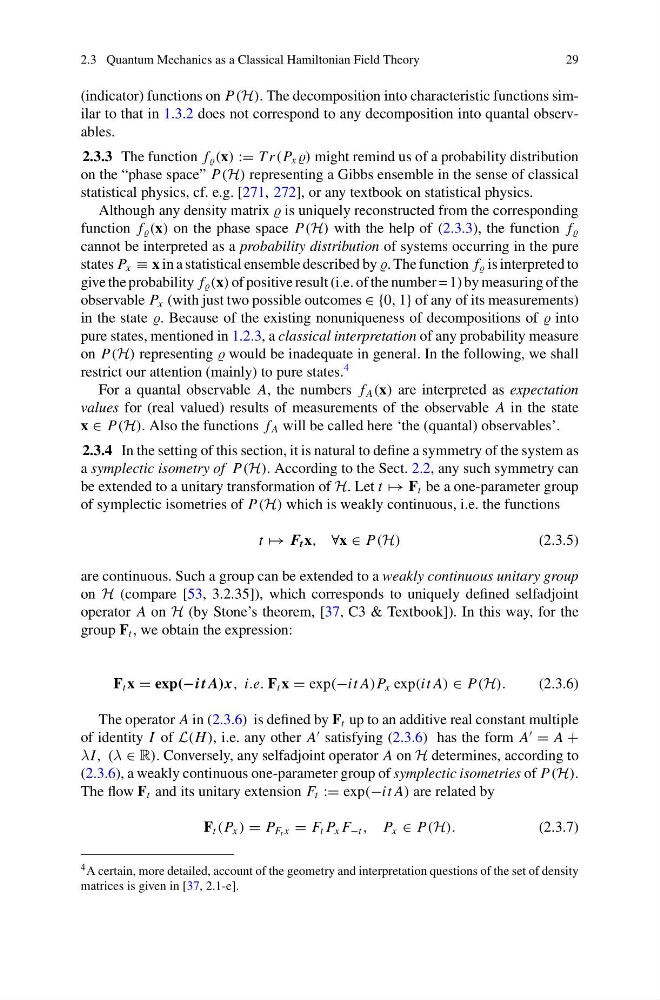
F t x = exp(−i t A)x, i.e. F t x = exp(−it A)P x exp(it A) ∈ P(H).
(2.3.6)
The operator A in (2.3.6) is defined by F t up to an additive real constant multiple
of identity I of L(H ), i.e. any other A
satisfying (2.3.6) has the form A
= A +
λI, (λ ∈ R). Conversely, any selfadjoint operator A on H determines, according to
(2.3.6), a weakly continuous one-parameter group of symplectic isometries of P(H).
The flow F t and its unitary extension F t := exp(−it A) are related by
F t (P x ) = P F t x = F t P x F −t , P x ∈ P(H).
(2.3.7)
4 A certain, more detailed, account of the geometry and interpretation questions of the set of density
matrices is given in [37, 2.1-e].
29
(indicator) functions on P(H). The decomposition into characteristic functions similar to that in 1.3.2 does not correspond to any decomposition into quantal observables.
2.3.3 The function f (x) := T r(P x ) might remind us of a probability distribution
on the “phase space” P(H) representing a Gibbs ensemble in the sense of classical
statistical physics, cf. e.g. [271, 272], or any textbook on statistical physics.
Although any density matrix is uniquely reconstructed from the corresponding
function f (x) on the phase space P(H) with the help of (2.3.3), the function f
cannot be interpreted as a probability distribution of systems occurring in the pure
states P x ≡ x in a statistical ensemble described by . The function f is interpreted to
give the probability f (x) of positive result (i.e. of the number = 1) by measuring of the
observable P x (with just two possible outcomes ∈ {0, 1} of any of its measurements)
in the state . Because of the existing nonuniqueness of decompositions of into
pure states, mentioned in 1.2.3, a classical interpretation of any probability measure
on P(H) representing would be inadequate in general. In the following, we shall
restrict our attention (mainly) to pure states.
4
For a quantal observable A, the numbers f A (x) are interpreted as expectation
values for (real valued) results of measurements of the observable A in the state
x ∈ P(H). Also the functions f A will be called here ‘the (quantal) observables’.
2.3.4 In the setting of this section, it is natural to define a symmetry of the system as
a symplectic isometry of P(H). According to the Sect. 2.2, any such symmetry can
be extended to a unitary transformation of H. Let t → F t be a one-parameter group
of symplectic isometries of P(H) which is weakly continuous, i.e. the functions
t → F t x, ∀x ∈ P(H)
(2.3.5)
are continuous. Such a group can be extended to a weakly continuous unitary group
on H (compare [53, 3.2.35]), which corresponds to uniquely defined selfadjoint
operator A on H (by Stone’s theorem, [37, C3 & Textbook]). In this way, for the
group F t , we obtain the expression:
F t x = exp(−i t A)x, i.e. F t x = exp(−it A)P x exp(it A) ∈ P(H).
(2.3.6)
The operator A in (2.3.6) is defined by F t up to an additive real constant multiple
of identity I of L(H ), i.e. any other A
satisfying (2.3.6) has the form A
= A +
λI, (λ ∈ R). Conversely, any selfadjoint operator A on H determines, according to
(2.3.6), a weakly continuous one-parameter group of symplectic isometries of P(H).
The flow F t and its unitary extension F t := exp(−it A) are related by
F t (P x ) = P F t x = F t P x F −t , P x ∈ P(H).
(2.3.7)
4 A certain, more detailed, account of the geometry and interpretation questions of the set of density
matrices is given in [37, 2.1-e].