

28
2 Geometry of the State Space of Quantum Mechanics
2.3 Quantum Mechanics as a Classical Hamiltonian Field
Theory
2.3.1 After introducing the symplectic structure on the set P(H) of all pure states
of conventional QM (compare Sect. 1.2), we shall try to reformulate also other concepts of QM into the form analogous to that of CM as it was outlined in Sect. 1.3. It
will be shown that this is possible to a large extent. There are, however, certain important differences. The main technical difference consists in infinite dimensionality of
the ‘phase space’ P(H) what implies e.g. nonexistence of a (Liouville) measure on
P(H), invariant with respect to all symplectic Wigner maps. The main physical
difference consists, however, in the interpretation of basic quantities in QM. This
difference between QM and CM does not vanish even for finite dimensional Hilbert
space H.
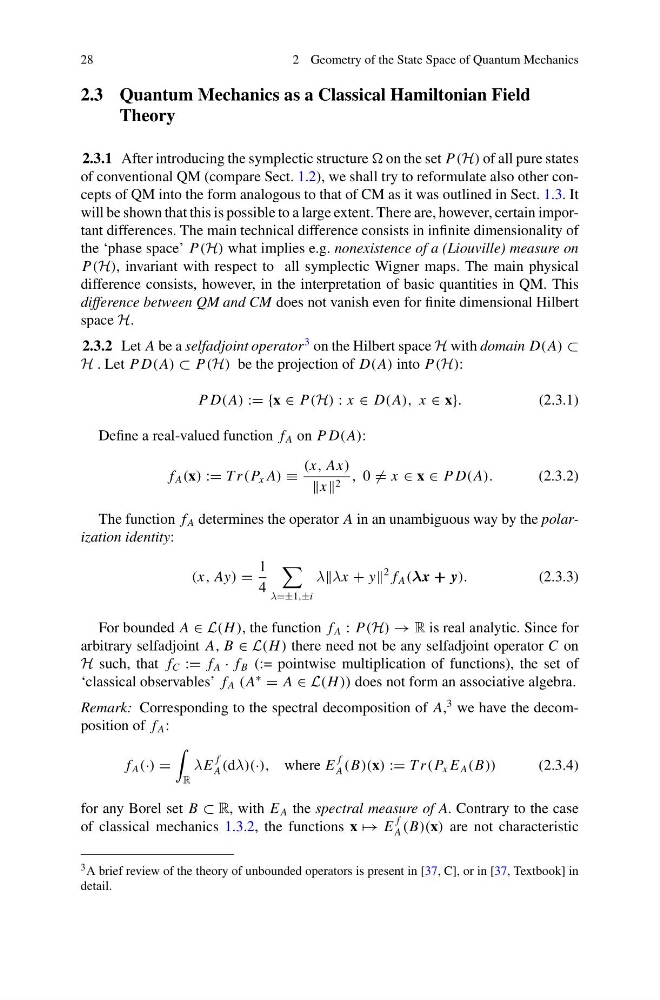
2.3.2 Let A be a selfadjoint operator
3 on the Hilbert space H with domain D(A) ⊂
H . Let P D(A) ⊂ P(H) be the projection of D(A) into P(H):
P D(A) := {x ∈ P(H) : x ∈ D(A), x ∈ x}.
(2.3.1)
Define a real-valued function f A on P D(A):
f A (x) := T r(P x A) ≡
(x, Ax)
x 2 , 0 = x ∈ x ∈ P D(A).
(2.3.2)
The function f A determines the operator A in an unambiguous way by the polarization identity:
(x, Ay) =
1
4
λ=±1,±i
λλx + y
2 f A (λx + y).
(2.3.3)
For bounded A ∈ L(H ), the function f A : P(H) → R is real analytic. Since for
arbitrary selfadjoint A, B ∈ L(H ) there need not be any selfadjoint operator C on
H such, that f C := f A · f B (:= pointwise multiplication of functions), the set of
‘classical observables’ f A (A
∗
= A ∈ L(H )) does not form an associative algebra.
Remark: Corresponding to the spectral decomposition of A,
3 we have the decomposition of f A :
f A (·) =
R
λE
f
A (dλ)(·), where E
f
A (B)(x) := T r(P x E A (B))
(2.3.4)
for any Borel set B ⊂ R, with E A the spectral measure of A. Contrary to the case
of classical mechanics 1.3.2, the functions x → E
f
A (B)(x) are not characteristic
3 A brief review of the theory of unbounded operators is present in [37, C], or in [37, Textbook] in
detail.
2 Geometry of the State Space of Quantum Mechanics
2.3 Quantum Mechanics as a Classical Hamiltonian Field
Theory
2.3.1 After introducing the symplectic structure on the set P(H) of all pure states
of conventional QM (compare Sect. 1.2), we shall try to reformulate also other concepts of QM into the form analogous to that of CM as it was outlined in Sect. 1.3. It
will be shown that this is possible to a large extent. There are, however, certain important differences. The main technical difference consists in infinite dimensionality of
the ‘phase space’ P(H) what implies e.g. nonexistence of a (Liouville) measure on
P(H), invariant with respect to all symplectic Wigner maps. The main physical
difference consists, however, in the interpretation of basic quantities in QM. This
difference between QM and CM does not vanish even for finite dimensional Hilbert
space H.
2.3.2 Let A be a selfadjoint operator
3 on the Hilbert space H with domain D(A) ⊂
H . Let P D(A) ⊂ P(H) be the projection of D(A) into P(H):
P D(A) := {x ∈ P(H) : x ∈ D(A), x ∈ x}.
(2.3.1)
Define a real-valued function f A on P D(A):
f A (x) := T r(P x A) ≡
(x, Ax)
x 2 , 0 = x ∈ x ∈ P D(A).
(2.3.2)
The function f A determines the operator A in an unambiguous way by the polarization identity:
(x, Ay) =
1
4
λ=±1,±i
λλx + y
2 f A (λx + y).
(2.3.3)
For bounded A ∈ L(H ), the function f A : P(H) → R is real analytic. Since for
arbitrary selfadjoint A, B ∈ L(H ) there need not be any selfadjoint operator C on
H such, that f C := f A · f B (:= pointwise multiplication of functions), the set of
‘classical observables’ f A (A
∗
= A ∈ L(H )) does not form an associative algebra.
Remark: Corresponding to the spectral decomposition of A,
3 we have the decomposition of f A :
f A (·) =
R
λE
f
A (dλ)(·), where E
f
A (B)(x) := T r(P x E A (B))
(2.3.4)
for any Borel set B ⊂ R, with E A the spectral measure of A. Contrary to the case
of classical mechanics 1.3.2, the functions x → E
f
A (B)(x) are not characteristic
3 A brief review of the theory of unbounded operators is present in [37, C], or in [37, Textbook] in
detail.