

162
6 Dynamics of Quantum Mechanical Macroscopic Systems
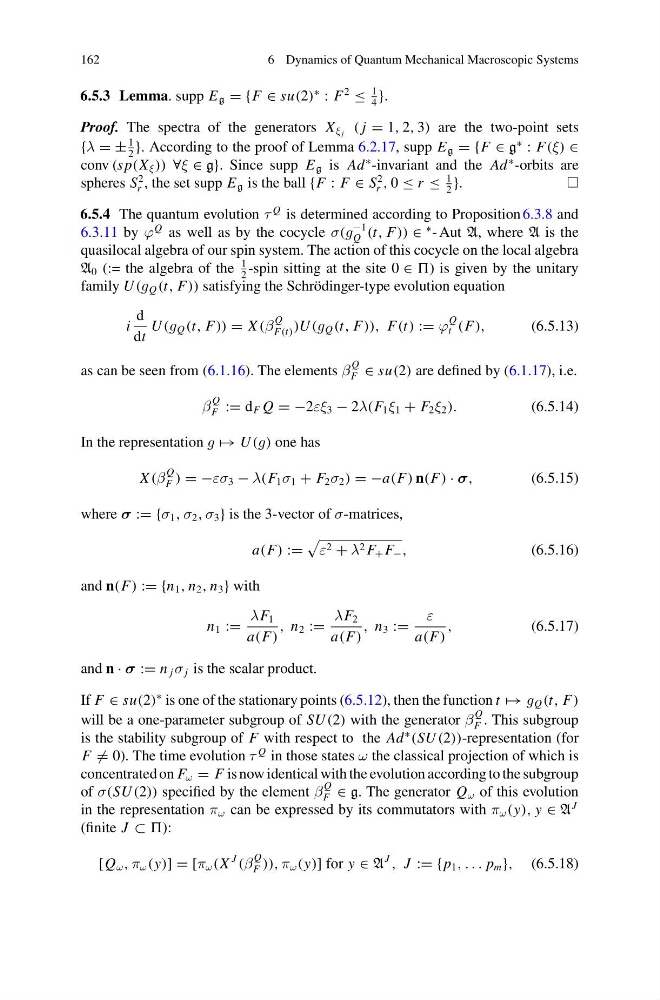
6.5.3 Lemma. supp E g = {F ∈ su(2)
∗
: F
2
≤
1
4
}.
Proof. The spectra of the generators X ξ j ( j = 1, 2, 3) are the two-point sets
{λ = ±
1
2
}. According to the proof of Lemma 6.2.17, supp E g = {F ∈ g
∗
: F(ξ) ∈
conv (sp(X ξ )) ∀ξ ∈ g}. Since supp E g is Ad
∗ -invariant and the Ad
∗ -orbits are
spheres S
2
r , the set supp E g is the ball {F : F ∈ S
2
r , 0 ≤ r ≤
1
2
}.
6.5.4 The quantum evolution τ
Q is determined according to Proposition 6.3.8 and
6.3.11 by ϕ
Q as well as by the cocycle σ(g
−1
Q (t, F)) ∈
∗ - Aut A, where A is the
quasilocal algebra of our spin system. The action of this cocycle on the local algebra
A 0 (:= the algebra of the
1
2
-spin sitting at the site 0 ∈ ) is given by the unitary
family U (g Q (t, F)) satisfying the Schrödinger-type evolution equation
i
d
dt
U (g Q (t, F)) = X (β
Q
F(t) )U (g Q (t, F)), F(t) := ϕ
Q
t (F),
(6.5.13)
as can be seen from (6.1.16). The elements β
Q
F ∈ su(2) are defined by (6.1.17), i.e.
β
Q
F := d F Q = −2εξ 3 − 2λ(F 1 ξ 1 + F 2 ξ 2 ).
(6.5.14)
In the representation g → U (g) one has
X (β
Q
F ) = −εσ 3 − λ(F 1 σ 1 + F 2 σ 2 ) = −a(F) n(F) · σ,
(6.5.15)
where σ := {σ 1 , σ 2 , σ 3 } is the 3-vector of σ-matrices,
a(F) :=
ε 2 + λ 2 F + F − ,
(6.5.16)
and n(F) := {n 1 , n 2 , n 3 } with
n 1 :=
λF 1
a(F)
, n 2 :=
λF 2
a(F)
, n 3 :=
ε
a(F)
,
(6.5.17)
and n · σ := n j σ j is the scalar product.
If F ∈ su(2)
∗ is one of the stationary points (6.5.12), then the function t → g Q (t, F)
will be a one-parameter subgroup of SU (2) with the generator β
Q
F . This subgroup
is the stability subgroup of F with respect to the Ad
∗
(SU (2))-representation (for
F = 0). The time evolution τ
Q in those states ω the classical projection of which is
concentrated on F ω = F is now identical with the evolution according to the subgroup
of σ(SU (2)) specified by the element β
Q
F ∈ g. The generator Q ω of this evolution
in the representation π ω can be expressed by its commutators with π ω (y), y ∈ A
J
(finite J ⊂ ):
[Q ω , π ω (y)] = [π ω (X
J
(β
Q
F )), π ω (y)] for y ∈ A
J
, J := { p 1 , . . . p m }, (6.5.18)
6 Dynamics of Quantum Mechanical Macroscopic Systems
6.5.3 Lemma. supp E g = {F ∈ su(2)
∗
: F
2
≤
1
4
}.
Proof. The spectra of the generators X ξ j ( j = 1, 2, 3) are the two-point sets
{λ = ±
1
2
}. According to the proof of Lemma 6.2.17, supp E g = {F ∈ g
∗
: F(ξ) ∈
conv (sp(X ξ )) ∀ξ ∈ g}. Since supp E g is Ad
∗ -invariant and the Ad
∗ -orbits are
spheres S
2
r , the set supp E g is the ball {F : F ∈ S
2
r , 0 ≤ r ≤
1
2
}.
6.5.4 The quantum evolution τ
Q is determined according to Proposition 6.3.8 and
6.3.11 by ϕ
Q as well as by the cocycle σ(g
−1
Q (t, F)) ∈
∗ - Aut A, where A is the
quasilocal algebra of our spin system. The action of this cocycle on the local algebra
A 0 (:= the algebra of the
1
2
-spin sitting at the site 0 ∈ ) is given by the unitary
family U (g Q (t, F)) satisfying the Schrödinger-type evolution equation
i
d
dt
U (g Q (t, F)) = X (β
Q
F(t) )U (g Q (t, F)), F(t) := ϕ
Q
t (F),
(6.5.13)
as can be seen from (6.1.16). The elements β
Q
F ∈ su(2) are defined by (6.1.17), i.e.
β
Q
F := d F Q = −2εξ 3 − 2λ(F 1 ξ 1 + F 2 ξ 2 ).
(6.5.14)
In the representation g → U (g) one has
X (β
Q
F ) = −εσ 3 − λ(F 1 σ 1 + F 2 σ 2 ) = −a(F) n(F) · σ,
(6.5.15)
where σ := {σ 1 , σ 2 , σ 3 } is the 3-vector of σ-matrices,
a(F) :=
ε 2 + λ 2 F + F − ,
(6.5.16)
and n(F) := {n 1 , n 2 , n 3 } with
n 1 :=
λF 1
a(F)
, n 2 :=
λF 2
a(F)
, n 3 :=
ε
a(F)
,
(6.5.17)
and n · σ := n j σ j is the scalar product.
If F ∈ su(2)
∗ is one of the stationary points (6.5.12), then the function t → g Q (t, F)
will be a one-parameter subgroup of SU (2) with the generator β
Q
F . This subgroup
is the stability subgroup of F with respect to the Ad
∗
(SU (2))-representation (for
F = 0). The time evolution τ
Q in those states ω the classical projection of which is
concentrated on F ω = F is now identical with the evolution according to the subgroup
of σ(SU (2)) specified by the element β
Q
F ∈ g. The generator Q ω of this evolution
in the representation π ω can be expressed by its commutators with π ω (y), y ∈ A
J
(finite J ⊂ ):
[Q ω , π ω (y)] = [π ω (X
J
(β
Q
F )), π ω (y)] for y ∈ A
J
, J := { p 1 , . . . p m }, (6.5.18)