

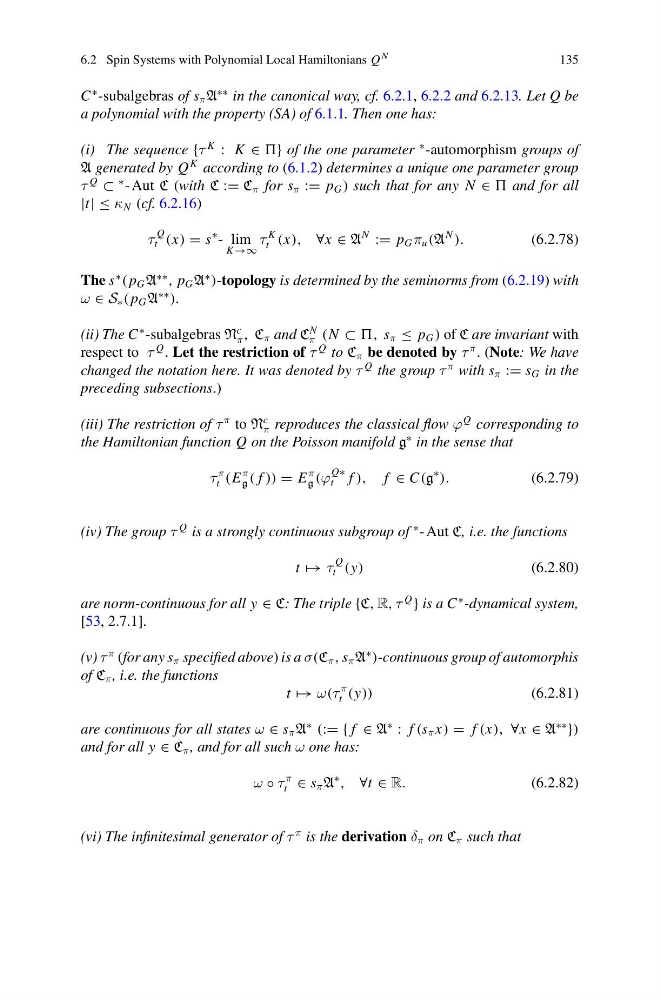
6.2 Spin Systems with Polynomial Local Hamiltonians Q N
135
C
∗ -subalgebras of s π A
∗∗ in the canonical way, cf. 6.2.1, 6.2.2 and 6.2.13. Let Q be
a polynomial with the property (SA) of 6.1.1. Then one has:
(i) The sequence {τ
K
: K ∈ } of the one parameter
∗ -automorphism groups of
A generated by Q
K according to (6.1.2) determines a unique one parameter group
τ
Q
⊂
∗ - Aut C (with C := C π for s π := p G ) such that for any N ∈ and for all
|t| ≤ κ N (cf. 6.2.16)
τ
Q
t (x) = s
∗ - lim
K →∞
τ
K
t (x), ∀x ∈ A
N
:= p G π u (A
N
).
(6.2.78)
The s
∗
( p G A
∗∗
, p G A
∗
)-topology is determined by the seminorms from (6.2.19) with
ω ∈ S ∗ ( p G A
∗∗
).
(ii) The C
∗ -subalgebras N
c
π , C π and C
N
π (N ⊂ , s π ≤ p G ) of C are invariant with
respect to τ
Q . Let the restriction of τ
Q to C π be denoted by τ
π . (Note: We have
changed the notation here. It was denoted by τ
Q the group τ
π with s π := s G in the
preceding subsections.)
(iii) The restriction of τ
π to N
c
π reproduces the classical flow ϕ
Q corresponding to
the Hamiltonian function Q on the Poisson manifold g
∗ in the sense that
τ
π
t (E
π
g ( f )) = E
π
g (ϕ
Q∗
t f ), f ∈ C(g
∗
).
(6.2.79)
(iv) The group τ
Q is a strongly continuous subgroup of
∗ - Aut C, i.e. the functions
t → τ
Q
t (y)
(6.2.80)
are norm-continuous for all y ∈ C: The triple {C, R, τ
Q
} is a C
∗ -dynamical system,
[53, 2.7.1].
(v) τ
π (for any s π specified above) is a σ(C π , s π A
∗
)-continuous group of automorphis
of C π , i.e. the functions
t → ω(τ
π
t (y))
(6.2.81)
are continuous for all states ω ∈ s π A
∗
(:= { f ∈ A
∗
: f (s π x) = f (x), ∀x ∈ A
∗∗
})
and for all y ∈ C π , and for all such ω one has:
ω ◦ τ
π
t ∈ s π A
∗
, ∀t ∈ R.
(6.2.82)
(vi) The infinitesimal generator of τ
π is the derivation δ π on C π such that
135
C
∗ -subalgebras of s π A
∗∗ in the canonical way, cf. 6.2.1, 6.2.2 and 6.2.13. Let Q be
a polynomial with the property (SA) of 6.1.1. Then one has:
(i) The sequence {τ
K
: K ∈ } of the one parameter
∗ -automorphism groups of
A generated by Q
K according to (6.1.2) determines a unique one parameter group
τ
Q
⊂
∗ - Aut C (with C := C π for s π := p G ) such that for any N ∈ and for all
|t| ≤ κ N (cf. 6.2.16)
τ
Q
t (x) = s
∗ - lim
K →∞
τ
K
t (x), ∀x ∈ A
N
:= p G π u (A
N
).
(6.2.78)
The s
∗
( p G A
∗∗
, p G A
∗
)-topology is determined by the seminorms from (6.2.19) with
ω ∈ S ∗ ( p G A
∗∗
).
(ii) The C
∗ -subalgebras N
c
π , C π and C
N
π (N ⊂ , s π ≤ p G ) of C are invariant with
respect to τ
Q . Let the restriction of τ
Q to C π be denoted by τ
π . (Note: We have
changed the notation here. It was denoted by τ
Q the group τ
π with s π := s G in the
preceding subsections.)
(iii) The restriction of τ
π to N
c
π reproduces the classical flow ϕ
Q corresponding to
the Hamiltonian function Q on the Poisson manifold g
∗ in the sense that
τ
π
t (E
π
g ( f )) = E
π
g (ϕ
Q∗
t f ), f ∈ C(g
∗
).
(6.2.79)
(iv) The group τ
Q is a strongly continuous subgroup of
∗ - Aut C, i.e. the functions
t → τ
Q
t (y)
(6.2.80)
are norm-continuous for all y ∈ C: The triple {C, R, τ
Q
} is a C
∗ -dynamical system,
[53, 2.7.1].
(v) τ
π (for any s π specified above) is a σ(C π , s π A
∗
)-continuous group of automorphis
of C π , i.e. the functions
t → ω(τ
π
t (y))
(6.2.81)
are continuous for all states ω ∈ s π A
∗
(:= { f ∈ A
∗
: f (s π x) = f (x), ∀x ∈ A
∗∗
})
and for all y ∈ C π , and for all such ω one has:
ω ◦ τ
π
t ∈ s π A
∗
, ∀t ∈ R.
(6.2.82)
(vi) The infinitesimal generator of τ
π is the derivation δ π on C π such that